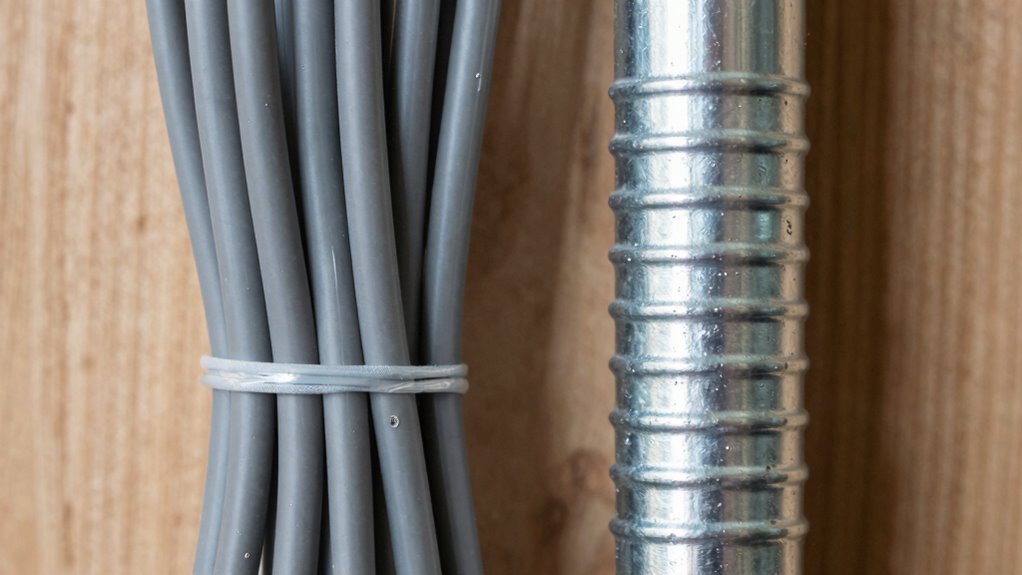
If you’re choosing between NM cable, MC cable, and conduit, understand that NM cable is common for residential wiring, easy to install, and has a plastic sheath. MC cable offers better protection with a metal exterior, suitable for harsher environments. Conduits are tubes that house wires, ideal for outdoor or industrial uses, but require more work to install. Knowing these differences helps guarantee you pick the right option for your project—more details follow if you want to learn further.
Key Takeaways
- NM cable is insulated wiring wrapped in plastic, mainly used for residential indoor wiring; MC cable has a metal sheath for added protection.
- Conduits are protective tubes that house and route wires, suitable for outdoor and industrial applications.
- NM cable is easy to install, stapled within walls, while conduit requires bending, threading, and fittings.
- MC cable offers durability and electromagnetic interference protection, ideal for demanding environments.
- Conduits provide maximum flexibility for complex or exposed wiring routes, with higher installation complexity.
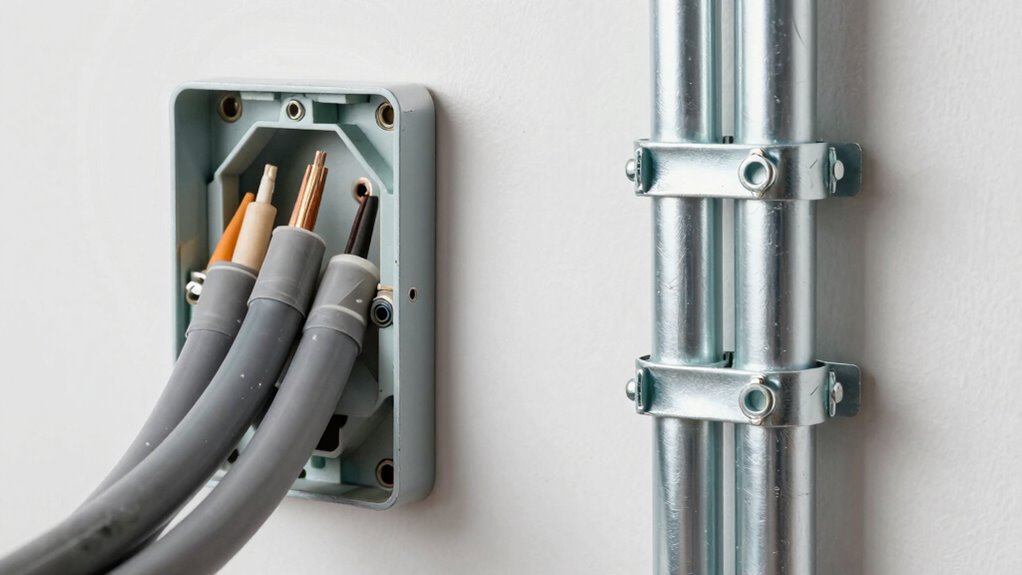
Are you unsure about the key differences between NM cable, MC cable, and conduit? Understanding these options is fundamental for safe and effective electrical wiring. Each type has its unique characteristics, especially when it comes to wire gauge and installation methods. NM cable, short for non-metallic sheathed cable, is usually what you see in residential wiring. It consists of insulated conductors wrapped in a plastic sheath, making it flexible and easy to work with. The wire gauge in NM cable varies, typically ranging from 14 to 12 AWG for lighting and general outlets, and up to 6 AWG for larger appliances. The installation methods are straightforward—often stapled to studs or joists within walls, ceilings, or attics, making it accessible for DIY projects or professional jobs alike.
In contrast, MC cable, or metal-clad cable, offers a more rugged solution. It features insulated conductors encased in a flexible metal sheath, which provides superior protection against physical damage and electromagnetic interference. When selecting wire gauge for MC cable, you’ll find similar options as NM cable, but the thicker metal sheath allows for more demanding environments or outdoor use. Installation methods for MC cable are more versatile; it can be run exposed, attached directly to surfaces, or concealed within walls and ceilings. Because the metal sheath offers extra durability, MC cable often requires fewer protective coverings, simplifying the process and increasing safety.
Conduits are different still—they’re fundamentally tubes that house wires, offering a flexible or rigid pathway for electrical cables. Conduits come in various materials like PVC, metal, or flexible plastic, and are especially useful in outdoor or industrial settings. When working with conduit, wire gauge selection depends on the conduit size and the type of conductors used. Installation methods involve bending and threading wires through the conduit, often requiring specialized tools and fittings. Unlike NM or MC cables, conduit installation is more labor-intensive but provides excellent protection and customization for complex wiring routes. It’s also important to consider cable management strategies to ensure safety and organization throughout the wiring system.
Knowing these distinctions helps you decide which system suits your project best. NM cable is quick and easy for standard residential wiring, while MC cable offers enhanced durability and protection in more demanding environments. Conduits, though more involved to install, give you maximum flexibility and security, especially where wires might be exposed or need to withstand harsh conditions. Your choice depends on your specific needs, the environment, and your comfort level with different installation methods—all of which hinge on understanding wire gauge and how each system is installed.

Energeaster Solid Indoor 12/2 W/G NMB Cable 100ft, Electrical Wire, Yellow
- Cable Type: Solid Indoor 12/2 NMB cable
- Length: 100 feet coil
- Jacket Coating: Cable jacket for easy pulling and stripping
As an affiliate, we earn on qualifying purchases.
As an affiliate, we earn on qualifying purchases.
Frequently Asked Questions
Can NM Cable Be Used Outdoors Without Additional Protection?
No, NM cable isn’t suitable for outdoor use without additional protection. Weatherproofing considerations are essential because NM cable isn’t designed to withstand exposure to moisture and UV rays, which can cause deterioration. You’ll find that installation complexity increases when trying to adapt NM cable outdoors, as you need to add weatherproof coverings or conduit. For safety and durability, it’s best to use outdoor-rated wiring methods like MC cable or conduit instead.
Are MC Cables More Cost-Effective Than Conduit Systems?
Sure, MC cables often seem like the budget-friendly superheroes of wiring, but beware—their cost comparison to conduit systems isn’t always a knockout. While MC cables offer easier installation with fewer fittings, their material costs can be higher than conduit. If you prioritize quick, straightforward installation, MC might save you some labor bucks. However, if budget is king, conduit’s cheaper materials might win the race, especially in long-term costs.
How Does Fire Resistance Compare Between NM Cable and Conduit?
You’ll find that conduit generally offers better fire safety and material durability than NM cable. Conduit’s metal construction makes it more resistant to heat and flames, providing superior protection in fire-prone areas. NM cable’s plastic insulation is less fire-resistant, which can compromise safety during a fire. If fire safety and durability are priorities, conduit is the smarter choice, ensuring your wiring system withstands harsh conditions longer.
Is Special Wiring Needed for High-Voltage Applications in MC Cable?
You don’t need special wiring for high-voltage applications in MC cable, but you must meet specific insulation requirements and voltage tolerance limits. Check that the cable’s insulation is rated for the voltage involved, guaranteeing safety and compliance. While MC cable is versatile, for extremely high voltages, consulting electrical codes and possibly upgrading insulation or using conduit might be necessary to prevent hazards and ensure proper performance.
What Are the Environmental Limitations for Each Wiring Type?
You should consider corrosion resistance and UV protection when choosing wiring types. NM cable is vulnerable to moisture and UV damage, making it unsuitable for outdoor or damp environments without proper protection. MC cable offers better corrosion resistance and UV protection, making it suitable for outdoor use. Conduit provides the highest environmental protection, shielding wires from corrosion, moisture, and UV exposure, perfect for harsh conditions.
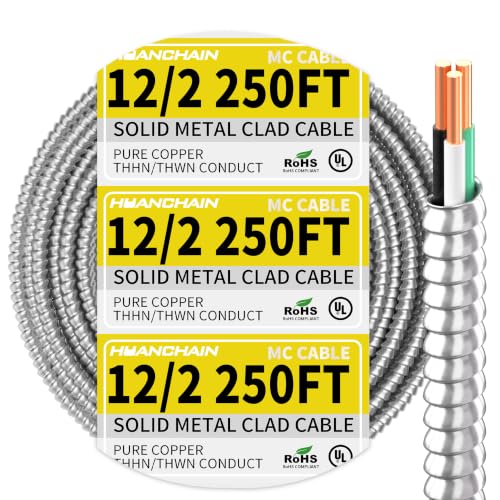
HUANCHAIN 12/2 MC Cable 250FT Solid Copper Wire with Aluminum Armor
- Product Specification: 12 AWG, 250ft, 3 copper wires
- High Conductivity: Solid bare copper conductors for superior performance
- Weather-Resistant Armor: Aluminum alloy armor for durability in harsh conditions
As an affiliate, we earn on qualifying purchases.
As an affiliate, we earn on qualifying purchases.
Conclusion
So, now that you understand the differences between NM cable, MC cable, and conduit, you’re better equipped to choose the right wiring for your project. Each has its own strengths and ideal uses, so it’s all about what fits your needs best. Isn’t it satisfying to know you can make smarter electrical choices? With this knowledge in hand, you’re ready to tackle your wiring tasks with confidence and ease.

1/2 Inch 10 ft Liquid Tight Conduit Kit, Flexible Electrical Conduit Kit
- Length: 10 feet long conduit kit
- Inner Diameter: 0.63 inches
- Outer Diameter: 0.84 inches
As an affiliate, we earn on qualifying purchases.
As an affiliate, we earn on qualifying purchases.

HDHAODA Conduit Connectors, 1/2 Inch, Straight, Grey, 10-Pack
- Impact and corrosion resistant: Made of durable nylon 6 material
- Flame retardant and heat resistant: 94V-2 flame grade, 125°C max temperature
- Easy tool-free installation: Push-on connection with domed nut
As an affiliate, we earn on qualifying purchases.
As an affiliate, we earn on qualifying purchases.