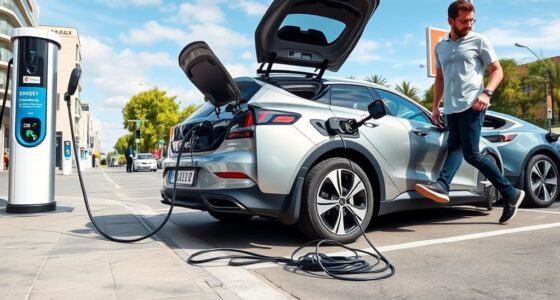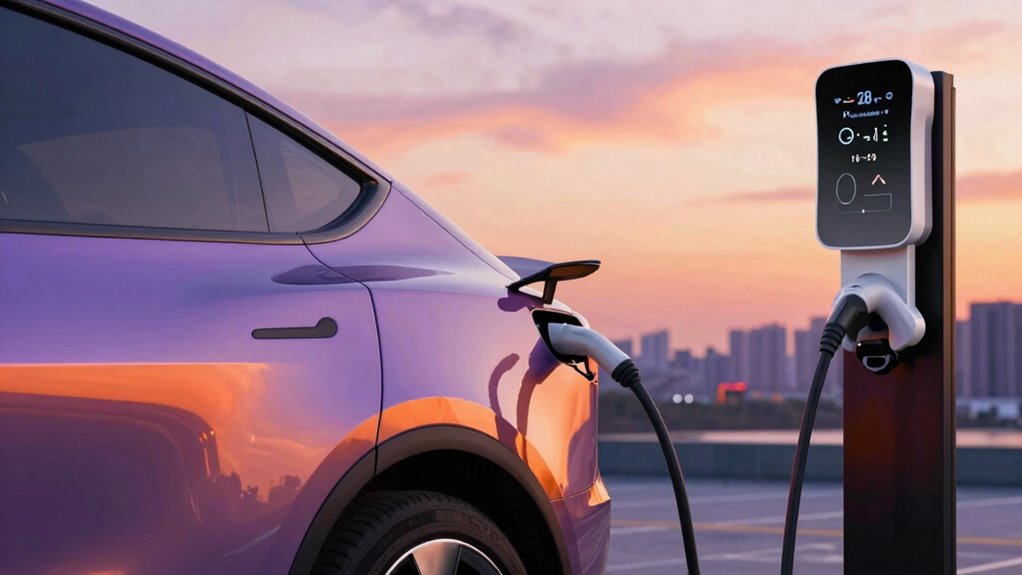

To understand EV charging speeds, keep in mind that both the station’s power output and your vehicle’s onboard charger set the limit. Even if a fast charger offers up to 350 kW, your car might only accept 50 kW, slowing down the process. Battery size and how much charge remains also matter, with charging slowing after about 80%. If you want to get a clear picture, exploring these factors further can really help.

Get backup power and energy gear delivered free — and shop member deals
- Fast, free delivery on millions of items
- Access to Prime Big Deal Days deals on October 6–7
- Prime Video, Amazon Music and more included
Key Takeaways
- Understand that charging speed depends on both the station’s power output and your vehicle’s onboard charger capacity.
- Recognize that larger batteries take longer to charge, especially at lower power stations.
- Expect charging rates to slow down after about 80% battery capacity to protect battery health.
- Match your vehicle’s maximum charging rate with station type for optimal speed.
- Use battery size and station power as key factors when planning charging sessions to set realistic expectations.
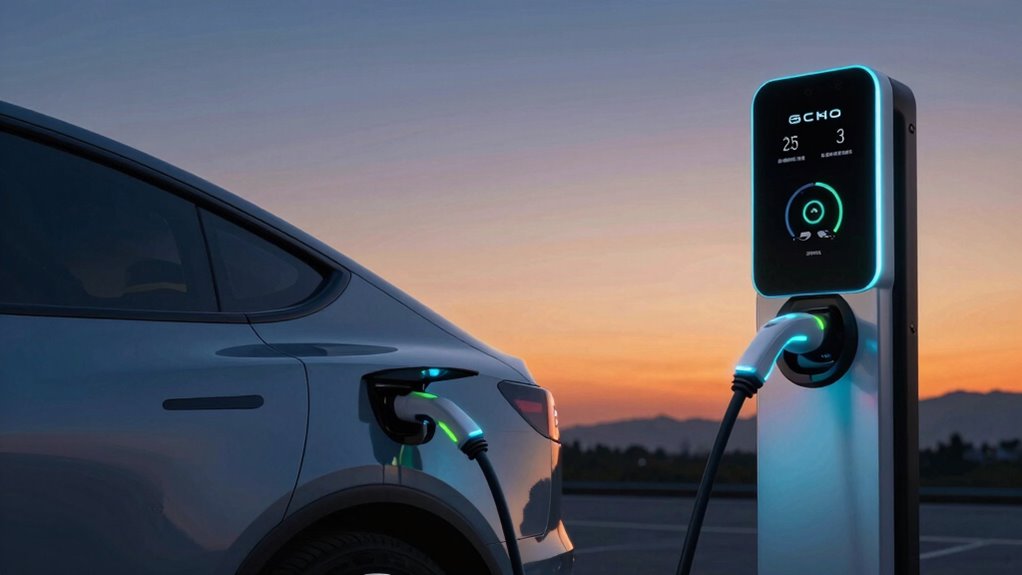
Understanding EV charging speeds can be confusing, especially with so many terms and numbers thrown around. It’s easy to get overwhelmed by the different numbers, like kilowatts (kW), and how they relate to how fast your vehicle charges. It’s important to consider your vehicle’s battery capacity and the types of charging stations available. Battery capacity, measured in kilowatt-hours (kWh), indicates how much energy your EV can store. Knowing this helps you understand how long it will take to fully charge your vehicle, especially when paired with the charging station type.
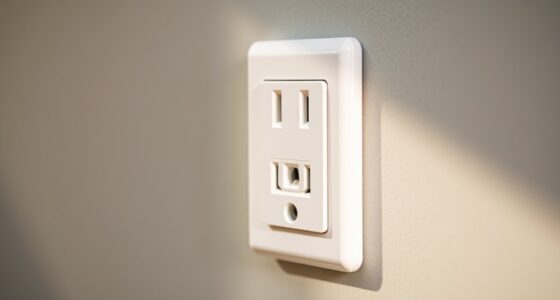
Charging station types vary in their power output, from Level 1 chargers that are slow to fast DC chargers. Level 1 chargers, typically using standard household outlets, deliver around 1.4 kW, meaning you add roughly 4-5 miles of range per hour of charging. These are best for overnight charging at home when you’re not in a rush. Level 2 chargers are more common for home or public charging stations and usually offer between 7 and 22 kW. At 11 kW, for instance, you could fully charge a 60 kWh battery in around 5-6 hours, but the actual charging time depends on your car’s ability to accept power. Fast DC chargers can push power levels from 50 kW up to 350 kW, significantly reducing charging times. A 150 kW fast charger might give your EV 100 miles of range in about 10-15 minutes, but only if your vehicle supports that charging rate.
Level 1 chargers are slow, delivering around 1.4 kW, ideal for overnight charging; Level 2 chargers range from 7 to 22 kW, reducing charging times significantly.
When you’re considering charging speed, focus on both your vehicle’s maximum charging capacity and the station type you plan to use. Your EV’s onboard charger determines how much power it can handle, so even if a station supplies 150 kW, your car might only accept 50 kW. This is important because the fastest charging station won’t make a difference if your vehicle can’t handle high power levels. Also, keep in mind that charging speed may slow down once the battery reaches around 80%, due to battery management systems preventing overcharging and heat buildup. Additionally, understanding the charge acceptance rate of your vehicle can help you better anticipate charging times and efficiencies. Recognizing the impact of battery size on charging time can also help you plan more effectively, especially for long trips. Moreover, the efficiency of charging stations plays a role in how quickly your vehicle can be charged, especially at higher power levels. Knowing how charging station types vary in their power output helps you choose the most appropriate station for your needs, whether for quick top-ups or longer charging sessions.
In addition, understanding the contrast ratio of a home cinema projector can help you select a model that delivers deep blacks and bright whites, enhancing your viewing experience.
In essence, understanding the relationship between your vehicle’s battery capacity and the charging station type helps you set realistic expectations. Smaller batteries charge faster, and faster stations can cut down your charging time considerably, but only if your vehicle supports those speeds. Knowing these factors enables you to plan your trips better and avoid frustration, whether you’re charging at home or on the go. Ultimately, it’s about matching your needs with the right station and understanding how your car’s specifications impact charging speed.
As an affiliate, we earn on qualifying purchases.
Frequently Asked Questions
How Does Charger Type Affect Charging Speed?
You’ll notice that charger type directly impacts your charging speed because different chargers offer varying power levels. Level 1 chargers are slower, while Level 2 chargers and DC fast chargers provide faster charging. Charger compatibility is essential—you need the right charger for your vehicle to optimize speed. Also, the charging infrastructure in your area determines how quickly you can recharge, so check if fast chargers are readily available nearby.
What Is the Typical Charging Time for Different EV Models?
Charging times vary based on the EV model and the charging infrastructure you use. Typically, you might spend around 30 minutes to several hours, depending on whether you’re fast-charging or using a standard outlet. Consumer preferences influence your choice, balancing quick top-ups with convenience. Keep in mind, more advanced models sometimes take longer, but they offer greater range, making your journey smoother and more enjoyable in the long run.
How Does Battery Size Influence Charging Speed?
Battery size directly impacts charging speed because larger battery capacity generally takes longer to charge. Your vehicle’s charging efficiency also plays a role, meaning how well it converts electricity into stored energy. If you have a bigger battery, expect longer charging times even at fast chargers, but efficient systems can help reduce this. So, consider both battery capacity and charging efficiency when evaluating how quickly your EV can recharge.
Are Faster Chargers More Efficient Long-Term?
Imagine a lightning bolt charging your car in moments—faster chargers seem tempting, but they can accelerate battery degradation over time. While they might save you time now, the strain on your battery could lead to costly replacements later. Consider the broader charging infrastructure and long-term efficiency. Slower, steady charging often preserves your battery’s health, making it a smarter choice for sustained performance and reduced costs down the road.
How Does Ambient Temperature Impact Charging Performance?
Ambient temperature substantially impacts your EV’s charging performance. Cooler temperatures can slow down charging due to reduced battery thermal management, while excessive heat can trigger thermal management systems to protect the battery, limiting charging speed. Maintaining temperature stability helps optimize charging efficiency. Proper thermal management ensures your battery stays within an ideal temperature range, allowing for faster, safer charging regardless of external conditions, and prolonging your battery’s lifespan.
fast DC EV charging station 150kW
As an affiliate, we earn on qualifying purchases.
As an affiliate, we earn on qualifying purchases.
Conclusion
So, next time you see an EV charging station, remember that faster isn’t always better—it’s about what fits your journey. Coincidentally, the perfect balance often shows up when you understand your needs, just like how your favorite coffee turns out best when brewed right. Don’t get caught up in the speed hype; instead, choose what’s practical for you. After all, in the world of EVs, timing and understanding truly go hand in hand.
EV charging station connector Type 2
As an affiliate, we earn on qualifying purchases.
As an affiliate, we earn on qualifying purchases.
As an affiliate, we earn on qualifying purchases.
Fall Picks
fall essentials
As an affiliate, we earn on qualifying purchases.