TL;DR

Get backup power and energy gear delivered free — and shop member deals
- Fast, free delivery on millions of items
- Access to Prime Big Deal Days deals on October 6–7
- Prime Video, Amazon Music and more included
Solar-powered outdoor string lights use a panel to charge a rechargeable battery, which powers LEDs after dark. Choose a sunny spot for the panel, check brightness, battery replacement options, and weather ratings, and expect shorter runtimes after cloudy days or during winter.
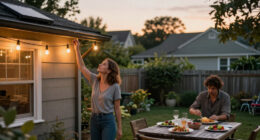
A patio can look ready for dinner at sunset and disappear into darkness an hour later. Solar-powered outdoor string lights can bring back that warm glow without routing a cord to an outlet—but their performance depends on a small panel getting enough daylight.
This guide explains how the panel, battery, and LEDs work together, where to place them, and which specifications matter more than a big bulb count. You’ll also get a practical way to compare products, install them securely, and judge whether solar suits your yard.
Think of the panel as a pitcher filling a battery-shaped glass during the day. The lights can only pour out what the glass has stored, so shade, cloudy weather, brightness settings, and battery age all affect how long your evening glow lasts.
Place the panel in direct sun; a separate panel and cable can serve a shaded pergola or porch.
Compare lumens when available, not just bulb count, and choose decorative glow or task lighting to match how you use the space.
Check battery replaceability, runtime conditions, controls, warranty, and outdoor ratings before buying.
Secure long strings at suitable support points, clean the panel periodically, and follow the maker’s advice for storms and winter storage.
Choose solar for sunny spots without convenient outlets; consider plug-in lighting where shade or dependable long runtimes dominate.
How solar string lights turn daylight into evening glow
Solar-powered outdoor string lights use a photovoltaic panel to charge a rechargeable battery during the day, then use that stored energy to power LED bulbs after dark. A light sensor or timer commonly switches them on, so you don’t have to walk outside to flip a switch every evening.
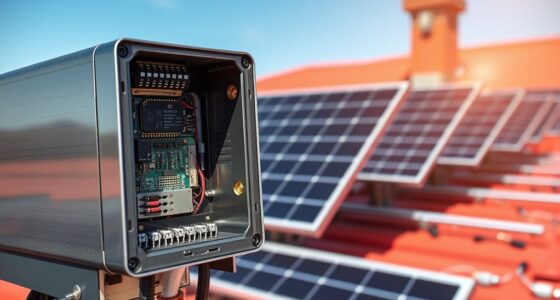
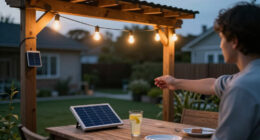
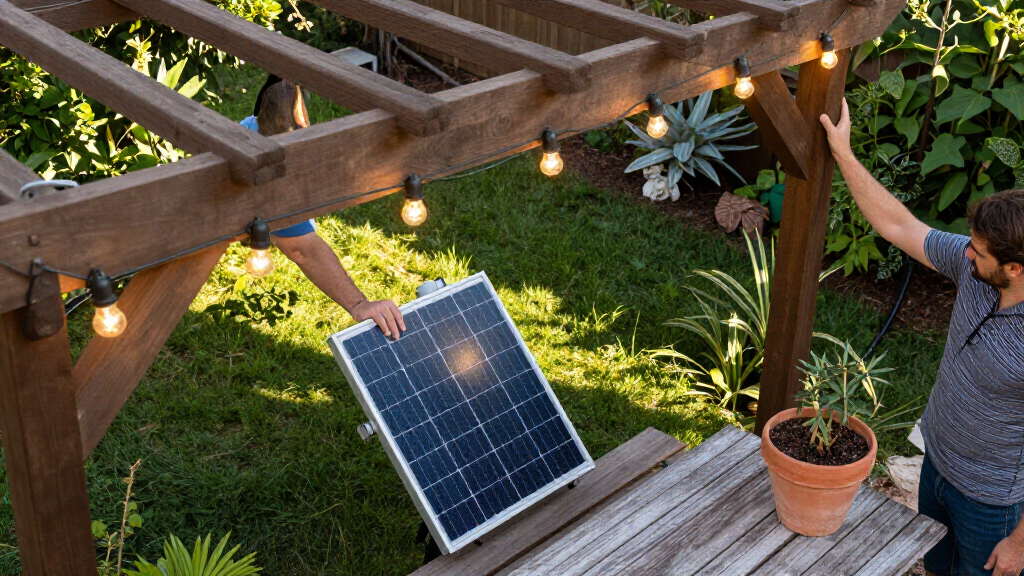
The parts work like a tiny off-grid lighting system: sunlight fills the battery, and the battery supplies the LEDs. Many sets connect the panel to the string with a cable, which lets you hang the lights under a shaded pergola while the panel sits in a sunnier corner. That arrangement can make the difference between a few dim hours and a more useful evening glow.
Most models use LEDs because they need relatively little power and stay cooler than incandescent bulbs. But bulb count is not a brightness rating. A string with 30 small decorative bulbs may create a soft, dotted glow, while another set with fewer bulbs could appear brighter. Look for lumens if the manufacturer provides them, and match the result to the job: atmosphere over a bistro table is different from lighting steps.
For example, if you want to read a book outside, decorative string lights alone may feel too gentle; a dedicated task light will help. If you’re setting out lemonade for friends, the warm dots overhead may be just right. The lights combine a panel, battery, sensor, LEDs, and wiring, but the panel’s daily charge is the fuel that sets the limit.
solar-powered outdoor string lights
As an affiliate, we earn on qualifying purchases.
As an affiliate, we earn on qualifying purchases.
Place the panel where it can collect a full day of sun
Put the solar panel where it receives strong, direct sunlight for the best chance of a full charge. Shade from a fence, roof, or leafy tree can cut charging, while short winter days, cloudy skies, and a dusty panel can all reduce the energy available at night.
Start by watching the intended spot at different times of day. A sunny patch at noon may sit in deep shade by late afternoon, when the panel could still collect useful light. If your preferred hanging area is under a porch roof, choose a model with a separate panel and enough cable to reach a sunnier location. This is one of the most practical features to check before you buy.
Imagine a small city patio where the string hangs above a table but the only sunny area is beside a gate. A detachable panel can sit by the gate while the bulbs stretch overhead. Without that flexibility, the lights might look lovely but struggle to stay on through dinner.
Keep the panel’s surface clear of dust, pollen, and fallen leaves. A quick wipe with a soft, damp cloth can help it receive daylight; follow the product instructions and avoid abrasive cleaners. During winter, the sun sits lower and daylight hours shrink, so expect shorter operation. A light sensor or timer turns the LEDs on automatically, but it cannot replace sunlight the panel never collected.
solar string lights with separate panel
As an affiliate, we earn on qualifying purchases.
As an affiliate, we earn on qualifying purchases.
Compare the features that affect real-world performance
Compare panel placement, battery options, brightness, weather ratings, and stated runtime before you choose a style or count the bulbs. Those specifications tell you more about whether the lights will suit your yard than a product photo showing a perfect summer patio.
Use this table to sort out the tradeoffs. Runtime claims vary because manufacturers may test different brightness settings, charge conditions, and battery states. Treat the number as a guide, not a promise that the lights will shine until sunrise every night.
| Feature | What to check | Why it matters |
|---|---|---|
| Solar panel | Separate or built-in; cable length | Lets you put the panel in sun even when the bulbs hang in shade |
| Battery | Capacity and whether it is replaceable | A worn battery can shorten runtime; replaceability may extend the product’s useful life |
| Brightness | Lumens, if listed; dimming modes | Helps you tell soft ambience from practical task lighting |
| Weather rating | Rating and guidance for each component | Outdoor resistance does not mean safe for flooding or immersion |
| Controls | Timer, sensor, remote, or modes | Can reduce manual adjustments and let you choose softer light |
Consider a homeowner choosing between two strings: one advertises more bulbs, while the other gives a longer panel cable and a replaceable rechargeable battery. If the patio has a shaded roofline, the second set may be the more useful choice even if it looks less impressive on the box. Check the manual and warranty, too. Newer features such as USB backup charging, app controls, and adjustable brightness exist, but availability and quality vary by product.
weatherproof solar LED string lights
As an affiliate, we earn on qualifying purchases.
As an affiliate, we earn on qualifying purchases.
Install the lights securely and keep the panel working
Hang the string with secure supports, position the panel in sunlight, and maintain the system according to the manufacturer’s instructions. A neat installation helps the lights look better, but it also reduces the chance that a gust will pull down a long, sagging strand.
- Map the route. Measure the distance from the panel’s sunny spot to the first bulb, and check that the cable reaches without stretching.
- Plan support points. Use suitable hooks or outdoor-rated clips for the mounting surface; don’t let the bulbs carry the full weight of a long span.
- Place and aim the panel. Set it where it gets direct sun, then follow the manual for its angle and mounting method.
- Test the controls. Switch the lights on and check the sensor, timer, or brightness modes before you tidy the cable.
- Check after weather. Look for loose clips, tangled wire, or a panel covered with debris.
For instance, a 20-foot run across a small balcony may need several attachment points rather than one hook at each end. That keeps the string from bowing into someone’s head when the wind picks up. Follow the product directions for outdoor mounting and keep cables away from places where doors pinch them.
Solar string lights are usually a low-voltage DIY setup, but don’t improvise electrical changes or connect strings unless the manufacturer says they are compatible. For work involving household wiring, an outlet, or other electrical alterations, use a licensed professional and follow local code and permit rules. Before any electrical work, turn power off at the breaker and use appropriate PPE; never assume a circuit is safe just because a switch is off.
solar string lights with replaceable batteries
As an affiliate, we earn on qualifying purchases.
As an affiliate, we earn on qualifying purchases.
Know when solar is worth it—and when plug-in lights make more sense
Solar lights are a strong fit when your panel can get sun and you want lighting without a nearby outlet. Plug-in lights usually suit shaded sites or situations where you need a more predictable, extended run time. Neither choice wins in every yard; the right one depends on your sunlight and how you use the space.
Solar avoids a cord running from the house and uses no grid electricity while operating. That makes it convenient for a garden table near the far end of a lawn, where an extension cord could become a trip hazard. The tradeoff is variable charging: a bright July day can leave a fuller battery than a gray winter afternoon, and an older battery may hold less charge than it once did.
Picture a family that hosts patio dinners from May through September. Their panel gets afternoon sun, and they want a gentle glow for three or four hours. Solar may fit them well. A household that needs bright lighting every night in a permanently shaded courtyard may prefer a plug-in set or a different lighting system, since steady operation matters more than avoiding a cable.
Check the outdoor rating for the lights, panel, connectors, and battery enclosure, rather than assuming one rating covers every part. Weather resistance does not promise protection from flooding, immersion, or severe storms. Follow the manual for rain exposure, winter storage, and battery care. If you’re wondering whether solar lights are worth it, start with a simple question: does your panel have a place to collect enough sun for the evenings you care about?
Set realistic expectations for runtime, rain, and winter
Solar string lights stay lit for as long as their stored charge allows, and that depends on the model, sunlight, battery condition, brightness, and selected mode. A full day of strong sun generally gives them a better chance at a longer evening than a cloudy day or a panel under a tree.
Manufacturers’ “all-night” claims need context. One brand may test with a fresh battery and a dim setting; another may use different conditions. Check the instructions for stated runtime and charging guidance, then treat it as an estimate. If your guests arrive at 6 p.m. and you need light until midnight, try the string for several evenings before planning an event around its performance.
Clouds and winter do not always stop charging, but indirect light may provide less energy. Shorter days and a low winter sun can reduce the charge further. Lowering brightness, when the product allows it, can help the stored energy last longer; it’s a bit like turning down a faucet when the water tank is small.
Rain is another product-specific question. Check the stated outdoor rating and the manual’s guidance for the panel, bulbs, connectors, and battery box. Weather resistance is not permission to leave any product submerged or exposed to severe storms. If a storm is forecast, follow the manufacturer’s advice about taking down or securing the string. These key facts for choosing solar lighting matter more than a vague claim that a product is “weatherproof.”
Frequently Asked Questions
How long do solar-powered outdoor string lights stay on?
Runtime varies with sunlight, battery condition, brightness, operating mode, and the specific product. A full day of strong sun generally supports longer operation than a shaded or cloudy day, but check the maker’s test conditions before relying on a stated runtime.
Do solar string lights work on cloudy days or in winter?
They may still charge in indirect light, but often collect less energy. Short winter days and low sun angles can also reduce runtime, so expect a shorter glow when daylight is limited.
Can I hang the lights in a shady area?
Yes, if the model has a separate solar panel connected by a cable. Hang the bulbs where you want them and place the panel where it receives direct sunlight, while staying within the cable length and installation instructions.
Can solar string lights stay outside in the rain?
Only when the product’s outdoor rating and instructions support the conditions. Check the guidance for the panel, bulbs, connectors, and battery enclosure; weather resistance does not necessarily cover flooding, immersion, or severe storms.
Can I connect two strings together?
Connect strings only when the manufacturer explicitly says the models are compatible and connectable. Joining incompatible products can damage them or create an electrical hazard, so check the manual rather than relying on matching plugs.
Conclusion
Before you buy, find the panel’s likely home in your yard. If it can collect strong sunlight, then compare battery serviceability, brightness, weather guidance, and the runtime you actually need—not just the number of bulbs in the box.
When the sun sets, a good string should make your patio feel welcoming, not leave you checking the clock for a fading glow. Give the panel a sunny seat, and let the evening begin.
Halloween Picks
halloween
As an affiliate, we earn on qualifying purchases.