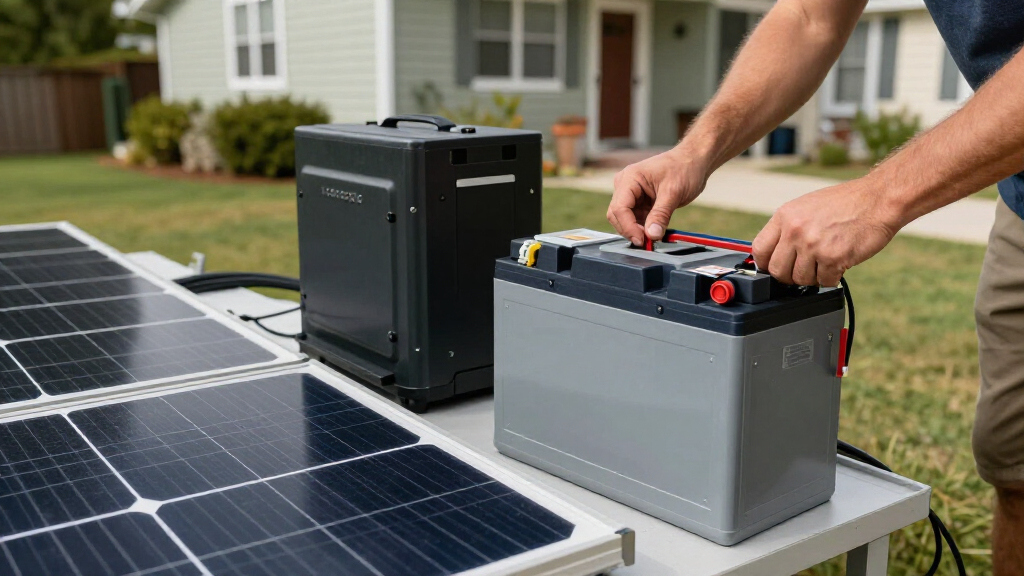
Among the 13 solar-powered emergency backup systems in this roundup, I rank the Jackery Solar Generator 1000 V2 as the best overall because its 1,070Wh battery, 1,500W output, LiFePO4 chemistry, and included 200W panel form a balanced outage kit. The Jackery Explorer 2000 v2 is my premium choice for larger household loads, although buyers must budget for compatible solar panels. For value, the 300W Portable Solar Generator with a 280Wh battery and 60W panel offers a stronger capacity-to-panel pairing than the smaller 146Wh and 220Wh kits. The main tradeoffs are battery capacity versus portability, appliance output versus price, and meaningful solar recovery versus slow emergency trickle charging. Continue reading for the full breakdown of which system fits each type of outage plan.
Complete the kit


Key Takeaways
- The Jackery Solar Generator 1000 V2 has the best overall balance: it combines enough output for many practical blackout loads with a 200W panel that is far more useful than the 25W and 40W panels bundled with smaller kits.
- The Jackery Explorer 2000 v2 leads on household capacity, but its lack of an included panel in the listed package makes it less solar-ready out of the box than the 1000 V2.
- The 300W, 280Wh system with a 60W panel is the value standout because it offers more stored energy and stronger solar collection than the similarly positioned 220Wh and 146Wh packages.
- Built-in panels favor convenience over recovery speed: the BLAVOR and BROWEY 1,024Wh models reduce setup friction, yet buyers should still plan on larger external panels for repeated outage use.
- The smallest products serve narrow emergency roles: the MARBERO kits suit phones, lights, radios, and small electronics, while the 12,000mAh weather radio is a communications tool rather than a household backup system.
| Solar Powered Generator 100W with 40W Solar Panels, Portable Power Station 146Wh |  | Best Starter Kit | Battery capacity: 146Wh | Running output: 100W | Maximum engine power: 200W | VIEW LATEST PRICE | See Our Full Breakdown |
| Portable Solar Generator 300W with 60W Solar Panel and 280Wh Battery | 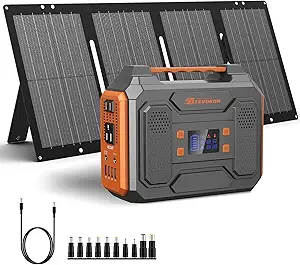 | Best Midrange Solar Bundle | Battery capacity: 280Wh | Rated output: 300W | Solar panel: 60W foldable monocrystalline, included | VIEW LATEST PRICE | See Our Full Breakdown |
| Jackery Explorer 300 Portable Power Station |  | Best for Battery Longevity | Battery capacity: 292Wh | Battery chemistry: LiFePO4 | Charge-cycle rating: More than 4,000 cycles | VIEW LATEST PRICE | See Our Full Breakdown |
| Jackery Explorer 2000 v2 Portable Power Station | 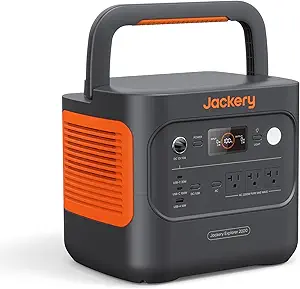 | Best High-Capacity Home Backup | Battery capacity: 2,042Wh | AC output: 2,200W | Battery chemistry: LiFePO4 | VIEW LATEST PRICE | See Our Full Breakdown |
| MARBERO Solar Powered Generator 88Wh with 25W Solar Panel Kit |  | Best Ultralight Solar Kit | Battery capacity: 88Wh (24,000mAh at 3.7V) | Surge power: 120W | Solar panel: 25W, included | VIEW LATEST PRICE | See Our Full Breakdown |
| Portable Solar Generator with 40W Solar Panel, 300W Power Station, 220Wh Lithium Battery |  | Best Compact 300W Kit | Battery capacity: 220Wh (60000mAh) | Continuous output: 300W | Peak output: 600W | VIEW LATEST PRICE | See Our Full Breakdown |
| Jackery Solar Generator 1000 V2 with 200W Solar Panel |  | Best Overall | Battery capacity: 1070Wh | Battery chemistry: LiFePO4 | Running output: 1500W | VIEW LATEST PRICE | See Our Full Breakdown |
| 200W Solar Powered Generator with 40W Solar Panel |  | Best Ultralight Multi-Port Kit | Battery capacity: 146Wh | Battery type: Lithium-ion | Output wattage: 200W | VIEW LATEST PRICE | See Our Full Breakdown |
| Emergency Weather Radio with Large Solar Panel and 12000mAh Battery |  | Best for Storm Alerts | Battery capacity: 12000mAh | Solar panel: 8500mm² monocrystalline | Charging methods: Solar, hand crank, USB, AC adapter, and car charger | VIEW LATEST PRICE | See Our Full Breakdown |
| Portable Power Station with 40W Solar Panel and 146Wh Battery Pack |  | Best for Low-Power Campsites | Battery capacity: 146Wh | Solar panel: 40W foldable | Solar cell efficiency: 22.8% | VIEW LATEST PRICE | See Our Full Breakdown |
| BLAVOR Portable Power Station 1600W with Built-in Solar Panel |  | Best Integrated Solar Design | Battery capacity: 1024Wh | Battery chemistry: LiFePO4 | Rated output: 1600W | VIEW LATEST PRICE | See Our Full Breakdown |
| BROWEY 1600W Portable Power Station with Built-in Solar Panel |  | Best for Multi-Device Backup | Battery capacity: 1024Wh | Battery chemistry: LiFePO4 | Rated output: 1600W | VIEW LATEST PRICE | See Our Full Breakdown |
| MARBERO 111Wh Solar Generator with 30W Solar Panel Kit |  | Best Compact Emergency Kit | Battery capacity: 111Wh | Battery chemistry: Lithium ion | Output wattage: 120W | VIEW LATEST PRICE | See Our Full Breakdown |
| solar-powered emergency backup system | Battery capacity | Solar panel | AC outlets |
|---|---|---|---|
| Solar Powered Generator 100W w | 146Wh | 40W, included | — |
| Portable Solar Generator 300W | 280Wh | 60W foldable monocrystalline, included | 2, 300W maximum |
| Jackery Explorer 300 Portable | 292Wh | — | 2 |
| Jackery Explorer 2000 v2 Porta | 2,042Wh | — | 3 |
| MARBERO Solar Powered Generato | 88Wh (24,000mAh at 3.7V) | 25W, included | — |
| Portable Solar Generator with | 220Wh (60000mAh) | 40W | 2 |
| Jackery Solar Generator 1000 V | 1070Wh | 200W monocrystalline | 3 |
| 200W Solar Powered Generator w | 146Wh | 40W | 2 x 110V pure sine wave |
| Emergency Weather Radio with L | 12000mAh | 8500mm² monocrystalline | — |
| Portable Power Station with 40 | 146Wh | 40W foldable | 2 x 100W maximum |
| BLAVOR Portable Power Station | 1024Wh | — | — |
| BROWEY 1600W Portable Power St | 1024Wh | — | — |
| MARBERO 111Wh Solar Generator | 111Wh | 30W foldable panel | — |
More Details on Our Top Picks
Solar Powered Generator 100W with 40W Solar Panels, Portable Power Station 146Wh
When I rank solar-powered emergency systems, I place this 146Wh generator kit above bare power stations for beginners because the 40W panel is already included. Its seven outlets support phones, lights, radios, and other small electronics, while the compact body is easier to store or carry than the Portable Solar Generator 300W with its larger 280Wh battery. The tradeoff is limited headroom: 100W running output rules out heaters, kettles, and most cooking appliances. Compared with the MARBERO 88Wh kit, it offers more stored energy and a larger panel, but it is less featherweight. I see it as a practical short-outage setup, not an extended home-power solution, since 40W solar recovery will remain slow whenever daylight is weak.
Pros:- 146Wh capacity provides more reserve than ultralight 88Wh kits
- Included 40W panel avoids a separate solar-panel purchase
- Seven outlets accommodate AC, USB, and DC devices
- Compact dimensions suit evacuation kits and small storage spaces
Cons:- 100W running output excludes most household appliances
- A 40W panel can take many daylight hours to refill a 146Wh battery
- Capacity is too limited for prolonged multi-device backup
Best for: First-time emergency-kit buyers who need bundled solar charging for phones, lights, radios, and low-wattage electronics
Not ideal for: Households expecting to run cooking, heating, refrigeration, or other appliances that exceed the 100W continuous limit
- Battery capacity:146Wh
- Running output:100W
- Maximum engine power:200W
- Solar panel:40W, included
- Total outlets:7
- Output types:AC, USB, and DC
- Frequency:60Hz
- Dimensions:7.5 x 3.7 x 6.1 inches
Our verdict“I recommend this as an accessible first solar backup kit for small essentials, provided buyers accept its strict 100W ceiling.”
Portable Solar Generator 300W with 60W Solar Panel and 280Wh Battery
I rank this as the strongest middle-ground bundle because its 280Wh battery and included 60W panel offer a useful step up from the 146Wh starter kit without reaching the size of a home-backup unit. Its 300W pure-sine-wave inverter provides cleaner AC power for sensitive electronics, and the QC3.0 port adds faster compatible-phone charging. Against the Jackery Explorer 300, capacity and output are nearly matched, but this package includes the solar hardware that Jackery sells separately. Jackery counters with LiFePO4 chemistry and a stated 4,000-plus-cycle life. I would choose this model for better out-of-box solar value, while recognizing that 300W still excludes high-draw appliances. The panel’s non-waterproof junction box also needs shelter during wet emergency conditions.
Pros:- Included 60W foldable monocrystalline panel creates a complete charging package
- 280Wh battery offers useful capacity for several small devices
- Pure-sine-wave inverter is better suited to sensitive electronics
- Wall, vehicle, and solar inputs provide flexible recharging
Cons:- 300W output remains inadequate for most heat-producing appliances
- Solar performance falls when sunlight is weak
- Solar-panel junction box is not waterproof and must be kept dry
Best for: Campers and outage planners who want a ready-to-use solar bundle for laptops, communications gear, lights, and other devices below 300W
Not ideal for: Buyers prioritizing long battery-cycle life or anyone needing to operate heaters, kettles, pumps, or appliances above 300W
- Battery capacity:280Wh
- Rated output:300W
- Solar panel:60W foldable monocrystalline, included
- Inverter:Pure sine wave
- AC outlets:2, 300W maximum
- USB ports:3 x 5V/3A and 1 x QC3.0
- DC output:9V–12.6V/10A maximum
- Charging methods:AC wall outlet, solar panel, and 12V vehicle port
- Panel conversion efficiency:20.5%
Our verdict“I favor this bundle for buyers who want more usable emergency capacity than an entry-level kit without purchasing a panel separately.”
Jackery Explorer 300 Portable Power Station
The Jackery Explorer 300 earns its place through durability rather than bundle value. Its LiFePO4 battery is rated for more than 4,000 charge cycles, making it better suited to frequent preparedness drills and repeated camping use than the Portable Solar Generator 300W, whose listed data does not provide a comparable cycle rating. Jackery also fits 292Wh into a 7.5-pound body, a compelling balance for buyers who move their backup supply between home and vehicle. However, I rank it behind a complete solar package for first-time buyers because no solar panel is included. The 300W rated output and 600W surge cover electronics and select low-draw equipment, not major appliances. Its USB-C PD connection is useful for modern devices, though the station’s modest capacity still limits outage duration.
Pros:- LiFePO4 battery is rated for more than 4,000 charge cycles
- 292Wh capacity in a relatively light 7.5-pound unit
- USB-C PD, USB-A, AC, and vehicle outputs support varied devices
- 600W surge rating handles brief startup demands within its class
Cons:- Solar panel must be purchased separately
- 300W rated output cannot support high-draw appliances
- 292Wh capacity provides limited runtime during long outages
Best for: Frequent campers and preparedness-minded buyers who value low weight and thousands of battery cycles over receiving a bundled panel
Not ideal for: Buyers seeking a complete solar kit in one purchase or enough output and capacity for large household appliances
- Battery capacity:292Wh
- Battery chemistry:LiFePO4
- Charge-cycle rating:More than 4,000 cycles
- Rated output:300W
- Peak surge:600W
- AC outlets:2
- USB connections:1 USB-C PD and 2 USB-A
- Vehicle port:1
- Weight:7.5 pounds
Our verdict“I would pick the Explorer 300 for repeat use and easy transport, but not for buyers who expect a solar panel in the box.”
Jackery Explorer 2000 v2 Portable Power Station
For serious outage coverage, I put the Jackery Explorer 2000 v2 well ahead of the smaller models here. Its 2,042Wh battery stores roughly seven times the energy of the Explorer 300, while 2,200W AC output can support many refrigerators, microwaves, and other household devices that 300W stations cannot run. A 102-minute wall recharge helps restore readiness between outages, and sub-30dB operation suits indoor living spaces. This is still a power station rather than a fully packaged solar system: solar panels are required separately, and the quoted solar refill takes six hours under suitable conditions. At 39.5 pounds, it is movable but hardly casual carry gear. I also find only three AC outlets restrictive for a unit aimed at broader backup, so some households may need safe power distribution.
Pros:- 2,042Wh capacity provides far longer backup than compact stations
- 2,200W AC output supports many common household appliances
- LiFePO4 battery has a stated 10-year lifespan
- Full AC recharge takes 102 minutes and operation stays below 30dB
Cons:- Solar panels are not included
- 39.5-pound weight limits grab-and-go portability
- Three AC outlets may feel sparse for a 2,200W backup unit
Best for: Households needing substantial stored energy for refrigerators, communications equipment, medical devices, and other loads during longer outages
Not ideal for: Apartment dwellers, solo campers, or budget-focused buyers who need a light all-in-one kit with solar panels included
- Battery capacity:2,042Wh
- AC output:2,200W
- Battery chemistry:LiFePO4
- Stated battery lifespan:10 years
- AC charging time:102 minutes
- Solar charging time:6 hours
- AC outlets:3
- USB-C output:100W Power Delivery
- Weight:39.5 pounds
Our verdict“I recommend the Explorer 2000 v2 when appliance-grade output and long runtime matter more than low weight or bundled solar hardware.”
MARBERO Solar Powered Generator 88Wh with 25W Solar Panel Kit
I see the MARBERO 88Wh kit as the most evacuation-friendly choice in this group. The station weighs 2.3 pounds and the included panel adds only 1.15 pounds, making the pair much easier to carry than the 7.5-pound Jackery Explorer 300 or the larger 146Wh generator kit. Its AC, USB-C, USB-A, and DC connections cover emergency communications and lighting, while the IP65-rated solar panel offers better outdoor protection than the 60W bundle’s non-waterproof junction box. Portability comes at a steep energy cost: 88Wh is the smallest reserve here, and 120W is only the surge figure, so this is not an appliance backup. I would also weigh the higher price versus basic power banks, especially if AC output and solar charging are not priorities.
Pros:- Combined station and panel weight is only 3.45 pounds
- Included 25W panel has a stated 24.3% conversion efficiency
- AC, USB-C, USB-A, and DC outputs cover varied small electronics
- IP65-rated panel and six-layer protection suit emergency use
Cons:- 88Wh battery has the least capacity among these five picks
- 120W surge rating does not make it suitable for household appliances
- Solar charging can exceed the stated four hours in weak sunlight
Best for: Evacuation-kit builders, hikers, and solo campers who need the lightest bundled solar source for phones, radios, lights, and other small devices
Not ideal for: Families needing multi-day capacity or buyers expecting to run refrigerators, cooking equipment, or other heavy loads
- Battery capacity:88Wh (24,000mAh at 3.7V)
- Surge power:120W
- Solar panel:25W, included
- Panel conversion efficiency:24.3%
- Power-station weight:2.3 pounds
- Solar-panel weight:1.15 pounds
- Power-station dimensions:6.5 x 3.1 x 4.6 inches
- Charging time:3 hours by AC; 4 hours by solar
- Operating temperature:14°F to 104°F
Our verdict“I would choose this MARBERO kit for minimum carrying weight, accepting that it is a communications-and-lighting backup rather than an appliance solution.”
Portable Solar Generator with 40W Solar Panel, 300W Power Station, 220Wh Lithium Battery
I rank the Portable Solar Generator with 40W Solar Panel as the compact choice for buyers who want more output than an ultralight station without carrying a large home-backup unit. Its 300W continuous output and 220Wh battery can support phones, laptops, lights, routers, and other modest loads. Compared with the 200W Solar Powered Generator with 40W Solar Panel, it provides another 100W of appliance headroom and 74Wh of storage. The competing Portable Solar Generator 300W with 60W Solar Panel has a larger 280Wh battery and stronger panel, however, making that model better for longer outages. I favor this pick for mobility, port variety, and its useful floodlight. The main tradeoff is endurance: refrigerators, heaters, pumps, and cooking appliances exceed its practical scope.
Pros:- Five-pound power station is easy to carry or store in a small emergency kit
- 300W continuous output offers more headroom than the 146Wh and 200W alternatives
- Seven device ports accommodate mixed AC, USB-A, USB-C, and automotive equipment
- Included 40W solar panel and LED floodlight add value during extended outages
Cons:- 220Wh capacity is too limited for prolonged appliance backup
- 300W ceiling excludes most heating, cooking, and motor-driven equipment
- A 40W panel can replenish the battery slowly and depends heavily on available sunlight
Best for: Apartment residents and car campers who need a five-pound backup for communications, lighting, laptops, and other devices below 300W
Not ideal for: Households seeking overnight refrigerator support or power for heaters, pumps, and cooking appliances
- Battery capacity:220Wh (60000mAh)
- Continuous output:300W
- Peak output:600W
- Solar panel:40W
- AC outlets:2
- USB ports:3 USB-A and 2 USB-C PD
- Weight:5 lbs
- Dimensions:8.5 x 6.7 x 4.1 in
Our verdict“This is my compact 300W pick for portable electronics and outage lighting, but buyers needing appliance-level backup should move to a larger system.”
Jackery Solar Generator 1000 V2 with 200W Solar Panel
I place the Jackery Solar Generator 1000 V2 first for its balance of meaningful storage, appliance-ready output, and battery longevity. The 1070Wh LiFePO4 battery and 1500W AC inverter move it beyond phone-and-laptop duty into refrigerators, selected kitchen devices, and several smaller loads. Compared with the Portable Solar Generator with 40W Solar Panel, it supplies nearly five times the stored energy and five times the continuous output. It remains easier to justify for routine emergency use than the larger Jackery Explorer 2000 v2, which offers 2042Wh and 2200W but is aimed at heavier backup demands. The included 200W panel also gives this kit a stronger solar-recovery path than any 40W model here. Its costs are scale and complexity: the panel ships separately, one-hour charging needs emergency mode, and full-load runtime is only about two hours.
Pros:- 1070Wh capacity supports far longer outage use than the compact 146Wh to 220Wh models
- 1500W running output handles a much broader range of household appliances
- LiFePO4 battery is rated for more than 4000 cycles and over 10 years of service
- Included 200W panel provides substantially more solar collection than the 40W kits
Cons:- One-hour AC charging requires a separately enabled emergency charging mode
- Solar panel and power station arrive in separate shipments
- Approximately two hours of runtime at full load limits sustained high-draw use
Best for: Homeowners and RV users who want a durable solar kit capable of running a refrigerator and several smaller emergency loads
Not ideal for: Buyers who only need phone charging or anyone expecting whole-home runtime from a portable 1070Wh battery
- Battery capacity:1070Wh
- Battery chemistry:LiFePO4
- Running output:1500W
- Starting output:3000W
- Solar panel:200W monocrystalline
- AC outlets:3
- AC voltage and frequency:120V, 60Hz
- Battery cycle rating:4000+ charge cycles
- Fast charging:0% to 100% in 1 hour using emergency mode
Our verdict“This is my best all-around choice for buyers who need real appliance capability without stepping up to a 2000Wh-class station.”
200W Solar Powered Generator with 40W Solar Panel
I choose the 200W Solar Powered Generator with 40W Solar Panel for buyers who put low carrying weight ahead of long runtime. At 800 g with seven outlets, it is unusually easy to place in a vehicle kit, evacuation bag, or cramped campsite while still accepting AC, automotive, and solar charging. It has the same 146Wh capacity as the Portable Power Station with 40W Solar Panel, yet its 200W inverter provides twice that model’s AC ceiling. Compared with the 220Wh Portable Solar Generator, this unit is lighter but stores 74Wh less and gives up 100W of continuous output. I like the pure sine wave inverter for sensitive electronics, though 146Wh remains a short-duration reserve. The included panel broadens charging options, but 40W solar recovery is slow when clouds, shade, or short winter days reduce collection.
Pros:- 800 g station is the lightest option in this batch with a stated weight
- 200W pure sine wave inverter is friendly to sensitive electronics
- Seven outputs provide flexible charging for several low-power devices
- Three recharging methods reduce reliance on sunlight alone
Cons:- 146Wh battery offers limited runtime once several devices are connected
- 200W output cannot support most cooking, heating, or full-size cooling equipment
- Included 40W panel may require many hours of strong sun for a full recharge
Best for: Solo campers, vehicle emergency-kit builders, and renters who need an ultralight source for phones, lights, cameras, and small laptops
Not ideal for: Families needing multi-day backup or anyone planning to power appliances drawing more than 200W
- Battery capacity:146Wh
- Battery type:Lithium-ion
- Output wattage:200W
- Solar panel:40W
- AC outlets:2 x 110V pure sine wave
- Other outlets:4 USB and 1 DC
- Recharging methods:AC wall, car, or solar panel
- Weight:800 g
- Dimensions:10 x 4.98 x 5 in
Our verdict“I recommend this for buyers who want the lightest practical multi-port kit and accept that it is a short-term electronics backup, not an appliance solution.”
Emergency Weather Radio with Large Solar Panel and 12000mAh Battery
I include the Emergency Weather Radio with 12000mAh Battery because emergency information can matter more than AC power during severe weather. Unlike the Jackery Solar Generator 1000 V2 or any compact power station here, this device combines NOAA alerts, an SOS alarm, and two lighting systems in one IPX6-rated package. Its solar panel, hand crank, USB input, AC-adapter support, and car charging provide more fallback methods than the generator kits, while the battery can supply limited phone power. That versatility earns it a dedicated preparedness role rather than an appliance-backup ranking. I would pair it with a power station instead of treating it as a substitute: there are no AC outlets, and 12000mAh does not approach the storage of a 146Wh generator. Manual cranking is tiring, while solar charging from an 8500mm² panel is best viewed as a slow emergency measure.
Pros:- NOAA alert reception adds an information source when cellular service is unreliable
- Solar, hand-crank, USB, AC-adapter, and car charging create multiple fallback paths
- 12000mAh battery can provide limited emergency phone charging
- IPX6 water resistance, SOS alarm, flashlight, and reading lamp suit storm preparation
Cons:- Cannot power AC appliances or replace a conventional portable power station
- Hand-crank charging demands sustained physical effort for modest energy
- Large solar panel is still too small for rapid battery recovery
Best for: Storm-prone households and emergency-kit builders who prioritize NOAA warnings, lighting, SOS signaling, and several last-resort charging methods
Not ideal for: Buyers seeking AC power for laptops, medical equipment, refrigerators, or other household appliances
- Battery capacity:12000mAh
- Solar panel:8500mm² monocrystalline
- Charging methods:Solar, hand crank, USB, AC adapter, and car charger
- Weather resistance:IPX6
- Weather alerts:NOAA alerts supported
- Flashlight:5W adjustable
- Reading lamp:12 LED
- Emergency signaling:SOS alarm
Our verdict“This is my storm-readiness pick for alerts, light, and limited phone power, but it belongs beside a generator rather than in place of one.”
Portable Power Station with 40W Solar Panel and 146Wh Battery Pack
I assign the Portable Power Station with 40W Solar Panel to low-power campsite and blackout kits where phones, lights, radios, and small electronics take priority. Its 146Wh battery and varied USB selection accommodate legacy USB devices, quick-charge gear, and USB-C equipment, while DC and AC outputs widen compatibility. The supplied panel’s 22.8% cell efficiency is appealing in a compact kit, though its 40W rating still sets a firm limit on daily recovery. Compared with the 200W Solar Powered Generator with 40W Solar Panel, this model has the same battery capacity but only half the AC output. That difference places it lower for appliance flexibility. I see value in its included car cable and safety protections, but the 100W ceiling requires careful load planning. The non-waterproof solar junction box also demands shelter from rain, an awkward restriction for emergency outdoor use.
Pros:- Multiple USB formats suit a mixed collection of older and newer electronics
- 22.8% efficient solar cells make good use of the panel’s compact surface area
- Wall, car, and solar inputs provide three ways to replenish the battery
- Solar kit, car cable, cigarette-lighter adapter, and AC adapter are included
Cons:- 100W maximum AC output is the lowest among the power stations in this batch
- 146Wh capacity restricts runtime and calls for disciplined energy use
- Solar-panel junction box is not waterproof and must be protected from rain
Best for: Tent campers and blackout planners whose backup list consists mainly of phones, LED lights, radios, tablets, and other devices below 100W
Not ideal for: Buyers who need weatherproof solar hardware or want to run refrigerators, heated appliances, pumps, or equipment above 100W
- Battery capacity:146Wh
- Solar panel:40W foldable
- Solar cell efficiency:22.8%
- AC outlets:2 x 100W maximum
- USB ports:USB1, USB2, QC USB, and USB-C
- DC output:9V to 12.6V, 10A maximum
- Recharging methods:Wall outlet, solar panel, or carport
- Included charging accessories:AC adapter, cigarette-lighter adapter, and car charging cable
- Solar junction box:Not waterproof
Our verdict“I would choose this for a low-wattage camping kit with varied charging needs, while buyers wanting appliance flexibility should select the 200W or 300W alternatives.”
BLAVOR Portable Power Station 1600W with Built-in Solar Panel
I rank the BLAVOR Portable Power Station highest among these three for buyers who want substantial emergency capacity without carrying a separate panel. Its 1024Wh LiFePO4 battery and 1600W output can support far more demanding equipment than the 120W MARBERO 111Wh, while the published cycle life makes it a stronger long-term backup investment. Compared with the similar BROWEY 1600W, BLAVOR provides clearer battery-longevity figures and explicitly supports external solar panels, giving buyers a path to faster solar recovery than the modest built-in 40W panel can provide. That panel is convenient for maintaining charge, but it is too small for quick recovery after a major outage. The other concern is unknown weight and dimensions, which makes its real portability hard to judge. I see it as a home-first system that can travel when needed.
Pros:- 1024Wh capacity supports longer emergency runtimes than compact generators
- 1600W rated output can operate a wider range of appliances
- LiFePO4 battery retains 80% capacity after more than 4000 cycles
- Built-in 40W panel is supplemented by external solar-panel compatibility
Cons:- The 40W built-in panel is undersized for rapidly replenishing a 1024Wh battery
- Weight and dimensions are not provided, leaving portability uncertain
- 1600W output falls short of larger systems such as the Jackery Explorer 2000 v2
Best for: Homeowners who want a durable, medium-capacity backup with an attached solar panel and the option to add larger external panels
Not ideal for: Buyers who need fast recovery from the included panel alone or require confirmed weight and dimensions before planning transport
- Battery capacity:1024Wh
- Battery chemistry:LiFePO4
- Rated output:1600W
- Peak output:3200W
- Built-in solar panel:40W foldable panel
- Charging methods:Wall outlet, car socket, built-in solar panel, or external solar panels
- USB-C:100W two-way fast charging
- Cycle life:Over 3500 cycles; 80% capacity after 4000+ cycles
- Display:LCD with input, output, and battery information
Our verdict“I recommend the BLAVOR for home backup buyers who value battery longevity and integrated solar convenience more than fast charging from the included panel.”
BROWEY 1600W Portable Power Station with Built-in Solar Panel
I place the BROWEY 1600W Portable Power Station just behind BLAVOR because it pairs the same 1024Wh capacity and 1600W rating with eight outputs and MPPT solar control. That combination makes it better suited to a household sharing power among phones, laptops, lights, and a compatible appliance. Its pure sine wave output is also the safer choice for sensitive electronics compared with inexpensive modified-wave generators. BROWEY claims 80% charging in three hours through combined AC and USB-C input, which is useful when grid power returns briefly. Yet BLAVOR supplies more explicit cycle-life data and identifies its built-in panel as 40W; BROWEY omits panel wattage, weight, and dimensions. Those gaps make solar recovery and portability harder to plan. I would choose it for connection flexibility, not for buyers seeking the best-documented system.
Pros:- Eight outputs provide flexible charging for a household or RV
- 1600W pure sine wave output accommodates many appliances and sensitive electronics
- MPPT controller manages available solar input efficiently
- AC and USB-C charging can bring the battery to 80% in three hours
Cons:- Built-in solar-panel wattage is not stated, so solar charging time cannot be judged
- Weight and dimensions are missing despite its portable positioning
- Battery cycle-life figures are less specific than BLAVOR’s published figures
Best for: Families or RV users who need to distribute emergency power across several low- and medium-draw devices at once
Not ideal for: Preparedness planners who need verified panel wattage, physical dimensions, and weight before building a solar-recharging plan
- Battery capacity:1024Wh
- Battery chemistry:LiFePO4
- Rated output:1600W
- Peak output:3200W
- AC waveform:Pure sine wave
- Output count:8 ports
- USB-C:100W Power Delivery
- Charging speed:3 hours to 80% using AC and USB-C
- Solar controller:MPPT
Our verdict“I favor the BROWEY for buyers who prioritize numerous connections and pure sine wave power, provided they can accept missing solar and portability details.”
MARBERO 111Wh Solar Generator with 30W Solar Panel Kit
I include the MARBERO 111Wh Solar Generator as the grab-and-go choice rather than a substitute for the 1024Wh BLAVOR or BROWEY. At 3.5 pounds, it is far easier to carry during an evacuation, and its eight outputs cover phones, radios, lights, cameras, and other low-draw gear. The included 30W folding panel is reasonably matched to this small battery, unlike a 40W panel paired with a much larger 1024Wh system. It also offers more capacity than the MARBERO 88Wh kit elsewhere in the roundup. Still, the 120W output ceiling rules out most cooking devices, heaters, pumps, and full-size refrigerators, while 111Wh can disappear quickly when several ports are occupied. Its lithium-ion chemistry also lacks the stated cycle-life advantage of the larger LiFePO4 models. I view this as a communications-and-lighting lifeline, not whole-home backup.
Pros:- 3.5-pound body is much easier to evacuate with than 1024Wh systems
- Eight outputs support a useful mix of small emergency devices
- Included 30W folding panel is sensibly paired with the 111Wh battery
- Compact dimensions suit closets, vehicles, and emergency bags
Cons:- 111Wh capacity provides limited runtime during a prolonged outage
- 120W maximum output excludes most household appliances
- Lithium-ion battery has no stated long-cycle durability figure
Best for: Apartment residents, solo campers, and evacuation-kit builders who mainly need solar charging for phones, radios, lights, and small electronics
Not ideal for: Households expecting to run refrigerators, cooking appliances, pumps, heaters, or other equipment drawing more than 120W
- Battery capacity:111Wh
- Battery chemistry:Lithium ion
- Output wattage:120W
- Solar panel:30W foldable panel
- Solar conversion rate:21.5%–23.5%
- Ports:4 USB-A, 1 USB-C, 2 AC, and 1 DC
- Weight:3.5 pounds
- Dimensions:6.5 x 3.1 x 4.6 inches
- Charging options:Solar, battery, or AC
Our verdict“I recommend the MARBERO as a lightweight emergency kit for communications and lighting, not as an appliance-capable home backup system.”
How We Picked
I compared each system using its stated battery capacity, continuous AC output, solar-panel pairing, and battery chemistry. I gave the highest positions to products that can support useful blackout loads without becoming too heavy, expensive, or slow to recharge. An included panel helped only when its wattage was proportionate to the battery; a small panel attached to a large power station earned credit for convenience but not for fast recovery. I also weighed pure sine-wave output, port selection, charging speed, portability, and emergency-specific features because stored energy has limited value when a system cannot safely connect to the devices a buyer needs.
My ranking places balanced, solar-ready systems ahead of single-strength products. That is why the Jackery 1000 V2 sits above the more powerful Explorer 2000 v2: the larger model offers greater home-backup capability, but the listed package is less complete for solar charging. Within the smaller tier, I favored kits with a better relationship between panel wattage and battery size, which separates the 280Wh and 60W combination from the many 146Wh and 40W packages. Specialized products such as the weather radio rank by their narrow emergency purpose rather than by direct competition with full AC power stations.
Factors to Consider When Choosing Solar-powered Emergency Backup Systems
Choosing among solar-powered emergency backup systems starts with defining what must remain powered and for how long. I would build a load list before comparing brands, then match that list to output wattage, usable watt-hours, and realistic solar recovery. This approach prevents paying for capacity that will rarely be used or buying a compact kit that cannot handle the first appliance connected to it.
Match Output Wattage to the Devices You Need
Watts describe how much power a station can deliver at once, while watt-hours estimate how long it can keep delivering it. A 1,000Wh battery is not automatically suitable for a high-draw appliance if its inverter output is too low. I would list the running wattage of each planned device and check for startup surges from refrigerators, pumps, and motor-driven equipment. A useful planning rule is to keep the combined continuous load below the station’s stated AC limit rather than operating at the ceiling. Small 100W to 300W systems fit phones, lights, routers, cameras, and some laptops, whereas 1,500W to 2,200W models cover a much broader appliance range. Buyers often focus on battery size and miss this output limit, which can cause a fully charged station to reject a device immediately.
Calculate Runtime From Usable Energy
Advertised watt-hours are not the same as energy delivered at the outlet because the inverter and internal electronics consume part of the charge. I would use roughly 80 to 85 percent of the listed capacity for a conservative AC runtime estimate. Divide that usable figure by the device’s average wattage: an 80W load drawing from 800 usable watt-hours would run for about ten hours. Appliances that cycle on and off require average-consumption data rather than a simple reading from their label. Tiny batteries can be excellent for communications and lighting even when they are poor choices for refrigeration. A watt meter removes much of the guesswork and can reveal that an older appliance consumes enough energy to change the entire purchase decision.
Judge the Panel and Battery as One System
A bundled panel does not guarantee practical solar recovery. Panel wattage is measured under favorable conditions, while clouds, heat, angle, shade, and cable losses lower real output. I would compare the battery’s watt-hour rating with the panel’s rated watts, then allow extra time beyond the simple division result. A 25W or 40W panel can replenish phones and small packs, but it may take several good solar days to refill a large power station. For repeat outages, higher solar-input capacity and compatible expansion panels matter more than a token panel mounted on the case. Check the station’s input voltage, connector type, maximum solar wattage, and whether adapters are included before buying panels separately.
Choose Battery Chemistry for Your Storage Pattern
LiFePO4 batteries are a strong fit for equipment kept through many outage seasons because they generally offer longer cycle life and good thermal stability. Conventional lithium-ion packs can be lighter at the same capacity, which still makes sense for occasional travel or a small evacuation kit. Chemistry does not remove the need for routine care: I would inspect and recharge any stored system on the schedule in its manual. Avoid leaving a power station in a hot vehicle, damp basement, or freezing shed. A battery that looks economical today may cost more over time if frequent cycling wears it out early. Paying more for LiFePO4 is easier to justify when the station will also handle camping, off-grid work, or regular household load shifting.
Balance Portability Against Outage Coverage
Capacity adds weight, bulk, and charging time, so the largest system is not automatically the best emergency choice. I would rather have a smaller station that one person can move to the required room than a heavy unit stored far from every planned load. Compact 88Wh to 292Wh models suit evacuation kits, bedside devices, and communications, while 1,000Wh-class units make more sense as stationary household hubs. Larger systems also need more panel area, which may be difficult to deploy from an apartment or shaded property. Handles, cable storage, display readability, and fan noise become more relevant when a station is used indoors during a long outage. Two smaller units can offer useful redundancy, but one larger inverter may be required for demanding appliances.
Pay for the Ports and Functions You Will Use
Outlet variety determines how conveniently stored energy can be distributed. USB-C power delivery is useful for modern laptops and phones because it can avoid the conversion losses of an AC charger, while regulated DC outputs may suit routers and portable refrigerators. I would count simultaneous connections rather than total ports, since some outlets may share a power limit or block neighboring sockets. Pass-through charging, app controls, fast wall charging, lights, and wireless pads can help, but none replaces adequate battery and inverter capacity. Weather alerts and an SOS function have real value in a communications kit, yet they do not make a radio equivalent to a power station. Value comes from a complete outage setup, including the right panel, cables, adapters, extension leads, and safe placement—not merely the lowest station price.
Frequently Asked Questions
How much battery capacity do I need for a typical overnight blackout?
I would start by multiplying each device’s average wattage by the hours it must run, then add the results together. Phones, LED lights, a router, and a laptop may fit comfortably within a 300Wh to 500Wh plan, depending on use. Adding refrigeration can push the target toward 1,000Wh or more, especially with an inefficient older appliance. Reserve roughly 15 to 20 percent for conversion losses and unexpected needs. A plug-in watt meter provides a better estimate than appliance labels when loads cycle throughout the night.
Can the included solar panel recharge a power station in one day?
That depends on battery size, panel wattage, weather, and the station’s solar-input limit. Dividing watt-hours by panel watts gives a best-case starting point, not a promised recharge time. For example, a 280Wh battery paired with a 60W panel needs more than five peak-sun hours after normal losses, while a 1,000Wh battery on a 40W panel could require several good days. I would choose a system whose panel can replace the energy I expect to use each day. A larger compatible panel often matters more than extra battery capacity during a prolonged outage.
Will a portable solar generator run a refrigerator?
A refrigerator requires a station with enough continuous output and startup-surge capacity, not merely a large battery. Many 100W to 300W systems are too limited even if their energy capacity looks adequate. The 1,500W and 2,200W models in this lineup are better candidates, but the refrigerator’s measured startup and daily energy use still govern compatibility. I would test the planned pairing before storm season and keep the refrigerator door closed during an outage. Medical refrigeration calls for a separate contingency plan rather than relying on one unverified portable station.
Is a LiFePO4 power station worth paying more for?
LiFePO4 is usually worth the premium for regular cycling or long ownership. Its longer expected cycle life makes it a good match for a station used for blackouts, camping, and routine off-grid power. A lighter conventional lithium-ion model may still be the better purchase when portability matters most and use will be infrequent. Battery chemistry alone does not guarantee quality, so I would also examine the warranty, inverter rating, charging controls, and storage instructions. The value gap grows with frequency of use, not merely with the size printed on the battery.
Can a built-in solar panel replace a separate folding panel?
A built-in panel is mainly a convenience and maintenance feature unless its rated output is high enough for the attached battery. It can help preserve charge, support very light daily use, or provide some recovery when no accessory panel is available. A 1,024Wh station, however, needs substantial solar wattage to recover from heavy appliance use within a practical daylight window. I would check whether a built-in-panel model also accepts external panels and how much input it can handle. A folding panel is usually the better primary collector for repeated or multi-day outages.
Conclusion
For most households, I recommend the Jackery Solar Generator 1000 V2 as the best overall choice because its 1,070Wh LiFePO4 battery, 1,500W output, and included 200W panel create the most balanced solar-ready package here. The 300W Portable Solar Generator with a 280Wh battery and 60W panel is my best-value pick for buyers focused on lights, phones, laptops, and other modest loads. Beginners who want a compact complete kit should start with the MARBERO 111Wh Solar Generator and 30W panel, while the smaller MARBERO 88Wh kit makes more sense when packability matters more than runtime.
For higher household demand, the Jackery Explorer 2000 v2 is the premium recommendation, provided the budget also covers enough compatible solar capacity. I would choose the BLAVOR 1600W model for buyers who specifically want LiFePO4 storage with built-in solar convenience, though an external panel remains the practical route for faster recovery; the similar BROWEY is worth comparing when price or availability is better. The Jackery Explorer 300 suits buyers wanting a compact mid-capacity station who are comfortable adding a panel, while the 12,000mAh emergency weather radio is the right specialized pick for NOAA alerts, lighting, and backup phone charging. The right final choice follows the load: small kits protect communications, 1,000Wh-class systems balance mobility and household usefulness, and the 2,042Wh model is built for buyers who place runtime above size and cost.