For most homes, I’d start with the EF EcoFlow DELTA 3 Max: its 2,048Wh capacity and 2,400W output offer more headroom than the 1,024Wh class without jumping to a much larger system. The BLUETTI Elite 300 is a stronger fit for longer outages, while the Anker SOLIX C1000 Gen 2 makes sense when portability matters more than extended runtime. The main tradeoff is between capacity, appliance-starting power, solar recharging, and the size of the unit you’re willing to store and move. Solar panels can extend backup time, but actual charging depends on sunlight, panel placement, and the station’s input limits. Read on for my full comparison and guidance on matching a system to your home’s backup needs.

Get backup power and energy gear delivered free with Prime
- Fast, free delivery on millions of items
- Prime Video, Amazon Music and more included
- Member-only deals all year
Complete the kit


Key Takeaways
- The 2,048Wh DELTA 3 Max is the middle-ground standout: it offers more stored energy and output headroom than the 1,024Wh models without the bulk and capacity commitment of the 3,000Wh-plus options.
- Capacity separates short outages from longer coverage: the 1,024Wh Anker, EcoFlow, and Jackery options suit selected essentials, while the 3,014–5,017Wh models better support longer use between charges.
- Included panel bundles vary widely: several picks include 400W of panels, while the BLAVOR has a built-in 40W panel and the ZeroKor bundle includes 60W; those smaller panels are better suited to gradual replenishment than fast home backup.
- High output and high capacity solve different problems: the 4,000W TITAN 5000 Classic and 3,600W SolarPlay Q3600 can handle more demanding loads, but stored watt-hours still determine how long those loads can run.
- Portability comes at a runtime cost: compact 1,024Wh units are easier to store and move, while the HomePower 3000, Elite 300, and larger systems trade convenience for more usable reserve.
| Anker SOLIX C1000 Gen 2 Portable Power Station with 200W Solar Panel |  | Best for Fast, Compact Home Backup | Battery capacity: 1,024Wh | Battery chemistry: LiFePO4 | AC output: 2,000W | VIEW LATEST PRICE | See Our Full Breakdown |
| EcoFlow DELTA 3 Portable Power Station, 1024Wh, 1800W |  | Best for Expandable Backup | Battery capacity: 1,024Wh | Battery chemistry: LiFePO4 | AC output: 1,800W | VIEW LATEST PRICE | See Our Full Breakdown |
| EF EcoFlow TITAN 5000 Classic Power Station, 5017Wh, 4000W AC Output |  | Best for Whole-Home Essential Loads | Battery capacity: 5,017Wh | Battery type: LiFePO4 | AC output: 4,000W | VIEW LATEST PRICE | See Our Full Breakdown |
| BLUETTI Elite 300 Solar Generator with Two 200W Solar Panels, 3014Wh LiFePO4 Battery |  | Best for RV-Ready Backup | Battery capacity: 3,014Wh | Battery type: LiFePO4 | Battery cycle life: 6,000+ cycles | VIEW LATEST PRICE | See Our Full Breakdown |
| Jackery Solar Generator 1000 V2 with 200W Solar Panel, 1,024Wh LiFePO4 Battery |  | Best for Portable, Included-Panel Backup | Battery capacity: 1,024Wh | Battery type: LiFePO4 | AC output: 1,500W | VIEW LATEST PRICE | See Our Full Breakdown |
| SolarPlay Q2402M Portable Power Station with Two 200W Solar Panels, 2304Wh Battery and 2500W Output |  | Best Mid-Size Home Backup Bundle | Battery capacity: 2304Wh | Battery chemistry: LiFePO4 | Battery cycle life: 3,500+ cycles | VIEW LATEST PRICE | See Our Full Breakdown |
| BLAVOR 1600W Solar Generator, 1024Wh Power Station with Built-In 40W Panel |  | Best Compact Backup with Built-In Solar | Battery capacity: 1024Wh | Battery type: LiFePO4, rated for 3,500+ cycles | Continuous output: 1600W | VIEW LATEST PRICE | See Our Full Breakdown |
| ABOK Ark3600 Portable Power Station with Three 200W Solar Panels |  | Best Expandable Home Backup | Battery capacity: 3840Wh, expandable to 11520Wh | Battery chemistry: LiFePO4 | Battery cycle life: 4000 cycles | VIEW LATEST PRICE | See Our Full Breakdown |
| EF EcoFlow DELTA 3 Max Portable Power Station, 2048Wh LFP Battery, 2400W Output |  | Best for Fast-Switching Backup | Battery capacity: 2048Wh | Battery chemistry: LiFePO4 (LFP) | Output wattage: 2400W | VIEW LATEST PRICE | See Our Full Breakdown |
| SolarPlay Q3600 Portable Power Station with Two 400W Solar Panels, 3840Wh LiFePO4 Battery, 3600W Output and UPS |  | Best High-Capacity Solar Bundle | Battery capacity: 3840Wh | Battery chemistry: LiFePO4 | Battery cycle life: 4000+ cycles to 80% capacity | VIEW LATEST PRICE | See Our Full Breakdown |
| ZeroKor 300W Portable Solar Generator with 60W Solar Panel |  | Best Compact Pick for Small Essentials | Output wattage: 300W | AC outlets: 2, up to 300W maximum | Solar panel: 60W monocrystalline, 20.5% conversion efficiency | VIEW LATEST PRICE | See Our Full Breakdown |
| Jackery HomePower 3000 Portable Power Station, 3072Wh |  | Best for RV-Ready High-Capacity Backup | Capacity: 3,072Wh | Running output: 3,600W | Surge output: 7,200W | VIEW LATEST PRICE | See Our Full Breakdown |
| Jackery HomePower 3600 Plus Portable Power Station, 3584Wh, 3600W |  | Best Expandable Home Backup | Battery capacity: 3,584Wh | Output wattage: 3,600W | Parallel output: 7,200W | VIEW LATEST PRICE | See Our Full Breakdown |
| EF ECOFLOW DELTA 3 Classic Portable Power Station, 1024Wh, 1800W |  | Best Compact UPS Backup | Capacity: 1,024Wh | Output: 1,800W | Surge output: 3,600W | VIEW LATEST PRICE | See Our Full Breakdown |
| solar backup generators for home | Battery capacity | Weight | Battery chemistry |
|---|---|---|---|
| Anker SOLIX C1000 Gen 2 Portab | 1,024Wh | 24.9 pounds | LiFePO4 |
| EcoFlow DELTA 3 Portable Power | 1,024Wh | 12.5kg | LiFePO4 |
| EF EcoFlow TITAN 5000 Classic | 5,017Wh | 102.5 pounds | — |
| BLUETTI Elite 300 Solar Genera | 3,014Wh | — | — |
| Jackery Solar Generator 1000 V | 1,024Wh | 23.4 pounds | — |
| SolarPlay Q2402M Portable Powe | 2304Wh | 47.4 lbs (22.4 kg) | LiFePO4 |
| BLAVOR 1600W Solar Generator | 1024Wh | 26 lbs | — |
| ABOK Ark3600 Portable Power St | 3840Wh, expandable to 11520Wh | — | LiFePO4 |
| EF EcoFlow DELTA 3 Max Portabl | 2048Wh | — | LiFePO4 (LFP) |
| SolarPlay Q3600 Portable Power | 3840Wh | About 93.7 lbs | LiFePO4 |
| ZeroKor 300W Portable Solar Ge | — | — | — |
| Jackery HomePower 3000 Portabl | — | 59.5 lb | LiFePO4 |
| Jackery HomePower 3600 Plus Po | 3,584Wh | 77.2 lb | — |
| EF ECOFLOW DELTA 3 Classic Por | — | 26.7 lb | LiFePO4 |
More Details on Our Top Picks
Anker SOLIX C1000 Gen 2 Portable Power Station with 200W Solar Panel
The Anker SOLIX C1000 Gen 2 suits households that want quick-response backup in a portable package. Its 2,000W output exceeds the Jackery Solar Generator 1000 V2’s 1,500W, giving it more room for higher-draw appliances, while its 1,024Wh battery remains better suited to shorter outages than the much larger EcoFlow TITAN 5000 Classic. Fast AC charging can restore the battery in 49 minutes, and under-10-ms UPS switchover can keep compatible electronics running through a brief interruption. Solar input tops out at 600W, but the included panel is 200W, so faster solar replenishment requires additional compatible capacity. The power station and panel ship separately, a practical inconvenience when preparing a complete backup kit. At 24.9 pounds, it is still manageable to move between rooms or take outdoors.
Pros:- 2,000W output provides more appliance headroom than the Jackery Solar Generator 1000 V2.
- 49-minute AC recharge helps restore backup readiness between outages.
- Under-10-ms UPS switchover supports compatible sensitive electronics.
- LiFePO4 battery is rated to retain at least 80% capacity after 4,000 cycles.
Cons:- 1,024Wh capacity limits runtime for larger household loads.
- Included 200W panel is below the station’s 600W maximum solar input.
- Power station and solar panel ship separately.
Best for: Households seeking a portable, quick-recharging backup for electronics, communications gear, and selected appliances during short outages.
Not ideal for: Buyers who need multi-day home coverage or want a high-output solar array included and ready to use without separately shipped components.
- Battery capacity:1,024Wh
- Battery chemistry:LiFePO4
- AC output:2,000W
- Peak output:3,000W
- Ports:9
- Solar panel:200W bifacial
- Maximum solar input:600W (60V maximum)
- AC recharge time:49 minutes at 1,600W
- Weight:24.9 pounds
Our verdict“Choose the Anker SOLIX C1000 Gen 2 for portable, fast-recharging backup with more output headroom than most 1kWh options.”
EcoFlow DELTA 3 Portable Power Station, 1024Wh, 1800W
The EcoFlow DELTA 3 is the most flexible choice here for buyers who want to start with a portable 1kWh station and add storage later. Compatible battery packs can expand it to 5kWh, a path the Anker SOLIX C1000 Gen 2 and Jackery Solar Generator 1000 V2 do not offer in the supplied specifications. That makes the DELTA 3 more adaptable as backup needs grow, though reaching that capacity means purchasing and storing extra packs. Its 1,800W AC output is lower than Anker’s 2,000W, but 13 outlets and stated support for up to 13 appliances make it useful for spreading power across smaller devices. AC charging takes 56 minutes; solar input is capped at 500W. IP65 protection applies to the battery pack, not necessarily the whole station.
Pros:- Expandable capacity reaches 5kWh with compatible EcoFlow battery packs.
- LiFePO4 battery is rated for 4,000 cycles to 80% capacity.
- 13 power outlets support several smaller devices at once.
- Stated 56-minute full recharge offers quick recovery from AC.
Cons:- Expansion to 5kWh requires compatible extra battery packs.
- 1,800W AC output is below the Anker SOLIX C1000 Gen 2’s 2,000W.
- IP65 protection is specified for the battery pack, not the full station.
Best for: Homeowners who want a portable starter system now and a defined option to increase stored energy as their outage plan grows.
Not ideal for: Buyers who need more than 1,800W AC output from the base unit, or expect the whole power station to have IP65 protection.
- Battery capacity:1,024Wh
- Battery chemistry:LiFePO4
- AC output:1,800W
- Surge output:3,600W
- Maximum expandable capacity:5kWh
- Solar input:Up to 500W
- Full recharge time:56 minutes
- Power outlets:13
- Weight:12.5kg
Our verdict“Pick the DELTA 3 if future capacity expansion matters more than having the highest base-unit output.”
EF EcoFlow TITAN 5000 Classic Power Station, 5017Wh, 4000W AC Output
For longer outages and heavier essential loads, the EcoFlow TITAN 5000 Classic is the clear capacity leader in this group. Its 5,017Wh battery and 4,000W AC output are a substantial step beyond the BLUETTI Elite 300’s 3,014Wh and 2,400W, while expansion up to 30kWh gives it a route toward longer backup runtimes. That scale makes it more relevant to home backup than the portable 1kWh stations, but it is not an easy room-to-room device: the unit weighs 102.5 pounds. Automatic switchover also depends on pairing it with the EcoFlow Smart Home Panel 10, so the station alone does not provide that home integration. Its under-30-dB operating noise and LiFePO4 battery suit a fixed backup setup, provided buyers plan around its weight and system requirements.
Pros:- 5,017Wh starting capacity is substantially larger than the BLUETTI Elite 300.
- 4,000W AC output supports a broader range of essential household loads.
- Expandable capacity reaches 30kWh for longer backup planning.
- Operates below 30 dB and uses LiFePO4 cells.
Cons:- At 102.5 pounds, it is difficult to move without planning.
- Automatic switchover requires the EcoFlow Smart Home Panel 10.
- Six outlets may require power strips when connecting many devices.
Best for: Homeowners planning extended backup for essential household loads, with space for a heavy unit and willingness to add the Smart Home Panel for automatic switchover.
Not ideal for: Renters, frequent movers, or buyers seeking an uncomplicated portable station with automatic home backup built in.
- Battery capacity:5,017Wh
- Battery type:LiFePO4
- AC output:4,000W
- Expandable capacity:5–30kWh
- Outlets:6
- Noise level:Under 30 dB
- Automatic switchover:Under 20 ms with Smart Home Panel 10
- Weight:102.5 pounds
- Warranty:5 years
Our verdict“Choose the TITAN 5000 Classic when household runtime and output matter more than portability or a simple out-of-box setup.”
BLUETTI Elite 300 Solar Generator with Two 200W Solar Panels, 3014Wh LiFePO4 Battery
The BLUETTI Elite 300 balances a useful home-backup reserve with connections aimed directly at RV owners. Its 3,014Wh capacity and 2,400W output exceed the 1kWh-class Anker SOLIX C1000 Gen 2, giving it more stored energy for longer outages, while its TT-30 outlet and 12V/30A DC port make it easier to connect RV equipment than the EcoFlow TITAN 5000 Classic. It is not a substitute for the TITAN’s much larger 5,017Wh battery when multi-day home runtime is the priority. The two 200W panels provide a solar starting point, but the stated 7–15-hour charging window is slow and depends on conditions. The panels also ship separately. A 6,000-plus-cycle rating is a strong longevity claim, although the larger capacity makes this less of a lightweight grab-and-go option.
Pros:- 3,014Wh capacity offers more outage reserve than the Anker SOLIX C1000 Gen 2.
- 2,400W AC output with 4,800W surge handles demanding startup loads.
- TT-30 outlet and 12V/30A DC port suit RV connections.
- LiFePO4 battery is rated for 6,000-plus cycles.
Cons:- Solar charging with the included panels is listed at approximately 7–15 hours.
- Solar panels ship separately from the power station.
- Its capacity and RV-focused ports make it less suited to buyers seeking a small, light station.
Best for: RV owners and households who want a mid-capacity backup station with dedicated RV connections and included solar panels.
Not ideal for: Buyers prioritizing fast solar replenishment, easy one-person portability, or the longer runtime offered by a 5kWh-class system.
- Battery capacity:3,014Wh
- Battery type:LiFePO4
- Battery cycle life:6,000+ cycles
- AC output:2,400W
- Surge power:4,800W
- Solar panels:2 × 200W
- RV connections:TT-30 outlet; 12V/30A DC port
- Solar charging time:Approximately 7–15 hours with included panels
- Fast AC charging:78 minutes to 80% maximum
Our verdict“Choose the Elite 300 for a solar-equipped backup kit that can also connect directly to common RV power needs.”
Jackery Solar Generator 1000 V2 with 200W Solar Panel, 1,024Wh LiFePO4 Battery
The Jackery Solar Generator 1000 V2 makes sense for buyers who want a 1kWh station and a matching solar panel in one purchase. That bundled approach contrasts with the Anker SOLIX C1000 Gen 2, whose panel and power station ship separately. Jackery is lighter at 23.4 pounds and has a foldable handle, but its 1,500W AC output is lower than Anker’s 2,000W, leaving less room for higher-draw appliances. Its 200W panel can help recharge during an outage, while emergency fast charging can fill the battery in 50 minutes only when enabled in the app. The two AC outlets may also constrain setups involving several plug-in devices. For a small household backup kit that may also travel, its portability is appealing; for heavier home loads, a higher-output or larger-capacity model is a better fit.
Pros:- Includes a 200W solar panel, unlike the separately dispatched panel with the Anker SOLIX C1000 Gen 2.
- 23.4-pound weight and foldable handle make it easier to move.
- 10ms UPS switchover supports backup for compatible electronics.
- App includes quiet overnight and energy-efficiency charging modes.
Cons:- 1,500W AC output is below the Anker SOLIX C1000 Gen 2’s 2,000W.
- Emergency fast charging requires activation in the app.
- Only two pure sine wave AC ports are listed.
Best for: People who want a relatively light 1kWh backup station with a 200W solar panel for essential electronics, short outages, and occasional trips.
Not ideal for: Households running higher-draw appliances, or buyers who want more than two AC outlets and do not want to enable fast charging through an app.
- Battery capacity:1,024Wh
- Battery type:LiFePO4
- AC output:1,500W
- Surge peak:3,000W
- Solar panel:200W
- Charging time:50 minutes with emergency charging enabled
- UPS switchover:10 ms
- Ports:2 USB-C, 1 USB-A, 1 DC car port, 2 AC ports
- Weight:23.4 pounds
Our verdict“Choose the Jackery 1000 V2 for a portable station-and-panel bundle, but pick a higher-output model for demanding home appliances.”
SolarPlay Q2402M Portable Power Station with Two 200W Solar Panels, 2304Wh Battery and 2500W Output
The Q2402M pairs a 2304Wh battery with two included 200W panels, making it a practical middle ground between smaller stations and the much larger SolarPlay Q3600. Its 2500W output and 5000W peak can cover many household essentials, while the 0.08-second UPS switch helps protect connected equipment during an outage. Four AC outlets and 14 total ports also make it easier to power several devices at once. The tradeoff is less stored energy and lower solar input than the Q3600, so it is a weaker fit for prolonged, high-load outages. At 47.4 pounds, it is movable but not an easy carry for frequent trips. I’d choose it for household backup when a large wheeled unit would be excessive.
Pros:- 2304Wh LiFePO4 battery with a stated 3,500+ cycle life
- Includes two 200W solar panels
- UPS switches to battery in 0.08 seconds
- 14 output ports support multiple devices
Cons:- 47.4-pound weight makes carrying over distance difficult
- 1100W maximum dual-input charging is below the Q3600’s stated 2000W solar input
- 2304Wh capacity offers less extended-outage reserve than larger 3840Wh models
Best for: Households seeking a ready-to-use solar backup kit for essentials such as routers, lights, phones, and select appliances.
Not ideal for: Buyers planning extended outages with several high-wattage appliances, or anyone who needs a lightweight station for frequent carrying.
- Battery capacity:2304Wh
- Battery chemistry:LiFePO4
- Battery cycle life:3,500+ cycles
- Maximum output:2500W
- Peak output:5000W
- Included solar panels:2 × 200W
- Maximum dual-input charging:1100W
- UPS switching time:0.08 seconds
- Weight:47.4 lbs (22.4 kg)
Our verdict“Choose the Q2402M for a substantial home-backup battery with panels included, but pick the Q3600 if you need more storage and faster solar replenishment.”
BLAVOR 1600W Solar Generator, 1024Wh Power Station with Built-In 40W Panel
The BLAVOR is the most self-contained solar option in this group: its built-in 40W panel can provide a charging source without carrying a separate panel, though it is better viewed as supplemental charging than rapid outage recovery. The 1024Wh LiFePO4 battery and 1600W continuous output suit a focused set of essentials, while its 26-pound weight is considerably easier to move than the SolarPlay Q2402M or Q3600. That convenience comes with a clear capacity limit: it stores less than half the Q2402M’s energy and has only eight output ports. External solar input reaches 200W, but the panel is sold separately. I’d pick this for compact, modest backup needs, not as the central power source for a whole household.
Pros:- Built-in 40W panel provides solar charging without a separate panel
- 1024Wh LiFePO4 battery rated for 3,500+ cycles
- 1600W continuous and 3200W peak output
- 100W USB-C port supports fast charging for compatible devices
Cons:- Built-in 40W solar panel charges slowly
- External solar input is limited to 200W and requires a separately purchased panel
- Eight output ports and 1024Wh capacity are restrictive for multi-device home backup
Best for: Apartment residents and occasional outage planners who want a comparatively compact station with an onboard solar trickle option.
Not ideal for: Households needing long runtimes, multiple AC connections, or meaningful solar recharge speed without buying an external panel.
- Battery capacity:1024Wh
- Battery type:LiFePO4, rated for 3,500+ cycles
- Continuous output:1600W
- Peak output:3200W
- Built-in solar panel:40W
- External solar input:Up to 200W
- Output ports:8
- Weight:26 lbs
Our verdict“Choose the BLAVOR for portable, modest backup with onboard solar, but the Q2402M is a better fit if household capacity and included panel area matter more.”
ABOK Ark3600 Portable Power Station with Three 200W Solar Panels
The Ark3600 makes the strongest case here for households that may need to scale backup beyond a single battery: its 3840Wh capacity expands to 11520Wh, far beyond the fixed 2304Wh Q2402M. A 3600W rated output and 15 ports also make it better suited to running several household loads together, while app monitoring and scheduled charging add useful control for planned outages. The included three 200W panels are described as foldable and IP68-rated, but the product information warns they may arrive one to two months after the station. That delay matters if the kit is meant to be solar-ready immediately. Fast combined charging is specified up to 3500W, though actual results depend on input and conditions. I’d favor it for expandable capacity over easy portability.
Pros:- 3840Wh capacity can expand to 11520Wh
- 3600W rated output and 15 ports support multiple loads
- App provides monitoring and scheduled charging
- Includes three 200W foldable panels with stated IP68 protection
Cons:- Included panels may ship one to two months after the power station
- Charging speed depends on available input and conditions
- Weight is not specified, making portability harder to judge
Best for: Homeowners who want a high-capacity base station they can expand for longer outages and monitor through an app.
Not ideal for: Buyers who need a complete solar kit on arrival, or shoppers who prioritize verified weight and easy transport.
- Battery capacity:3840Wh, expandable to 11520Wh
- Battery chemistry:LiFePO4
- Battery cycle life:4000 cycles
- Peak power:7200W
- Combined AC and solar input:Up to 3500W
- Included solar panels:3 × 200W
- Output ports:15
- Panel protection:IP68 dust and water resistance
Our verdict“Choose the Ark3600 if expandable storage is your priority, but the SolarPlay Q3600 is the more clearly specified alternative for buyers who want substantial solar input and a wheeled design.”
EF EcoFlow DELTA 3 Max Portable Power Station, 2048Wh LFP Battery, 2400W Output
The DELTA 3 Max stands out for fast charging and a transfer time under 10ms, useful for keeping compatible electronics powered through a brief outage interruption. Its 2048Wh LFP battery and 2400W output place it near the Q2402M in capacity and output, while EcoFlow app monitoring and scheduled charging give it a more connected approach. The tradeoff is that no solar panel is included, unlike the SolarPlay Q2402M and Q3600 bundles, so a solar-ready setup requires a separate purchase. It also lists only three outlets, limiting how many AC devices can connect directly. The stated 0–80% charge time of 1.13 hours is appealing for AC replenishment, but does not describe solar charging speed. I’d choose it when response time and app control outweigh an all-in-one panel kit.
Pros:- Less than 10ms transfer time for backup use
- Charges from 0% to 80% in about 1.13 hours
- 2400W output with X-Boost rated up to 3400W
- App supports energy monitoring and scheduled charging
Cons:- Solar panel is not included
- Only three outlets are listed
- Listed 10-hour runtime depends on connected load and is not a universal runtime
Best for: Households prioritizing rapid backup transfer, quick AC recharge, and app-based monitoring for a few key devices.
Not ideal for: Buyers who want solar panels included or need to plug in several AC appliances at once.
- Battery capacity:2048Wh
- Battery chemistry:LiFePO4 (LFP)
- Output wattage:2400W
- X-Boost output:Up to 3400W
- AC charging time:0–80% in about 1.13 hours
- Transfer time:Less than 10ms
- Outlets:3
- Warranty:5 years
Our verdict“Choose the DELTA 3 Max for fast switching and quick AC recharge, but select a SolarPlay bundle if included panels and more direct connections are higher priorities.”
SolarPlay Q3600 Portable Power Station with Two 400W Solar Panels, 3840Wh LiFePO4 Battery, 3600W Output and UPS
For a household that needs more than lights and device charging, the Q3600 offers the biggest ready-made solar package in this batch: 3840Wh of storage, 3600W running output, and two 400W panels. Its 15 ports and ≤8ms UPS switching are well suited to keeping several essentials connected, while wheels and a telescopic handle help move a unit weighing about 93.7 pounds. That weight remains a real limitation: the handle helps with rolling, not lifting over stairs or thresholds. Compared with the ABOK Ark3600, the Q3600 specifies its panel wattage and adds a wheeled design, but the Ark3600 offers expandable storage up to 11520Wh. The Q3600’s 2000W maximum solar input also supports faster replenishment than the Q2402M’s stated 1100W dual-input limit.
Pros:- 3840Wh LiFePO4 battery rated for 4000+ cycles to 80% capacity
- Includes two 400W solar panels and accepts up to 2000W solar input
- 3600W running output with 5500W peak output
- ≤8ms UPS switching, 15 ports, wheels, and telescopic handle
Cons:- About 93.7 pounds, making lifting and stair transport difficult
- Fixed 3840Wh capacity is not listed as expandable
- Actual runtime varies with connected devices despite the listed one-hour runtime
Best for: Households seeking substantial stored power, included high-wattage solar panels, and a UPS for several essential circuits or devices.
Not ideal for: Buyers who must carry a power station upstairs often, or who need expandable capacity beyond its fixed 3840Wh battery.
- Battery capacity:3840Wh
- Battery chemistry:LiFePO4
- Battery cycle life:4000+ cycles to 80% capacity
- Running output:3600W
- Peak output:5500W
- Maximum solar input:2000W
- Included solar panels:2 × 400W
- UPS switching time:≤8ms
- Weight:About 93.7 lbs
Our verdict“Choose the Q3600 for a high-capacity solar bundle with fast UPS switching and rolling transport, but consider the Ark3600 if expandable storage matters more.”
ZeroKor 300W Portable Solar Generator with 60W Solar Panel
The ZeroKor is the smallest-scale home backup choice in this group: its 300W output is suited to phones, lights, routers, and other modest loads, not household appliances. Its included 60W monocrystalline panel with MPPT gives it an out-of-the-box solar option, unlike the Jackery HomePower 3000 and DELTA 3 Classic, which require separately purchased panels. Multiple USB outputs, two AC outlets, and an SOS light add flexibility for short outages or outdoor use. The tradeoff is limited power: it cannot run a device drawing more than 300W, and the listed data does not state battery capacity, making runtime harder to plan. The panel junction box also needs protection from moisture. I’d choose it for basic charging needs, not as a refrigerator or whole-room backup system.
Pros:- Includes a 60W monocrystalline solar panel with an MPPT controller
- Offers AC, DC, standard USB, and quick-charge USB outputs
- Built-in battery management protection covers several electrical and temperature risks
- SOS flashlight adds an emergency-lighting option
Cons:- 300W maximum output rules out many household appliances
- Battery capacity is not provided in the supplied specifications, limiting runtime planning
- Solar-panel junction box is not waterproof and must stay dry
Best for: Apartment residents or campers who want an included solar panel to keep phones, lights, and other low-wattage essentials charged.
Not ideal for: Households seeking overnight appliance backup or power for anything above 300W; its output ceiling is too low, and battery capacity is not specified here.
- Output wattage:300W
- AC outlets:2, up to 300W maximum
- Solar panel:60W monocrystalline, 20.5% conversion efficiency
- Solar controller:MPPT
- DC port:9V–12.6V, 10A maximum
- USB outputs:3 × 5V/3A; 1 × Quick Charge 5V/3A or 9V/2A
- AC voltage:110V
- Battery protection:Short-circuit, over-current, over-voltage, overload, and overheating protection
Our verdict“Choose the ZeroKor for solar-assisted charging of small essentials, but pick a higher-capacity station such as the DELTA 3 Classic for more substantial home backup.”
Jackery HomePower 3000 Portable Power Station, 3072Wh
With 3,072Wh of capacity and 3,600W running output, the HomePower 3000 is a strong fit for households that want substantial stored energy without moving to a multi-unit setup. Its TT-30 RV port also makes it more useful for compatible RV loads than the smaller DELTA 3 Classic, while a ≤20ms UPS switching time can help keep connected electronics powered through brief interruptions. Jackery lists several charging routes, including solar, car, generator, AC, and hybrid charging, but solar panels are sold separately, so the listed unit is not a complete solar kit. At 59.5 pounds, it is heavy to carry, though lighter than the expandable HomePower 3600 Plus. I’d favor this model for a single, large-capacity station; buyers seeking 240V operation or substantial expansion should look at the 3600 Plus instead.
Pros:- 3,072Wh capacity and 3,600W running output support larger loads than compact stations
- TT-30 RV port adds compatibility for suitable RV equipment
- Supports AC, hybrid, solar, car, and generator charging
- LiFePO4 battery is rated for 4,000 cycles to 70% capacity
Cons:- Solar panels are sold separately
- At 59.5 pounds, it is cumbersome to carry regularly
- Does not list the 240V parallel operation and expansion options of the HomePower 3600 Plus
Best for: RV owners and households who want a single 3,072Wh station, strong AC output, and a TT-30 outlet for compatible equipment.
Not ideal for: Buyers who need a ready-to-use solar bundle, 240V backup, or a lighter station to move frequently; panels are separate and the unit weighs 59.5 pounds.
- Capacity:3,072Wh
- Running output:3,600W
- Surge output:7,200W
- Battery chemistry:LiFePO4
- Battery cycle life:4,000 cycles to 70% capacity
- Charging time:1.7 hours via hybrid AC and DC; 2.2 hours via AC
- Solar charging:Up to 80% in 9 hours with two 200W SolarSaga panels
- UPS switching time:≤20ms
- Weight:59.5 lb
Our verdict“Pick the HomePower 3000 for substantial single-unit backup with an RV outlet, and choose the HomePower 3600 Plus if expansion and 240V operation matter more.”
Jackery HomePower 3600 Plus Portable Power Station, 3584Wh, 3600W
The HomePower 3600 Plus is the lineup’s clearest choice for a backup system that may grow: it starts at 3,584Wh and 3,600W, then supports expansion up to 21kWh per unit and parallel connection for higher capacity and 240V output. That makes it more adaptable than the HomePower 3000, which offers substantial capacity but no listed parallel expansion. Four charging methods, including hybrid AC+DC and a gas generator, give owners alternatives when solar conditions are poor. Its wheels and telescopic handle help with movement, but at 77.2 pounds it is still a heavy piece of equipment. Solar panels are optional, and 240V operation requires connecting units in parallel, so this is not the simplest pick for someone wanting an all-in-one solar bundle. I’d choose it when future expansion is a real requirement.
Pros:- Expandable capacity up to 21kWh per unit, with larger multi-unit configurations also supported
- Parallel operation supports up to 7,200W output and 240V operation
- Four charging methods include hybrid AC+DC, AC, solar, and gas generator
- Wheels and telescopic handle ease movement compared with carrying a heavy station
Cons:- Weighs 77.2 pounds despite its wheeled design
- Solar panel is optional rather than included
- 240V output and higher parallel output require connecting units
Best for: Homeowners planning a scalable backup setup who may need added capacity or 240V output through parallel-connected units.
Not ideal for: Buyers who need a lightweight, ready-to-go solar kit or want 240V from one standalone unit; panels are optional and parallel connection is required for 240V.
- Battery capacity:3,584Wh
- Output wattage:3,600W
- Parallel output:7,200W
- Expandable capacity:Up to 21kWh per unit; up to 43kWh with multiple units
- Voltage:120V; 240V in parallel
- Battery type and cycle life:LFP; rated for 6,000 cycles
- Charging time:Hybrid: 2 hours; AC: 2.5 hours; solar: 4 hours; gas generator: 2.5 hours
- Weight:77.2 lb
- Warranty:5 years
Our verdict“Choose the HomePower 3600 Plus if you expect to expand backup capacity or need a path to 240V; the HomePower 3000 is simpler for a fixed, single-unit setup.”
EF ECOFLOW DELTA 3 Classic Portable Power Station, 1024Wh, 1800W
The DELTA 3 Classic balances a manageable 26.7-pound weight with 1,024Wh capacity and 1,800W output, making it a more practical carry-around backup than the much larger Jackery HomePower 3000 or 3600 Plus. Its under-10ms UPS switching is the standout for a home office or network setup where a brief interruption matters, and six AC outlets let several devices share the station. Fast AC charging can restore 80% in 45 minutes; solar charging is also supported, but the panel is optional. The capacity remains modest beside the Jackery units, so long outages or power-hungry appliances call for a larger station. X-Boost is listed for loads up to 2,600W, but buyers should not treat that as a replacement for the standard 1,800W output rating. Extra batteries from DELTA 2 and DELTA 3 Series are not compatible.
Pros:- Under-10ms UPS switching suits sensitive electronics and home-office equipment
- 1800W output with 3600W surge capacity
- AC charging reaches 80% in 45 minutes
- At 26.7 pounds, it is easier to move than the larger Jackery HomePower stations
Cons:- 1,024Wh capacity provides less stored energy than the HomePower 3000 or 3600 Plus
- Solar panel is sold separately
- Not compatible with DELTA 2 or DELTA 3 Series Smart Extra Batteries
Best for: Remote workers and households needing portable backup for a router, computer, and selected electronics, especially where fast UPS switching is useful.
Not ideal for: Households seeking long-duration appliance backup or a system expandable with DELTA 2 or DELTA 3 Series Smart Extra Batteries; its capacity is limited and those batteries are incompatible.
- Capacity:1,024Wh
- Output:1,800W
- Surge output:3,600W
- X-Boost output:Up to 2,600W
- Battery chemistry:LiFePO4
- AC charging:0–80% in 45 minutes
- Solar charging:Supports a 500W panel; recharge in 2.5 hours
- UPS switching time:Under 10ms
- Weight:26.7 lb
Our verdict“Choose the DELTA 3 Classic for portable, fast-switching backup for electronics, but pick a larger-capacity station for extended outages or major household loads.”
How We Picked
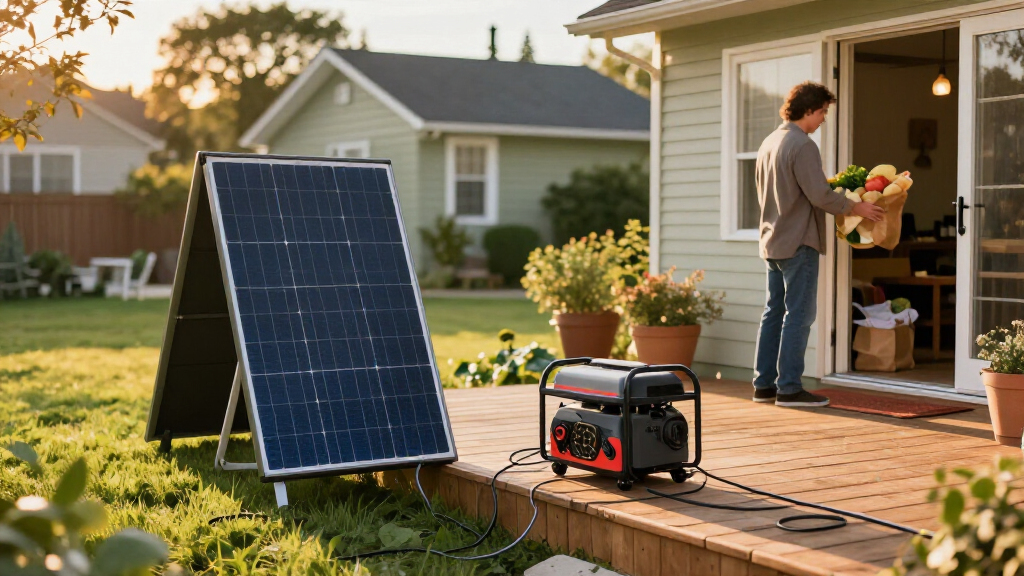
I compared these solar backup generators for home by the factors that shape actual outage use: battery capacity, rated output, solar panel bundle and input potential, portability, and the breadth of stated features. Capacity indicates how much energy is stored; output indicates which appliances a station may support at once. I treated those as separate measures, since a powerful inverter does not by itself provide long runtime. I also gave weight to battery chemistry where specified and to practical details such as built-in panels, UPS capability, and whether panels are included.
The ranking favors balanced household usefulness over a single largest specification. The DELTA 3 Max ranks ahead of smaller 1,024Wh stations because it gives buyers more runtime and output headroom, while larger systems rank higher for extended backup or demanding loads but lose points for size and commitment. Bundled panels add value only when their capacity suits the station and the buyer’s recharge expectations. Where product details are limited, I avoid assuming performance beyond the listed specifications.
| solar backup generators for home | Battery chemistry |
|---|---|
| Anker SOLIX C1000 Gen 2 Portab | LiFePO4 |
| EcoFlow DELTA 3 Portable Power | LiFePO4 |
| EF EcoFlow TITAN 5000 Classic | — |
| BLUETTI Elite 300 Solar Genera | — |
| Jackery Solar Generator 1000 V | — |
| SolarPlay Q2402M Portable Powe | LiFePO4 |
| BLAVOR 1600W Solar Generator | — |
| ABOK Ark3600 Portable Power St | LiFePO4 |
| EF EcoFlow DELTA 3 Max Portabl | LiFePO4 (LFP) |
| SolarPlay Q3600 Portable Power | LiFePO4 |
| ZeroKor 300W Portable Solar Ge | — |
| Jackery HomePower 3000 Portabl | LiFePO4 |
| Jackery HomePower 3600 Plus Po | — |
| EF ECOFLOW DELTA 3 Classic Por | LiFePO4 |
Factors to Consider When Choosing Solar Backup Generators For Home
I’d size a home backup station around the loads you need to keep running and the time you expect to be without power—not around the biggest number on a product page. These four checks help prevent a common mismatch: buying plenty of output but too little stored energy, or choosing a large battery that cannot be recharged as quickly as the household needs.
Separate Running Watts From Startup Surges
List the appliances you want to use together, then add their running wattage; that total is only the first check. Refrigerators, pumps, and some compressors can draw a short startup surge above their normal operating load. A station that meets the steady load may still shut down when one of these appliances starts. Check the manufacturer’s surge rating and your appliance labels rather than relying only on a headline output figure. If you cannot find surge data for a device, leave margin instead of assuming it will work. Buyers powering several appliances at once should prioritize output headroom, while a phone-and-lights backup can accept a smaller inverter.
Estimate Runtime From Energy Use
Battery capacity in watt-hours gives a starting point, not a guaranteed runtime. Add the watt-hours of the devices you expect to run over a day, using their actual consumption when available; a refrigerator cycles on and off, so its daily energy use is more useful than its running wattage alone. Inverter losses and conversion overhead mean not all stored energy reaches appliances. Leave a reserve for unexpected needs rather than planning to drain the battery completely. This is why a high-wattage unit is not automatically a long-running unit: output describes power at a moment, while capacity describes the energy available over time. If your priority is overnight coverage, favor battery capacity over an oversized output rating you will rarely use.
Match Solar Input to Your Recharging Plan
Panel wattage in a bundle is a rated figure, not a promise of that much power throughout the day. Shade, clouds, panel angle, season, and the station’s maximum solar input all affect charging. A larger battery paired with a modest panel bundle can take longer to refill than buyers expect, especially when appliances are drawing power at the same time. Check the station’s solar input limits and connector compatibility before adding panels; extra panel capacity may not help if the unit cannot accept it. For outage planning, think about whether you need to recharge during daylight while still running essential loads. A small built-in panel can be handy for portable top-ups, but it is not a substitute for a suitable panel array when rapid replenishment matters.
Choose a Battery Size You Can Store and Move
Large-capacity stations can reduce how often you need to ration appliances, but they take up more storage space and can be less convenient to relocate. Before buying, check the unit’s weight, dimensions, handle design, and the route between its storage spot and the devices it will power. A station kept in a garage may need long cables to reach indoor essentials, while moving it during an outage may be difficult. Smaller units are easier to position and can still cover selected loads, but repeated recharging may become part of the routine. I’d choose the smallest capacity that covers the loads and duration you actually expect, with room for a modest reserve. Do not assume a portable power station can connect to home wiring without compatible equipment and a safe, approved installation.
Decide Whether UPS and Expansion Features Matter
UPS capability can help keep certain electronics powered during a grid interruption, but transfer behavior and supported loads differ by model. If you need uninterrupted operation for a router, computer, or medical device, check the published transfer time and confirm that the device’s requirements are compatible. Expansion batteries can make a smaller base unit more adaptable, but only if the exact model supports them and the added components are available. A feature is useful only when it fits the way you plan to use the station; a buyer who wants a simple outage reserve may not benefit from paying for a more involved setup. For whole-home integration, verify equipment requirements with the manufacturer and a qualified electrician rather than treating a portable station as a direct replacement for a home generator system.
Frequently Asked Questions
Can a 1,024Wh solar generator run a refrigerator overnight?
It may, but the answer depends on the refrigerator’s daily energy use, the station’s usable capacity, and any other devices drawing power. A refrigerator cycles, so its consumption over several hours is more informative than its running wattage alone. Startup surge capacity also matters because the compressor can briefly draw more power when it starts. Check the refrigerator’s energy label or measure its use, then allow for inverter losses and a reserve. If overnight refrigeration is a firm requirement, a larger-capacity option gives more margin than assuming the battery will last a fixed number of hours.
Are the panels included with these generators enough for a multi-day outage?
Not necessarily: panel bundles differ substantially, and rated wattage does not equal all-day production. The 400W bundles in this roundup offer a more substantial starting point than the BLAVOR’s built-in 40W panel or the ZeroKor’s included 60W panel, but weather, daylight, orientation, and input limits still shape results. If you expect several days without grid power, estimate your daily energy use and compare it with realistic solar production for your location and season. You may need more compatible panels, lower consumption, or both. Check the station’s maximum solar input before buying extra panels so their output can be used by the unit.
Should I choose a 3,000Wh-plus station over a 2,048Wh model?
Choose the larger battery when you need longer runtime between charging opportunities or plan to support several essential loads. A 2,048Wh station such as the DELTA 3 Max is a more manageable middle ground for buyers who want more reserve than a 1,024Wh unit without stepping up to a much larger system. Capacity alone does not decide whether an appliance can start; output and surge ratings matter too. Larger stations also demand more storage space and can be harder to move. Base the decision on a written list of loads and expected daily energy use, not capacity alone.
Can I connect a portable solar generator to my home’s electrical panel?
Do not connect a portable station to household wiring with an improvised cable or by backfeeding an outlet. Panel connection requires equipment designed for that purpose, correct installation, and compliance with local electrical rules. Many portable stations are intended to power appliances directly from their own outlets rather than feed an entire home. If you want selected circuits powered through your panel, ask the manufacturer which configurations are supported and consult a qualified electrician. That check can also clarify whether the station’s output and transfer behavior suit the circuits you want to back up.
What should I prioritize if I need backup power for a sump pump or well pump?
Start with the pump’s running wattage and startup surge, then confirm that the station can handle both. Pumps can be demanding loads, and a unit with ample battery capacity may still lack the output needed to start one. Next, estimate how often and how long the pump will run so you can size battery capacity for the expected outage. Solar input matters if the outage may last beyond the stored reserve, but recharging depends on weather and panel placement. If pump operation protects your home from flooding or loss of water, verify compatibility with the pump manufacturer and avoid relying on a rough wattage estimate.
Conclusion
For the broadest balance of capacity and output, I’d choose the EF EcoFlow DELTA 3 Max as the best overall pick; it sits between the compact 1,024Wh stations and the larger, heavier backup systems. For buyers who value a generous included solar bundle and a 3,014Wh battery, the BLUETTI Elite 300 is a strong alternative, while the SolarPlay Q3600 suits people who want higher output and UPS capability. The Anker SOLIX C1000 Gen 2 is a practical starting point for beginners who need portable backup for selected essentials, and the Jackery HomePower 3000 offers a larger-capacity option for buyers who prefer that product line. For high-demand loads, compare the output figures of the EcoFlow TITAN 5000 Classic and Jackery HomePower 3600 Plus against appliance startup needs. My final rule: buy for the loads and outage duration you can describe, then confirm solar input, space, and safe connection options before choosing.