
If you’re looking to build a reliable home energy storage and backup system, this checklist is designed for homeowners, outdoor enthusiasts, and emergency preparedness buffs alike. Whether you’re aiming to keep your essentials powered during outages or harness solar energy for off-grid living, you’ll find the right gear here.

Get backup power and energy gear delivered free with Prime
- Fast, free delivery on millions of items
- Prime Video, Amazon Music and more included
- Member-only deals all year
The guide is organized into key categories that cover the core components of a resilient energy setup. Each section highlights essential features and considerations, helping you make informed decisions. Use this as a quick reference to compare products, understand their roles, and assemble a cohesive system tailored to your needs.
To get started, identify your primary energy needs—whether it’s powering appliances, charging devices, or providing backup during outages. Keep in mind compatibility, capacity, and portability as you review the options. This checklist aims to simplify your shopping process and ensure you choose gear that works harmoniously for a reliable energy future.
Portable Power Stations
Portable power stations are the cornerstone of mobile energy solutions. They allow you to generate and store electricity for a variety of applications, from outdoor adventures to emergency backup. When selecting a portable station, consider its capacity, weight, and input options. The Jackery HomePower 3600 Plus, with its substantial output and solar compatibility, is a versatile choice for those needing reliable power on the go. These units are especially valuable when you want to avoid the hassle of wiring or permanent installations. However, watch out for models that are too heavy or have limited ports, which can hinder usability.
Another common mistake is overlooking the importance of solar input compatibility. Ensure your station supports solar panels if you plan to use renewable energy sources. Also, check the number and types of outlets to match your devices. A higher capacity doesn’t always mean better if it exceeds your actual needs, so consider your typical power draw and usage duration. Properly sizing your portable station can save you money and maximize efficiency during critical times.
What to look for:
- High wattage output (at least 200W)
- Multiple charging ports (USB, AC, DC)
- Solar panel compatibility
- Lightweight and portable design
- Reliable battery capacity
Jackery HomePower 3600 Plus Portable Power Station with Two 200W Solar Panels

This portable power station has a 3,584Wh capacity and 3,600W AC output, expandable up to 21kWh per unit. It supports AC, solar, gas generator, and hybrid charging, and features wheels and a telescopic handle for easier transport.
Pros:
- High 3,600W output with 3,584Wh capacity
- Supports multiple charging methods
- Expandable capacity
- Wheels and telescopic handle aid transport
Cons:
- Power station and solar panels ship separately
- No customer reviews are provided in the supplied text
Best for: Outdoor activities and emergency backup
Not ideal for: Heavy or limited port options
Bottom line: Choose a portable station that balances capacity and portability.
Deep Cycle Batteries
Deep cycle batteries are essential for storing energy over the long term, making them perfect for solar setups and backup systems. The Renogy 12 Volt 200Ah Deep Cycle AGM Battery is a popular choice because of its durability and maintenance-free design. These batteries are designed to handle repeated deep discharges, which is common in renewable energy applications. When shopping for deep cycle batteries, pay attention to capacity, cycle life, and compatibility with your existing system. Avoid batteries that are too small, which may not meet your energy demands, or those with incompatible voltage ratings.
Proper sizing is crucial—oversized batteries can be unnecessarily expensive, while undersized ones may leave you short during outages. Make sure the battery terminals and connectors are compatible with your wiring. Also, consider environmental factors; AGM batteries perform well in varying temperatures and are less prone to spillage, making them suitable for indoor or outdoor use. Always follow manufacturer guidelines for installation and maintenance to extend your battery’s lifespan.
What to look for:
- High capacity (at least 200Ah)
- Sealed AGM design for maintenance-free use
- Compatible with your inverter and charger
- Durability for deep discharges
- Temperature tolerance for outdoor use
Renogy 12 Volt 200Ah Deep Cycle AGM Battery

The Renogy 12V 200Ah Deep Cycle AGM Battery is maintenance-free with advanced valve regulation, offering high discharge performance and a long shelf life. Suitable for solar and other deep cycle applications, it is designed for stable operation across a wide temperature range.
Pros:
- Maintenance-free with advanced valve regulation
- High discharge currents up to 10 times rated capacity
- Long shelf life with low self-discharge rate
- Operates reliably across wide temperature ranges
Cons:
- Requires upright installation for optimal performance
- Heavy weight may be difficult to handle
Best for: Solar power systems and backup storage
Not ideal for: Incompatible voltage or capacity
Bottom line: Select a deep cycle battery that matches your energy needs.
Solar Charge Controllers
Solar charge controllers are vital for managing the flow of energy from your solar panels to your batteries. The Renogy 400W Premium Solar Kit with 40A MPPT Charge Controller offers high efficiency and robust protection features. MPPT (Maximum Power Point Tracking) controllers are especially effective at optimizing power harvest, making them ideal for larger or more complex solar setups. When choosing a controller, consider your system’s total wattage, voltage compatibility, and future expansion plans.
A common mistake is selecting a controller with insufficient capacity, which can limit your system’s performance or damage components. Always verify that the controller can handle your maximum input current and voltage. Features like overcharge protection, temperature compensation, and user-friendly interfaces can save you time and trouble. Properly sized and configured charge controllers will prolong your battery life and improve overall system efficiency.
What to look for:
- Appropriate wattage capacity (at least 40A)
- MPPT technology for maximum efficiency
- Compatibility with your solar panel array
- Built-in protection features
- User-friendly interface
Renogy 400W Premium Solar Kit with 40A MPPT Charge Controller
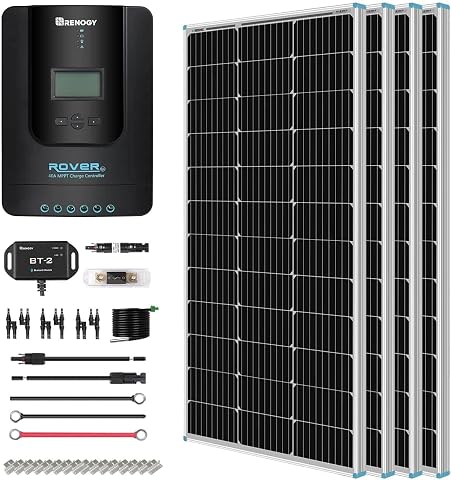
This solar kit includes four 100W monocrystalline panels and a 40A MPPT charge controller with Bluetooth connectivity. It is designed for efficient energy generation and easy setup, suitable for off-grid applications.
Pros:
- High efficiency monocrystalline panels
- Includes Bluetooth module for remote monitoring
- Complete system with mounting hardware and cables
- Long-term warranty and sturdy build
Cons:
- Heavy weight at 56.4 pounds
- Requires space for installation
- Limited to 12V systems
Best for: Large solar setups and expanding systems
Not ideal for: Oversized or undersized capacity
Bottom line: Choose a charge controller that matches your system size and future needs.
Inverter Systems
Inverter systems convert DC power stored in batteries into usable AC power for your household appliances. The Jackery Explorer 300 Portable Power Station, 292Wh is an excellent example of a portable inverter that balances capacity with portability. When selecting an inverter, consider the total wattage of the devices you plan to run simultaneously. Pure sine wave inverters are preferable for sensitive electronics, ensuring clean power that won’t cause damage or performance issues.
Many buyers make the mistake of underestimating their power needs, leading to inadequate performance during outages. Always add a buffer to your calculations to account for startup surges and future device additions. Size your inverter to handle your peak load comfortably. Also, check the inverter’s compatibility with your battery system and its weight if portability is a concern. Proper sizing and quality features will ensure reliable operation and longevity of your backup power system.
What to look for:
- Sufficient wattage capacity for your needs
- Pure sine wave output
- Compatibility with your battery system
- Multiple AC and USB outlets
- Lightweight and portable design
Jackery Explorer 300 Portable Power Station, 292Wh

The Jackery Explorer 300 is a lightweight, portable power station weighing only 7.5 lbs, with a 292Wh capacity suitable for camping, hiking, and off-grid use. It features multiple outlets including AC, USB-C, USB-A, and a car port, making it versatile for powering various devices.
Pros:
- Lightweight and portable design
- Versatile charging options for multiple devices
- Durable LiFePO4 battery with long cycle life
- Fast solar charging capability
Cons:
- No included solar panel
- Limited to 300W continuous output
- Battery capacity may be insufficient for high-power devices
Best for: Portable backup and outdoor use
Not ideal for: Oversized or incompatible units
Bottom line: Match your inverter’s capacity with your power demands.
Battery Management Systems
Emergency Power Supplies
Emergency power supplies are crucial for ensuring continuous operation of critical devices during outages. The Eaton Tripp Lite SMART2500XLHG 2200VA Medical-Grade UPS provides a dependable backup with clean power delivery. When selecting an uninterruptible power supply (UPS), consider its capacity, runtime, and compatibility with your essential devices. Medical-grade units like this one are designed to meet stringent standards, making them ideal for sensitive equipment.
Many users overlook the importance of runtime, which determines how long your devices can operate during an outage. Larger capacity units provide longer backup times but tend to be more expensive. Also, ensure the UPS has enough outlets and features like surge protection and automatic shutdown. Properly sizing your UPS will prevent unexpected shutdowns and protect your equipment from power fluctuations, ensuring peace of mind during emergencies.
What to look for:
- Sufficient VA rating for your devices
- Pure sine wave output for sensitive electronics
- Longer runtime options
- Surge protection features
- Multiple outlets and easy management
Eaton Tripp Lite SMART2500XLHG 2200VA Medical-Grade UPS

This medical-grade UPS provides reliable power protection for sensitive electronic equipment in patient-care areas, featuring built-in isolation transformer and surge suppression. It offers continuous power during outages and expandable runtime with external battery packs.
Pros:
- Medical-grade certification ensures safety in healthcare environments
- Built-in isolation transformer reduces noise and prevents shock potential
- Expandable runtime with external battery packs
Cons:
- May be more expensive than standard UPS units
- Complex setup for external battery expansion
Best for: Home medical equipment and essential electronics
Not ideal for: Inadequate capacity or poor surge protection
Bottom line: Choose a UPS that safeguards your critical appliances.
Starting with budget-friendly options and gradually upgrading as needed is a smart way to build your home energy system. Prioritize core components like batteries and inverters first, then expand with solar controllers and backup supplies as your budget allows.
Remember, a well-chosen setup not only provides peace of mind but also enhances your energy independence. Keep educating yourself about new technologies and best practices to ensure your system remains efficient and reliable for years to come. Happy shopping and powering your home confidently!