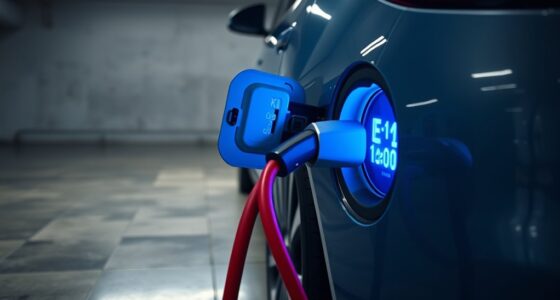
As your battery approaches full capacity, the charging process naturally slows down to protect its chemistry and keep temperatures in check. When the State of Charge (SOC) gets high, chemical reactions become less efficient, and heat can build up, risking damage. To prevent overheating and prolong battery life, the system reduces current flow. Keep exploring to understand how these safety measures work together to keep your battery healthy and safe over time.

Get backup power and energy gear delivered free — and shop member deals
- Fast, free delivery on millions of items
- Access to Prime Big Deal Days deals on October 6–7
- Prime Video, Amazon Music and more included
Key Takeaways
- Chemical reactions become less efficient as battery approaches full capacity, slowing ion movement.
- Heat generated during high SOC charging risks overheating, prompting safety systems to reduce charging rates.
- Elevated temperatures at high SOC can accelerate battery degradation and thermal runaway.
- Battery management systems automatically limit current to prevent damage and extend battery lifespan.
- Slowing charging near full capacity helps maintain thermal stability and preserves battery health.
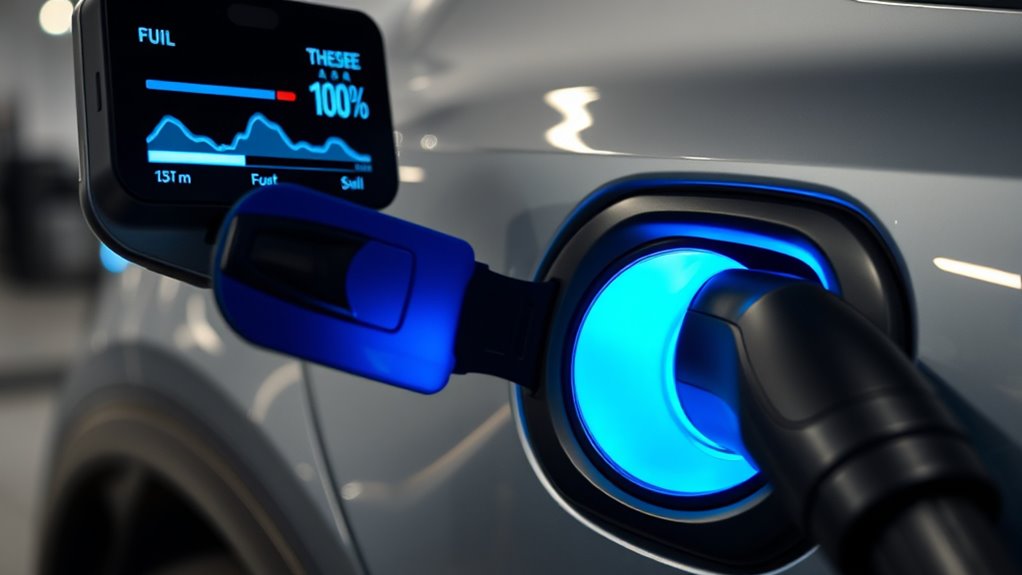
Charging typically slows down as your battery approaches its full capacity, a process known as “slowing at high SOC.” This happens because the battery’s chemistry and safety mechanisms limit rapid charging to prevent damage and overheating. As you monitor your device or vehicle charging, you might notice that the speed tapers off near 80-90% charge, and understanding why involves delving into the fundamentals of battery chemistry and thermal effects.
The core reason for this slowdown stems from the chemical processes within the battery cells. Lithium-ion batteries, the most common type used today, rely on the movement of lithium ions between electrodes during charging and discharging. When the battery is at a low state of charge (SOC), the chemical reactions occur smoothly and efficiently. But as the battery fills up, the chemical reactions become less efficient, and the movement of ions slows down. This natural change in chemistry means that pushing in more charge rapidly can lead to unstable conditions, so the charger reduces its pace to maintain safe and stable operation.
Thermal effects also play a vital role in slowing the charge. As the battery charges, especially at high rates, it generates heat. This heat can cause the internal temperature of the battery to rise, and excessive heat is dangerous because it accelerates degradation of the battery’s materials. To prevent overheating and potential thermal runaway, safety systems automatically limit the current flow at high SOC. When the battery gets too warm, the charging rate is further slowed to allow the internal temperature to stabilize. This interplay between chemical reactions and thermal effects ensures that the battery remains safe and retains its longevity.
This slowdown isn’t just about safety; it’s also about preserving the battery’s health over time. Rapid charging at high SOC can cause stress to the battery’s materials, leading to capacity loss and reduced lifespan. By naturally decelerating the charge, the battery minimizes these risks, ensuring you get more cycles out of it in the long run. This is why fast chargers often prioritize rapid charging only up to a certain point and then throttle back as the battery reaches higher levels of charge.
Additionally, modern batteries incorporate battery management systems that actively monitor and control charging to optimize lifespan and safety.
In essence, the slowdown at high SOC is a protective feature rooted in the principles of battery chemistry and thermal management. It’s a necessary process that balances the desire for quick charging with the realities of chemical stability and heat management. When you see your charging slow as it nears full capacity, remember that it’s working to keep your battery safe, healthy, and long-lasting.
fast charging lithium-ion batteries
As an affiliate, we earn on qualifying purchases.
As an affiliate, we earn on qualifying purchases.
Frequently Asked Questions
Does Battery Temperature Affect Charging Speed at High SOC?
Yes, battery temperature affects charging speed at high SOC. When your battery gets too hot or cold, it impacts battery chemistry, causing charging to slow down. Thermal management systems work to keep the temperature within a suitable range, preventing overheating or overcooling. If your battery isn’t properly cooled or heated, charging slows to protect the battery’s health, especially at high state of charge where thermal effects are more pronounced.
How Does Charger Type Influence Slow Charging Near Full Capacity?
Did you know that using a compatible fast charger can cut charging time by up to 50%? Charger type substantially influences slow charging near full capacity because only chargers with proper compatibility and high power delivery can efficiently top off your battery. When your charger isn’t compatible or lacks sufficient power, it can’t deliver the necessary current, causing charging to slow down as your battery approaches full capacity.
Can Software Updates Improve High SOC Charging Rates?
Yes, software updates can improve high SOC charging rates. You’ll benefit from software optimizations and firmware improvements that better manage battery temperature, power flow, and cell balancing. Manufacturers often release updates that enhance charging algorithms, allowing you to charge faster near full capacity. Keep your vehicle’s software up-to-date to maximize charging efficiency, reduce slowdowns, and ensure safer, more reliable high SOC charging performance.
What Role Do Battery Age and Health Play in Slowing Charge?
Think of your battery as a tired marathon runner; as it ages, battery degradation reduces its ability to accept charge efficiently. Over time, this affects charging efficiency, especially at high SOC levels, causing slower charging. Battery age and health directly influence how well your vehicle charges, making it essential to monitor and maintain your battery for ideal performance and faster charging times, even when it seems like your battery is running out of steam.
Are There Safety Risks When Charging to 100%?
Charging to 100% can pose safety risks if your battery isn’t properly calibrated or if your charging infrastructure isn’t reliable. Over time, battery calibration guarantees accurate SOC readings, preventing overcharging. Using quality charging infrastructure minimizes risks like overheating or potential fires. Always monitor the charging process, and it’s best to unplug once fully charged to safeguard your battery’s health and ensure safe operation.
battery management system for electric vehicles
As an affiliate, we earn on qualifying purchases.
As an affiliate, we earn on qualifying purchases.
Conclusion
So, next time you notice your battery’s charging slowing down as it nears full capacity, remember there’s more at play than just science. It’s a clever safeguard, hinting at a hidden balance your battery maintains to last longer. But what happens when this balance is pushed too far? Keep an eye on your charging habits, because beneath the slow-down lies a secret that could change how we think about powering up. Are you truly in control?
high capacity portable power bank
As an affiliate, we earn on qualifying purchases.
As an affiliate, we earn on qualifying purchases.
As an affiliate, we earn on qualifying purchases.
Fall Picks
fall essentials
As an affiliate, we earn on qualifying purchases.