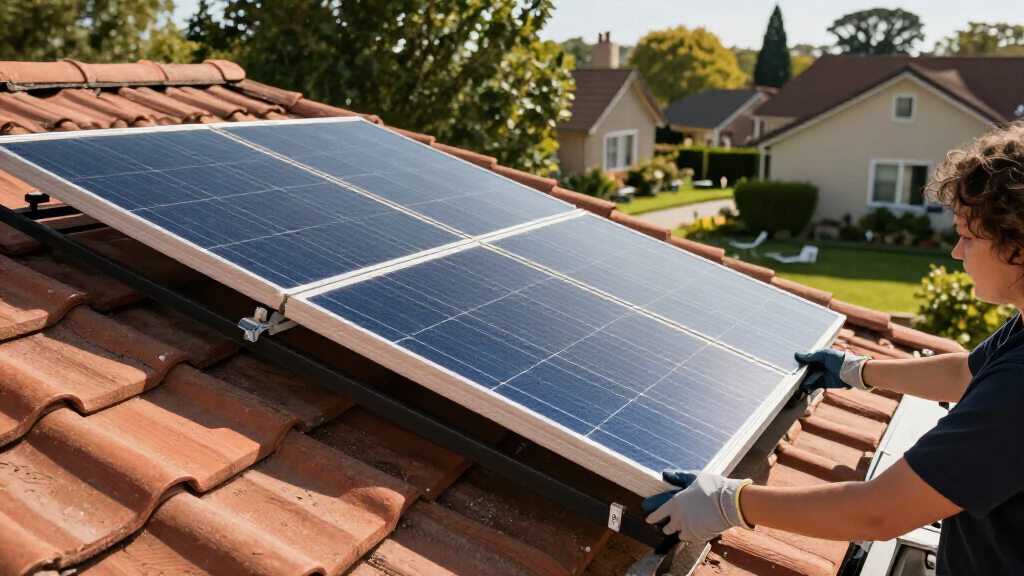

For a flexible home backup setup, I’d start with the Jackery HomePower 3600 Plus with four 200W panels; it pairs substantial battery capacity with a ready-to-use portable format. The ECO-WORTHY 10 kW kit with 5,310W of panels and 20.48 kWh storage is a stronger fit for buyers planning a larger off-grid system, while the Renogy 400W kit suits smaller 12V projects that need a charge controller rather than a complete household system. The main tradeoff is between simple, portable power stations and larger systems that need more planning and installation work. Battery capacity, panel output, inverter rating, and compatibility all affect what a kit can actually power. Read on for the full comparison and guidance on matching a kit to your home and power needs.

Get backup power and energy gear delivered free with Prime
- Fast, free delivery on millions of items
- Prime Video, Amazon Music and more included
- Member-only deals all year
Complete the kit


Key Takeaways
The Jackery HomePower 3600 Plus stands out for buyers who want a portable, bundled backup setup with four 200W panels and 3,584Wh of storage, rather than a fixed home installation.
The largest ECO-WORTHY systems differ most in panel wattage and battery capacity: compare those figures alongside the 10 kW inverter label, which describes output capability, not how much energy the system stores.
The Renogy 400W kit and ECO-WORTHY 400W options are small-system components, not direct substitutes for complete off-grid home kits with batteries and high-output inverters.
The Jackery Explorer 300, Jackery 1000 Plus v2, and EcoFlow DELTA Pro are portable power station packages; they prioritize convenience and mobility over the expansion and installation choices of a fixed system.
Several products share similar ECO-WORTHY branding but serve different loads: the 5 kW kit and 10 kW kits need to be compared by included panels, storage, and output—not by headline inverter rating alone.
| Jackery Explorer 300 Portable Power Station with 40W Solar Panel |  | Best Compact Solar Generator | Battery capacity: 292Wh | Peak output: 600W | Battery chemistry: LiFePO4 | VIEW LATEST PRICE | See Our Full Breakdown |
| Jackery HomePower 3600 Plus Portable Power Station with Four 200W Solar Panels and Two Connectors, 3584Wh |  | Best Portable Home-Backup Kit | Battery capacity: 3,584Wh | Output wattage: 3,600W | Parallel output: 7,200W | VIEW LATEST PRICE | See Our Full Breakdown |
| Renogy 400W 12V Monocrystalline Solar Kit with 40A MPPT Charge Controller |  | Best for a DIY 12V Solar Build | Total panel power: 400W | Panel configuration: 4 × 100W | System voltage: 12V | VIEW LATEST PRICE | See Our Full Breakdown |
| ECO-WORTHY 400W 12V Solar Panel Kit with Lithium Batteries and 2000W Inverter | 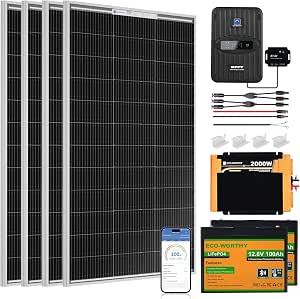 | Best Complete 12V Off-Grid Bundle | Solar panel power: 400W (4 × 100W) | System voltage: 12V | Battery capacity: 2 × 12V 100Ah lithium batteries | VIEW LATEST PRICE | See Our Full Breakdown |
| ECO-WORTHY 10 kW Off-Grid Solar Panel Kit with 32.2 kWh Battery Storage |  | Best for High-Capacity Off-Grid Homes | Solar panel count: 18 | Total PV capacity: 10,620W | Maximum daily generation: Up to 39.36kWh under optimal conditions | VIEW LATEST PRICE | See Our Full Breakdown |
| ECO-WORTHY 10 kW Off-Grid Solar System Kit with 2,340 W Panels, 10 kW Inverter, and 10.24 kWh Batteries |  | Best Balanced Off-Grid Kit | Solar panels: 12 × 195 W; 2,340 W total | Panel efficiency: 25% | Inverter: 10,000 W maximum continuous output | VIEW LATEST PRICE | See Our Full Breakdown |
| Jackery Solar Generator 1000 Plus v2 with 200W Solar Panel |  | Best Compact Backup and Solar Starter | Battery capacity: 1,024 Wh LiFePO₄ | Expandable capacity: Up to 11 kWh with up to five separately sold battery packs | AC output: 1,800 W; 3,600 W surge peak | VIEW LATEST PRICE | See Our Full Breakdown |
| ECO-WORTHY 10 kW Off-Grid Solar System Kit with 5,310 W Panels and 20.48 kWh Battery Storage |  | Best for High Household Storage Needs | Solar panels: 9 × 590 W; 5,310 W total | Panel type: N-type monocrystalline, bifacial dual-glass | Panel efficiency: 23.23% | VIEW LATEST PRICE | See Our Full Breakdown |
| ECO-WORTHY 10 kW Off-Grid Solar Panel Kit with 16.1 kWh Battery |  | Best for High Inverter Output on a Smaller Array | Solar panels: 5 × 590 W; 2,950 W total | Inverter output: 10,000 W continuous; 20,000 W peak | AC output: 120 V or 120/240 V split-phase | VIEW LATEST PRICE | See Our Full Breakdown |
| ECO-WORTHY 400W 12V Solar Panel Kit with MPPT Controller and Bluetooth |  | Best Small 12 V DIY Kit | Solar panels: 4 × 100 W monocrystalline; 400 W total | Output voltage: 12 V DC | Charge controller: 40 A MPPT | VIEW LATEST PRICE | See Our Full Breakdown |
| ECO-WORTHY 10000W Output Complete Off-Grid Solar Panel Kit for Home |  | Best for High-Load Off-Grid Homes | Solar array: 8 × 590W panels; 4,720W total | Battery: 48V, 314Ah LiFePO₄ | Battery energy: 16.1kWh | VIEW LATEST PRICE | See Our Full Breakdown |
| EF ECOFLOW DELTA Pro 3600Wh Solar Generator with 400W Portable Solar Panel |  | Best Portable Home Backup | Power station capacity: 3,600Wh | Included solar panel: 400W foldable panel | Panel conversion rate: 22.4% | VIEW LATEST PRICE | See Our Full Breakdown |
| ECO-WORTHY 200W 12V/24V Monocrystalline Solar Panel Kit with 30A PWM Charge Controller |  | Best for Small Off-Grid Loads | Total panel output: 200W | Panel configuration: 2 × 100W | System voltage: 12V or 24V | VIEW LATEST PRICE | See Our Full Breakdown |
| ECO-WORTHY 5kW Off-Grid Solar System Kit with 2340W Panels, Inverter, and Battery |  | Best Complete Mid-Size System | Solar panel count: 12 × 195W | Total panel output: 2,340W | Inverter: 5,000W, 48V | VIEW LATEST PRICE | See Our Full Breakdown |
| ECO-WORTHY 1200W 48V Solar Power Kit with 3500W Inverter and 50Ah LiFePO4 Battery |  | Best Compact 48V Starter System | Maximum solar power: 1,200W | Panels: 6 × 195W N-type bifacial | Panel conversion efficiency: 25% | VIEW LATEST PRICE | See Our Full Breakdown |
More Details on Our Top Picks
Jackery Explorer 300 Portable Power Station with 40W Solar Panel
For small-scale backup and portable charging, I’d choose the Explorer 300 over a roof-style kit: it pairs a 292Wh battery with an included 40W solar panel, so the setup stays simple to move and use. Its two AC outlets and USB ports suit phones, laptops, lights, and other modest loads, while the 100W USB-C port gives compatible devices a more direct charging option. The LiFePO4 battery’s stated life of over 4,000 cycles is a plus for repeated use. Compared with the larger Jackery HomePower 3600 Plus, this is far easier to carry, but it stores much less energy and its small panel will replenish it more slowly. I’d skip it for running major household appliances. The product information also conflicts on weight, and the station and panel may ship separately.
Pros:- Includes a 40W solar panel for off-grid recharging
- LiFePO4 battery is rated for over 4,000 charge cycles to 70% capacity
- Multiple outputs include two AC outlets and a 100W USB-C port
- More portable than the HomePower 3600 Plus
Cons:- 292Wh capacity and 300W rated output limit the size and duration of supported loads
- The included 40W panel recharges more slowly than the larger arrays in the lineup
- Listed weight is inconsistent, and the panel and power station may ship separately
Best for: Campers, renters, and households seeking portable backup for phones, laptops, lights, and other low-wattage devices.
Not ideal for: Buyers who need to power large appliances, run several high-draw devices, or keep household circuits operating through an extended outage.
- Battery capacity:292Wh
- Peak output:600W
- Battery chemistry:LiFePO4
- Included solar panel:40W
- AC outlets:2
- USB-C:100W PD
- Weight:12.9 lb (listed; product description gives a conflicting figure)
Our verdict“Choose the Explorer 300 for portable, small-device power, not whole-home or appliance-scale backup.”
Jackery HomePower 3600 Plus Portable Power Station with Four 200W Solar Panels and Two Connectors, 3584Wh
I rank the HomePower 3600 Plus as the strongest middle ground here for buyers who want a substantial battery and an included solar array without committing to a permanent off-grid installation. Its 3,584Wh capacity and 3,600W output suit a broader range of backup needs than the Explorer 300, while four 200W panels provide a more capable solar-charging setup than that compact bundle. The system can also expand to 21kWh per unit, giving buyers room to add storage later. AC, solar, hybrid AC-plus-DC, and generator charging offer useful flexibility when sunlight is limited. The tradeoff is weight: at 77.2 pounds, this is portable in a wheeled, handle-equipped sense, not something I’d want to lift often. Compared with the ECO-WORTHY 10 kW kit, it is less of a fixed installation, but it has less storage and output for larger household loads.
Pros:- 3,584Wh battery and 3,600W output support more than small-device charging
- Includes four 200W solar panels and two connectors
- Expandable to 21kWh per unit
- Supports solar, AC, hybrid AC-plus-DC, and gas-generator charging
Cons:- At 77.2 lb, it is heavy to lift despite the wheeled design
- Its capacity and output remain below the larger ECO-WORTHY 10 kW system
- Panels and power station may arrive in separate packages
Best for: Households seeking wheeled, expandable outage backup with a substantial included solar array and multiple ways to recharge.
Not ideal for: Buyers who need a lightweight carry-in unit or a professionally installed system for high continuous household loads and large energy storage.
- Battery capacity:3,584Wh
- Output wattage:3,600W
- Parallel output:7,200W
- Battery type:LFP
- Included solar panels:Four 200W panels
- Expandable capacity:Up to 21kWh per unit
- Hybrid AC and DC recharge time:2 hours
- Weight:77.2 lb
Our verdict“Pick the HomePower 3600 Plus if you want a portable, expandable backup system with a meaningful solar array rather than a permanent high-capacity installation.”
Renogy 400W 12V Monocrystalline Solar Kit with 40A MPPT Charge Controller
The Renogy kit makes the most sense for a buyer building a 12V off-grid system who already has a battery plan and wants the core solar charging components together. Four 100W monocrystalline panels, a 40A MPPT controller, mounting brackets, cables, and an adapter kit cover more of the setup than the ECO-WORTHY 400W kit that includes batteries and an inverter. That difference matters: Renogy leaves battery storage and AC conversion to the buyer, while the ECO-WORTHY bundle is closer to a ready-to-use system. Bluetooth monitoring can help track charging without adding a separate monitor. I would be cautious about purchasing based on the listing alone, though: its stated maximum power and voltage details appear inconsistent with the kit’s 400W and 12V description. It is best for someone comfortable verifying compatibility before installation, not a buyer expecting a clearly specified plug-and-play package.
Pros:- Four 100W panels provide a 400W named array
- 40A MPPT controller is included for solar charging
- Bluetooth module supports phone monitoring
- Includes Z-brackets, cables, and an adapter kit
Cons:- No battery or inverter is listed among the included components
- Product information conflicts on maximum power and voltage
- At 56.4 lb, the kit is less convenient to handle than a compact portable power station
Best for: DIY RV and cabin builders who need a 12V panel-and-controller package and can select a compatible battery and inverter separately.
Not ideal for: First-time buyers seeking a complete system with batteries and an inverter, or anyone unwilling to clarify conflicting power and voltage specifications before purchase.
- Total panel power:400W
- Panel configuration:4 × 100W
- System voltage:12V
- Charge controller:40A MPPT
- Panel material:Monocrystalline silicon
- Maximum battery voltage:32V (listed; other product information gives conflicting voltage details)
- Item weight:56.4 lb
- Panel warranty:5 years
Our verdict“Choose Renogy for a DIY 12V panel-and-controller foundation only if you can verify the specifications and source storage and inversion separately.”
ECO-WORTHY 400W 12V Solar Panel Kit with Lithium Batteries and 2000W Inverter
Unlike the Renogy 400W kit, which focuses on panels and charging hardware, this ECO-WORTHY bundle includes the pieces needed for a more complete 12V off-grid setup: four panels, two lithium batteries, an MPPT controller, and a 2,000W pure sine wave inverter. That makes it a better fit for an RV or cabin buyer who wants battery storage and AC power in the same package rather than sourcing each separately. Its 400W array is still modest next to the much larger ECO-WORTHY 10 kW kit, so I’d reserve it for lighter daily loads rather than whole-home backup. The batteries are rated for more than 3,000 deep cycles, and Bluetooth monitoring adds visibility into the system. The stated 1.6kWh daily output depends on ideal sunlight, while the inverter rating limits which appliances can run together.
Pros:- Bundles four 100W panels with two 12V 100Ah lithium batteries
- Includes a 40A MPPT controller and 2,000W pure sine wave inverter
- Battery cycle life is rated at more than 3,000 deep cycles
- Bluetooth module supports system monitoring
Cons:- The 400W array is small for substantial household energy needs
- The 1.6kWh daily-output figure depends on ideal sunlight conditions
- The 2,000W inverter limits the AC loads that can run at once
Best for: RV owners and small-cabin users who want panels, lithium storage, a controller, and an inverter bundled for a 12V system.
Not ideal for: Households aiming to back up major appliances or cover high daily energy use; the 400W array and 2,000W inverter are limited compared with the 10 kW ECO-WORTHY kit.
- Solar panel power:400W (4 × 100W)
- System voltage:12V
- Battery capacity:2 × 12V 100Ah lithium batteries
- Inverter power:2,000W
- Charge controller:40A MPPT
- Battery cycle life:More than 3,000 deep cycles
- Solar cell conversion rate:23%
- Stated ideal daily output:1.6kWh under four hours of sunlight
Our verdict“Choose this bundle for a small 12V RV or cabin system when a more complete package matters more than high household output.”
ECO-WORTHY 10 kW Off-Grid Solar Panel Kit with 32.2 kWh Battery Storage
For buyers planning a substantial off-grid installation, this ECO-WORTHY kit offers the greatest stated storage in this batch: 32.2kWh across two LiFePO₄ batteries, paired with 18 panels and a 10,000W split-phase inverter. That combination puts it in a different category from the portable Jackery systems and the 400W ECO-WORTHY RV bundle, which suit limited loads rather than a larger household energy plan. The inverter can provide 120V or 120/240V output, and its 20,000W peak rating gives more headroom for brief starting loads than its continuous rating alone suggests. This scale brings serious installation demands, though. Professional installation is recommended, the panels are nearly 90 inches long, and delivery requires space for a large truck shipment. The listed generation figure is also conditional on favorable conditions, not a guaranteed daily yield.
Pros:- 32.2kWh combined LiFePO₄ storage
- 18 monocrystalline panels provide 10,620W total PV capacity
- 10,000W continuous inverter supports 120V or 120/240V split-phase output
- Battery monitoring supports Bluetooth, Wi-Fi, and PC connectivity
Cons:- Professional installation is recommended
- Large panels and shipment require significant handling and truck-accessible delivery
- The stated maximum daily generation depends on favorable conditions
Best for: Owners of larger off-grid homes or properties who need substantial battery storage, split-phase output, and a system planned for professional installation.
Not ideal for: Renters, small cabins, and buyers seeking a portable or simple DIY kit; the equipment scale, delivery requirements, and installation needs are substantial.
- Solar panel count:18
- Total PV capacity:10,620W
- Maximum daily generation:Up to 39.36kWh under optimal conditions
- Inverter continuous output:10,000W
- Inverter peak output:20,000W
- Output voltage:120V or 120/240V split-phase
- Battery storage:32.2kWh total; 2 × 48V, 314Ah LiFePO₄ batteries
- Installation:Professional installation recommended
Our verdict“Choose this kit for a professionally planned, high-capacity off-grid home system, not for portable backup or a small-scale solar setup.”
ECO-WORTHY 10 kW Off-Grid Solar System Kit with 2,340 W Panels, 10 kW Inverter, and 10.24 kWh Batteries
I’d put this kit on the shortlist for buyers who want a coordinated off-grid system without stepping up to the larger panel and storage package in the ECO-WORTHY 5,310 W kit. Its 2,340 W of bifacial panels and 10.24 kWh of battery storage pair with a 10 kW split-phase inverter, giving it 120 V and 240 V output for a wider range of household loads. The stated daily production of up to 9.36 kWh assumes four hours of full sunshine, so cloudy conditions and seasonal changes can reduce what it supplies.
Bluetooth and Wi-Fi battery monitoring, plus multiple charging and output-priority modes, give owners useful system controls. The tradeoff is that a 10 kW inverter does not mean the panels can produce 10 kW; the array is much smaller, and professional installation is recommended. Compared with the ECO-WORTHY 400 W kit, this is a whole-home-scale system rather than a modest 12 V setup, but it also calls for more planning, space, and installation expertise.
Pros:- Includes panels, inverter, batteries, mounting brackets, and accessories
- Split-phase output supports 120 V and 240 V loads
- Bluetooth and Wi-Fi battery monitoring with multiple operating modes
- Bifacial panels may capture additional light from the rear under suitable installation conditions
Cons:- Professional installation is recommended
- The 2,340 W array is modest beside the 10 kW inverter rating
- Daily energy production varies with sunlight and site conditions
Best for: Off-grid homeowners who need 120 V and 240 V output, a complete matched system, and moderate battery storage.
Not ideal for: Buyers seeking a simple DIY starter kit or a larger solar array and longer storage reserve; installation is more involved and the panel capacity is below the ECO-WORTHY 5,310 W kit.
- Solar panels:12 × 195 W; 2,340 W total
- Panel efficiency:25%
- Inverter:10,000 W maximum continuous output
- AC output:120 V / 240 V split-phase
- Battery storage:2 × 48 V, 100 Ah; 10.24 kWh total
- Estimated daily production:Up to 9.36 kWh under four hours of full sunshine
- Panel dimensions:58.86 × 26.18 × 1.18 in
- Certifications:Inverter: UL 1741; batteries: UL 1973 and UL 9540A
Our verdict“Choose this as a coordinated off-grid package if you need split-phase output and moderate storage, but not the larger array and battery reserve of the ECO-WORTHY 5,310 W system.”
Jackery Solar Generator 1000 Plus v2 with 200W Solar Panel
This Jackery is the most approachable pick here for buyers who want portable backup rather than a permanently installed home solar array. The 1,024 Wh LiFePO₄ battery, 1,800 W AC output, and included 200 W panel can support smaller essentials, while four AC outlets are divided between two independently controlled circuits. Its under-10-ms UPS switchover adds a useful backup role for compatible equipment, a feature not described for the ECO-WORTHY off-grid kits.
The compact unit is easier to place and manage than a pallet-delivered system, but its 200 W panel and 1,024 Wh capacity are not a substitute for whole-home storage. Capacity can grow to 11 kWh, though the extra battery packs are sold separately. Compared with the Jackery Explorer 300 with 40 W Solar Panel in the broader roundup, this model offers substantially more output and expansion headroom; compared with the ECO-WORTHY 400 W kit, it trades a fixed panel-and-controller setup for an integrated portable power station.
Pros:- LiFePO₄ battery with stated 6,000-cycle lifespan to at least 70% capacity
- Under-10-ms UPS switchover and 3 kV / 1,000 J surge protection
- Two independently controlled AC circuits
- Includes a 200 W solar panel and supports battery expansion
Cons:- Additional battery packs needed for expansion are sold separately
- The included 200 W panel and 1,024 Wh battery suit backup use better than whole-home supply
- Solar charging speed depends on sunlight and the relatively small panel
Best for: Households wanting portable backup for selected appliances, electronics, or a small home office, with the option to add battery capacity later.
Not ideal for: Buyers planning to power a home from a fixed solar array or expecting the included panel to recharge the unit quickly during heavy use.
- Battery capacity:1,024 Wh LiFePO₄
- Expandable capacity:Up to 11 kWh with up to five separately sold battery packs
- AC output:1,800 W; 3,600 W surge peak
- Solar panel:200 W included
- AC outlets:4 across 2 independently controlled circuits
- UPS switchover:Under 10 ms
- USB-C output:140 W
- Dimensions:12.3 × 7.9 × 9.3 in
- Warranty:5 years
Our verdict“Pick this Jackery for portable, expandable backup for selected loads, not as a replacement for a fixed home solar kit with a larger array.”
ECO-WORTHY 10 kW Off-Grid Solar System Kit with 5,310 W Panels and 20.48 kWh Battery Storage
Among the large ECO-WORTHY systems in this group, this one makes the strongest case for buyers who want substantial battery reserve alongside a capable solar array. It combines 5,310 W of bifacial panels with 20.48 kWh of LiFePO₄ storage and a 10 kW split-phase inverter. That is a larger solar array and twice the stated storage of the 2,340 W ECO-WORTHY kit, making this a better fit for homes with higher daily demand or a greater need to store energy for later use.
The dual MPPT controllers, Wi-Fi monitoring, and support for connecting up to six inverters in parallel provide room for system planning and expansion. Those capabilities come with logistics: the 89.7-inch panels ship by pallet via truck, and professional installation is recommended. Its panel count is lower than the 12-panel smaller-array kit, but each panel is much more powerful. I’d skip it if roof access, delivery space, or installation support is limited.
Pros:- Includes 5,310 W of panels and 20.48 kWh of battery storage
- 10 kW split-phase inverter supports 120 V or 120/240 V output
- Dual MPPT controllers and Wi-Fi monitoring
- System supports up to six inverters in parallel
Cons:- Large panels ship by pallet via truck and require space for delivery and handling
- Professional installation is recommended
- The large panel format may be difficult to position on constrained roofs
Best for: Off-grid homeowners with substantial daily electricity needs, room for large panels, and a need for more stored energy than the 10.24 kWh ECO-WORTHY kit provides.
Not ideal for: Buyers with limited roof or ground-mount space, restricted truck access, or a preference for a small DIY system.
- Solar panels:9 × 590 W; 5,310 W total
- Panel type:N-type monocrystalline, bifacial dual-glass
- Panel efficiency:23.23%
- Inverter output:10,000 W continuous; 20,000 W peak
- AC output:120 V or 120/240 V split-phase
- Battery storage:4 × 48 V, 100 Ah LiFePO₄; 20.48 kWh total
- Panel dimensions:89.7 × 44.6 × 1.4 in
- Maximum panel voltage:1,500 V
- Certifications:UL 1973, UL 9540A, CEC, TÜV, CSA
Our verdict“Choose this system over the smaller ECO-WORTHY kit when a larger array and 20.48 kWh of storage justify the delivery and installation demands.”
ECO-WORTHY 10 kW Off-Grid Solar Panel Kit with 16.1 kWh Battery
This kit pairs a powerful inverter with a more restrained solar array, which makes it a distinct choice from ECO-WORTHY’s 5,310 W system. The 10,000 W continuous inverter supports 120 V or 120/240 V split-phase output, while a 20,000 W peak rating can accommodate short surges within the system’s limits. Its 16.076 kWh LiFePO₄ battery gives stored energy more room than the 10.24 kWh kit, but the five panels total only 2,950 W—well below the 5,310 W model’s array capacity.
That balance may suit buyers prioritizing inverter capacity and battery storage over faster solar replenishment. The battery’s 200 A PACE BMS and Bluetooth, Wi-Fi, and PC monitoring add useful oversight, and both batteries and inverters can be expanded in parallel. Large panels require palletized truck delivery, and professional installation is recommended. I would not choose it over the 5,310 W kit if daytime solar production is the main priority.
Pros:- 10,000 W continuous inverter output with 120/240 V split-phase support
- Includes a 16.076 kWh LiFePO₄ battery and five solar panels
- Battery monitoring supports Bluetooth, Wi-Fi, and PC connection
- Supports parallel expansion for batteries and inverters
Cons:- The 2,950 W array is considerably smaller than the ECO-WORTHY 5,310 W kit’s array
- Professional installation is recommended
- Large components require palletized truck delivery
Best for: Off-grid homeowners who need split-phase inverter capacity and substantial battery storage but can work with a 2,950 W solar array.
Not ideal for: Households that need a larger array to replenish storage more quickly or have limited access for palletized delivery.
- Solar panels:5 × 590 W; 2,950 W total
- Inverter output:10,000 W continuous; 20,000 W peak
- AC output:120 V or 120/240 V split-phase
- Battery:48 V, 314 Ah LiFePO₄
- Battery energy capacity:16.076 kWh
- Battery management system:PACE 200 A BMS
- Panel dimensions:89.69 × 44.65 × 1.18 in
- Expansion:Parallel expansion supported for batteries and inverters
Our verdict“Choose this kit if inverter output and battery reserve matter more than array size, but favor the 5,310 W ECO-WORTHY system when solar production capacity leads your priorities.”
ECO-WORTHY 400W 12V Solar Panel Kit with MPPT Controller and Bluetooth
This is the practical small-system pick in a lineup that also includes multiple 10 kW off-grid packages. Four 100 W monocrystalline panels, a 40 A MPPT controller, mounting brackets, and a Bluetooth module give buyers the core components for a 12 V DC setup. The stated average production of 1.6 kWh per day offers a rough planning figure, not a guarantee: actual output depends on sunshine, orientation, and other site conditions.
Compared with the Renogy 400 W 12 V kit in the broader roundup, this ECO-WORTHY package calls out Bluetooth monitoring and includes mounting brackets, which may appeal to buyers who want system data on a phone. Its main limit is scale: 12 V DC output and 400 W of panels suit modest off-grid uses better than whole-home power. The listed 32.66 kg weight may also make handling less convenient, and batteries or an inverter are not among the listed included components.
Pros:- Includes four panels, a 40 A MPPT controller, Bluetooth module, and mounting brackets
- MPPT controller offers up to 99% tracking efficiency
- Bluetooth module sends system data to a mobile phone
- Panels are rated for high wind and snow loads
Cons:- 400 W capacity and 12 V DC output are not a whole-home solar solution
- Batteries and an inverter are not listed as included components
- Listed 32.66 kg weight may make handling and installation harder
Best for: DIY owners building a modest 12 V system for a small cabin, shed, or other off-grid application who value phone-based monitoring.
Not ideal for: Homeowners seeking 120/240 V household power or a complete package with batteries and an inverter included.
- Solar panels:4 × 100 W monocrystalline; 400 W total
- Output voltage:12 V DC
- Charge controller:40 A MPPT
- MPPT tracking efficiency:Up to 99%
- Peak conversion efficiency:98%
- Estimated daily production:Average 1.6 kWh, depending on sunlight
- Panel dimensions:35.2 × 23 × 1.37 in
- Bluetooth range:Up to 82 ft
- Included components:Bluetooth module, mounting Z brackets, and fuse
Our verdict“Pick this for a modest 12 V DIY system with Bluetooth monitoring, and skip it if you need household AC power or a complete storage package.”
ECO-WORTHY 10000W Output Complete Off-Grid Solar Panel Kit for Home
This kit pairs a 10,000W split-phase inverter with a substantial 16.1kWh battery, making it the strongest fit here for homes that need to run several household loads from an off-grid system. Its 4,720W of panels is more substantial than the 2,340W array in the ECO-WORTHY 5kW kit, while the 120V/240V output supports a broader range of household equipment. The battery’s display, wireless monitoring, and expandable parallel setup add useful visibility and room to grow. The tradeoff is the gap between inverter output and solar input: high power delivery does not mean the panels can replenish the battery quickly in limited sun. The pallet delivery and recommendation for professional installation also make this a less approachable choice for beginners.
Pros:- 10,000W continuous inverter output with 120V/240V split-phase support
- 16.1kWh LiFePO₄ battery provides substantial stored energy
- 4,720W panel array offers more solar input than the ECO-WORTHY 5kW kit
- Battery monitoring, protective BMS, and support for parallel expansion
Cons:- Large panels and battery ship by truck on a pallet, requiring suitable delivery access
- Professional installation is recommended, limiting its appeal to novice DIY buyers
- The 10kW inverter rating is much higher than the 4,720W solar array, so solar charging capacity is the limiting factor
Best for: Off-grid homeowners with substantial 120V and 240V loads, space for eight large panels, and access to a qualified installer.
Not ideal for: First-time DIY users, small properties, or buyers who need a compact system that can be installed without truck delivery and electrical expertise.
- Solar array:8 × 590W panels; 4,720W total
- Battery:48V, 314Ah LiFePO₄
- Battery energy:16.1kWh
- Inverter continuous output:10,000W
- Peak inverter output:20,000W
- AC output:120V or 120V/240V split phase
- Charge controllers:Dual MPPT
- Panel dimensions:89.68 × 44.65 × 1.18 in
Our verdict“Choose this kit if you need split-phase household power and substantial battery storage and can accommodate professional installation.”
EF ECOFLOW DELTA Pro 3600Wh Solar Generator with 400W Portable Solar Panel
The DELTA Pro is the most convenient choice here for buyers who want backup power they can move and set up without building a fixed rooftop array. Its 3,600Wh power station and foldable 400W panel arrive as a ready-to-use pairing, with 15 ports for spreading power across household devices. Compared with the ECO-WORTHY 5kW kit, it is easier to relocate and less dependent on a permanent installation, but its 120V output and smaller storage capacity make it a poorer match for whole-home loads or extended outages. Recharging is another constraint: one panel is listed at about 11 hours for a full recharge, so this setup favors backup for selected appliances and electronics rather than rapid recovery after heavy use. The panel ships separately from the power station.
Pros:- Bundled foldable 400W solar panel avoids sourcing a compatible panel separately
- 3,600Wh capacity and 3,600W running output support a range of backup loads
- 15 outlets and ports provide flexible device connections
- App monitoring and control over Wi-Fi and Bluetooth
Cons:- One 400W panel takes about 11 hours to recharge the station under stated conditions
- 120V output does not provide the split-phase 240V support found in the 10kW ECO-WORTHY kit
- Power station and panel ship in separate packages
Best for: Households wanting portable outage backup for selected 120V appliances, electronics, and devices, with the option to place the panel in suitable sun.
Not ideal for: Buyers seeking a fixed whole-home system, 240V support, or enough solar input to recharge quickly from a single panel.
- Power station capacity:3,600Wh
- Included solar panel:400W foldable panel
- Panel conversion rate:22.4%
- AC outlets:5
- Total outlets and ports:15
- Output voltage:120V
- Running and starting output:3,600W running; 4,500W starting
- Connectivity:Wi-Fi and Bluetooth
Our verdict“Pick the DELTA Pro for movable, ready-paired solar backup for selected household loads rather than a fixed whole-home installation.”
ECO-WORTHY 200W 12V/24V Monocrystalline Solar Panel Kit with 30A PWM Charge Controller
This is a small-scale panel kit for adding basic solar charging to a 12V or 24V battery setup, not a stand-alone home backup system. Its two 100W panels can be wired in either configuration, and the included controller, brackets, and cables reduce the number of parts a buyer must source separately. That flexibility makes it more adaptable than a single-voltage starter setup, but its 200W array is far below the 2,340W panels in the ECO-WORTHY 5kW system and cannot serve comparable household loads. The PWM controller is a simpler, more limited charging choice than the MPPT controllers included with larger kits. I’d treat it as an entry point for a shed, small cabin battery, or auxiliary system, with output dependent on available sun—not as a route to whole-home backup.
Pros:- Two panels can be configured for either 12V or 24V systems
- Includes a 30A controller, mounting brackets, cables, and connectors
- Aluminum frames and an IP65-rated junction box suit outdoor installation
- Small, modular array fits auxiliary setups more readily than the larger ECO-WORTHY home kits
Cons:- 200W total panel output is limited for household-scale power needs
- PWM controller is less capable than the MPPT controllers supplied with larger kits
- Stated daily output depends on receiving four hours of full sunlight
Best for: Owners of small cabins, sheds, boats, or RVs who need a modest 12V or 24V charging system with mounting hardware included.
Not ideal for: Homeowners planning to power multiple household appliances or build a high-capacity backup system from a single kit.
- Total panel output:200W
- Panel configuration:2 × 100W
- System voltage:12V or 24V
- Charge controller:30A PWM
- Panel efficiency:Up to 21.5%
- Panel dimensions:35.2 × 23.1 × 1.3 in
- Item weight:31.6 lb
- Included components:Two panels, Z brackets, charge controller, solar cables, connectors, and tray cable
Our verdict“Choose this kit for modest battery charging on a small 12V or 24V off-grid setup, not for household backup.”
ECO-WORTHY 5kW Off-Grid Solar System Kit with 2340W Panels, Inverter, and Battery
This kit brings together the main pieces of a fixed off-grid system: 2,340W of panels, a 5,000W inverter, a 48V setup, and a 100Ah LiFePO₄ battery. That makes it a more complete starting point than the 200W ECO-WORTHY kit, which is aimed at smaller battery-charging jobs, while it avoids the far larger battery and 10kW inverter in the ECO-WORTHY 10,000W kit. Its main compromise is the mismatch between the inverter’s rated output and the smaller panel array: the inverter can supply more power than the panels can replenish at once. The included brackets and cables support a DIY approach, but handling and connecting a fixed system still calls for electrical care. It suits cabins and backup setups better than buyers expecting long-duration household coverage from the included battery.
Pros:- Includes panels, inverter, LiFePO₄ battery, cables, and mounting brackets
- 5,000W inverter supports a broader range of loads than the 200W ECO-WORTHY kit
- 48V system paired with a 51.2V, 100Ah lithium battery
- Panels can be mounted on a roof, ground, or shed
Cons:- The 2,340W array is well below the inverter’s 5,000W rating, limiting solar replenishment relative to output capacity
- 100Ah battery capacity may not cover extended household use
- DIY installation can require electrical expertise
Best for: Cabin owners and experienced DIY installers seeking a bundled 48V off-grid system with a mid-size inverter and battery.
Not ideal for: Buyers who need long-duration whole-home backup, large daily solar production, or a system that requires no electrical installation work.
- Solar panel count:12 × 195W
- Total panel output:2,340W
- Inverter:5,000W, 48V
- Battery:51.2V, 100Ah LiFePO₄
- Maximum voltage:48V DC
- Output voltage:120V
- Connector type:MC4
- Panel dimensions:58.86 × 26.18 × 1.18 in
Our verdict“Choose this as a bundled mid-size off-grid system for a cabin or backup setup if its 2,340W array and 100Ah battery fit your loads.”
ECO-WORTHY 1200W 48V Solar Power Kit with 3500W Inverter and 50Ah LiFePO4 Battery
Among the fixed kits here, this one aims for a smaller footprint and a straightforward 48V entry point: six 195W bifacial panels, a 3,500W inverter, and a 50Ah LiFePO₄ battery. The inverter’s Wi-Fi monitoring, 80A MPPT controller, and listed 20ms UPS switching give it useful control and backup features without the 5,000W inverter and twelve panels of the other ECO-WORTHY mid-size kit. The compromise is limited stored energy: its listed usable battery capacity is 2,560Wh, so the inverter’s high output rating should not be mistaken for long runtime. Its 1,200W solar input also makes it a smaller-scale choice than the 4,720W array in the 10,000W kit. This is best for modest loads and backup, with adequate panel space and sun exposure.
Pros:- Complete kit includes panels, inverter, battery, and accessories
- 80A MPPT controller and Wi-Fi monitoring are built into the inverter
- LiFePO₄ battery is rated for more than 4,000 cycles
- Bifacial panels have a stated 25% conversion efficiency
Cons:- Listed usable battery energy is 2,560Wh, limiting runtime for larger loads
- 1,200W panel capacity is much lower than the 2,340W array in the ECO-WORTHY 5kW kit
- Daily energy estimate depends on four hours of full sunlight, and packages ship separately
Best for: Buyers building a modest 48V off-grid or backup setup who want an integrated MPPT inverter and app monitoring.
Not ideal for: Households expecting extended whole-home backup, high daily energy use, or 10kW-class solar production.
- Maximum solar power:1,200W
- Panels:6 × 195W N-type bifacial
- Panel conversion efficiency:25%
- Inverter output:3,500W
- Inverter surge power:7,000W
- Battery:48V, 50Ah LiFePO₄
- Usable battery energy:2,560Wh
- Charge controller:80A MPPT
- Battery cycle life:More than 4,000 cycles
Our verdict“Pick this kit for modest 48V backup loads and integrated monitoring, but choose a larger system if runtime or daily energy demand is high.”
How We Picked
I compared these home solar panel kits by how clearly their components match a buyer’s intended use: portable backup, a small 12V setup, or a larger off-grid home system. I gave weight to panel wattage, battery capacity, inverter output, system voltage, and included components, since each determines a different part of real-world usefulness. A kit with a high inverter rating but modest storage may run powerful loads briefly; a kit with more battery capacity but fewer panels may take longer to recharge.
The ranking favors products that offer a clear and coherent fit for their stated role, not simply the largest headline number. Portable power stations rank well for convenience and beginner-friendly use, while the larger ECO-WORTHY kits earn attention for whole-system capacity but involve greater planning and installation demands. Smaller controller-based kits rank lower for whole-home use because they are better suited to limited 12V or 24V applications. I also account for tradeoffs such as portability, system complexity, and whether the product listing describes a complete setup or a narrower collection of components.
Factors to Consider When Choosing Home Solar Panel Kits
Before choosing a kit, I’d define the job it needs to do and check whether the included parts can do that job together. A headline wattage alone won’t tell you how long a fridge can run, whether an inverter can start a pump, or how quickly panels can refill a battery. These checks help distinguish a portable backup unit from a system designed to support a home off-grid.
1. Start With Loads and Daily Energy Use
Make a list of the appliances you want to power, their wattage, and how many hours each runs per day. Add the energy use rather than relying only on the largest appliance’s wattage; a device running for many hours can drain a battery faster than a brief high-power load. Motors and compressors can also draw more power at startup than their running label suggests, so check both figures when available. This separates a kit meant for lights and device charging from one that might support a refrigerator or well pump. A common mistake is buying a system by its 10 kW inverter label without checking whether its battery can sustain the desired loads overnight. If your goal is essential-load backup, size around those circuits rather than trying to power the entire house at once.
2. Match Battery Storage to the Backup Window
Battery capacity tells you how much energy is stored, while inverter output tells you how much power can be delivered at a moment. Those are separate limits: a powerful inverter cannot compensate for a small battery when loads run for many hours. Think through how long you need power without sun, including cloudy weather and overnight use. Also check whether the stated battery capacity is nominal or usable and whether the battery chemistry and operating limits are disclosed. Buying much more storage than your panels can regularly recharge may leave capacity unused, while too little storage can make a large system feel constrained. For backup, plan around the number of hours you need covered, not just the total capacity printed in the product name.
3. Compare Panel Wattage With Your Recharging Needs
Panel wattage is a rated output under favorable conditions, not a promise of the energy you will collect each day. Shade, roof direction, season, temperature, and local sunlight all affect production. Portable panels are easier to reposition, but they can be inconvenient to set up and secure every day; fixed panels take more planning and installation. Check that the included panels and charge controller are compatible with the battery voltage and the power station’s solar input limits. A mismatch can limit charging speed or prevent the components from working together as expected. If you expect to use substantial power daily, compare the system’s likely solar production with your actual energy use rather than assuming the included array will refill any battery in one sunny day.
4. Treat Inverter Ratings and Wiring as System Limits
Look beyond the inverter’s headline output and confirm whether it supports the voltage and outlets your appliances require. A split-phase 120V/240V inverter is designed for a different range of home loads than the smaller inverters in portable stations. Surge capacity matters for equipment with motors, while continuous output matters for loads that run steadily. For a fixed installation, wiring, fuses, disconnects, grounding, and overcurrent protection are part of the system—not optional details to improvise after delivery. Check the product documentation for included protections and required external components. If you plan to connect a system to household circuits, have a qualified installer assess the setup and local electrical requirements rather than feeding power into a wall outlet.
5. Choose Between Portable Convenience and Fixed-System Flexibility
Portable power stations bundle storage, inverter functions, and charging controls in a format intended to reduce setup work. They make sense for temporary backup, camping, or moving power between rooms, though expansion and solar input limits can restrict a long-term home role. Fixed off-grid kits can support larger arrays and battery banks, but they demand more space, wiring work, and planning around system compatibility. Consider where the equipment will sit, how panels will be mounted, and whether you can safely manage installation and maintenance. Buyers sometimes assume that the word “kit” means every cable, mounting part, and electrical protection device is included; verify the bill of materials before ordering. Paying more for a bundled portable unit can be worthwhile for simplicity, while a larger component system may better suit buyers who need capacity and are prepared to plan an installation.
6. Plan for Expansion, Maintenance, and Replacement
Ask whether the system allows additional panels or batteries, and whether expansion requires matching the original equipment. Mixing battery types, ages, or voltages can create compatibility and performance problems, so check manufacturer guidance before planning upgrades. Panels generally need periodic inspection for dirt, shading, loose connections, or physical damage, while batteries and electronics need a suitable operating environment. Confirm what monitoring is available and whether the controller exposes useful charging information; Bluetooth monitoring can make a small system easier to check without replacing basic electrical knowledge. Consider replacement paths for the inverter and battery, since a whole-system failure can be more disruptive than replacing one component. A system that fits today’s loads but cannot grow may cost less effort now and more later if your backup needs change.
Frequently Asked Questions
Can a home solar panel kit power an entire house during an outage?
It depends on the kit’s inverter output, battery capacity, panel production, and the loads you need to run. Many portable stations are better for selected essentials than for an entire home, while larger off-grid systems may support more circuits if properly designed and installed. High-draw appliances such as electric ranges, central air conditioners, and clothes dryers can quickly exceed a modest system’s capacity. Make a list of essential circuits and check both their running and startup requirements. For household circuit connection, use a qualified professional and approved transfer equipment.
How do I compare a kit labeled 10 kW with one that has more battery storage?
The 10 kW label generally refers to inverter output, or the power the system can supply at a moment, while battery capacity describes stored energy. A system with a larger battery may run loads for longer, even if its inverter output is lower; a high-output inverter may handle more simultaneous demand but run out of stored energy sooner. Compare inverter continuous and surge ratings, battery kilowatt-hours, panel wattage, and system voltage as separate specifications. Then match those limits to your appliances and the hours you need them powered. Avoid ranking kits by one headline number.
Are portable solar generators a practical choice for home backup?
They can be practical when the goal is to power selected devices or essential appliances without building a fixed array. Their integrated components and portable design simplify setup, but solar input limits, storage capacity, and expansion options may constrain longer outages or high daily consumption. Check whether the unit can support the appliances’ startup loads and whether its outlets match your needs. Portable panels also need clear sun and may need repositioning during the day. For whole-home backup or frequent off-grid use, compare a fixed system’s capacity and installation requirements before choosing portability alone.
Do I need a battery with a 400W solar kit?
Not always: a panel-and-controller kit can charge a compatible battery bank, but it does not store power on its own. Without a battery, usable power depends on sunlight and the connected equipment’s compatibility with variable solar output. Check whether the product includes a battery, inverter, and required wiring, since 400W kits in this roundup differ in what they bundle. Confirm the controller supports the battery chemistry and voltage you plan to use. If you need power after sunset or during passing clouds, storage is part of the system plan.
What should I check before connecting a solar kit to household circuits?
First confirm that the inverter supports the household voltage, circuit arrangement, and load requirements, including any 120V/240V needs. Check the installation instructions for transfer equipment, disconnects, grounding, overcurrent protection, and permitted wiring methods. A portable power station’s outlets do not automatically make it safe to connect directly to home wiring. Local rules, utility requirements, and permitting can apply, especially for fixed systems or any grid connection. Have a qualified electrician review the design and install household connections; never energize home wiring through a standard outlet.
Conclusion
For most buyers seeking a ready-to-use balance of storage and portable backup, I’d choose the Jackery HomePower 3600 Plus as the best overall fit in this lineup. The best value for a small 12V project is the Renogy 400W kit when you already understand battery and inverter requirements; it is not a substitute for a complete home system. For premium, larger off-grid capacity, compare the ECO-WORTHY 10 kW kits by panel wattage and battery storage, with the 5,310W-panel, 20.48 kWh version standing out for buyers who need a larger combined array and reserve. Beginners who want straightforward portable power should look at the Jackery Explorer 300 for modest loads or the Jackery 1000 Plus v2 for a broader portable role, while recognizing their limits as home systems. For a specific small-system need, the ECO-WORTHY 200W kit suits basic 12V/24V applications, and the 400W controller kits give more room for charging a compatible battery bank. Choose by the loads you must run, the time you need them covered, and whether you want portable equipment or a professionally planned fixed installation.