The best roof insulation and air sealing products depend on whether you’re insulating broad areas, sealing small penetrations, or closing gaps beneath a metal roof. I’d make the FROTH-PAK 630 Closed-Cell Spray Foam Insulation Kit my overall pick for larger insulation jobs, while the FROTH-PAK 200 suits smaller projects and Sthovd Foam Closure Strips address a specific metal-roof gap that spray foam may not fit as neatly. The main tradeoff is coverage and application control versus convenience: two-part kits cover more area but call for careful preparation, while can sealants are easier to handle for small gaps. Roof design, moisture control, and product compatibility matter as much as the foam itself. Read on for the full comparison and guidance on choosing the right product for your roof.

Get backup power and energy gear delivered free with Prime
- Fast, free delivery on millions of items
- Prime Video, Amazon Music and more included
- Member-only deals all year
Key Takeaways
- The FROTH-PAK 630 is the strongest all-around candidate for larger areas in this lineup, while its 15-foot-hose version offers added reach when the work area is awkward.
- FROTH-PAK 200 fills the smaller-job role; choosing a larger kit for a few isolated gaps can add setup and material beyond what the task calls for.
- Metal roof profiles call for a profile-matched solution: Sthovd closure strips are purpose-built for classic rib gaps, unlike the general-purpose foam products.
- Can sealants suit localized air leaks, not broad roof insulation projects. Great Stuff and Loctite are more manageable for small cracks, while two-part kits are intended for more extensive application.
- Kit size alone does not determine value. Hose reach, applicator control, job scale, and the ability to use the product appropriately all affect which option makes sense.
| FROTH-PAK 200 Closed-Cell Spray Foam Insulation Kit with 9 ft Hose |  | Best for Small Roof Repairs | Foam type: Two-component closed-cell polyurethane | Coverage: Up to 200 sq ft at 1 inch thick | R-value: 6.2 per inch; 12.2 at 2 inches | VIEW LATEST PRICE | See Our Full Breakdown |
| FROTH-PAK 630 Closed-Cell Spray Foam Insulation Kit |  | Best for Larger Roof and Attic Jobs | Foam type: Two-component polyurethane spray foam | Coverage: Up to 630 board feet | R-value: 6.2 per inch; 12.2 at 2 inches | VIEW LATEST PRICE | See Our Full Breakdown |
| DAP Wall and Cavity Foam with Wide Spray Applicator, 20 oz. |  | Best for Small, Accessible Air-Sealing Jobs | Foam type: One-component polyurethane | Container size: 20 oz | Aged R-value: 4.1 at 1 inch | VIEW LATEST PRICE | See Our Full Breakdown |
| Sthovd 9-Inch Foam Closure Strips for Metal Roofs, Classic Rib Profile, 10 Pack |  | Best for Classic-Rib Metal Roof Edges | Material: Polyurethane foam | Quantity: 10 pieces | Total length: 3 ft | VIEW LATEST PRICE | See Our Full Breakdown |
| NKYJSJLY 12-Can Closed-Cell Spray Foam Insulation Kit with Applicator Gun |  | Best Multi-Can Kit with Protective Gear Included | Foam type: Closed-cell polyurethane spray foam | Number of cans: 12 | Can size: 30.1 oz (850 ml) each | VIEW LATEST PRICE | See Our Full Breakdown |
| FROTH-PAK 630 Closed-Cell Spray Foam Insulation Kit with 15-Foot Hose | 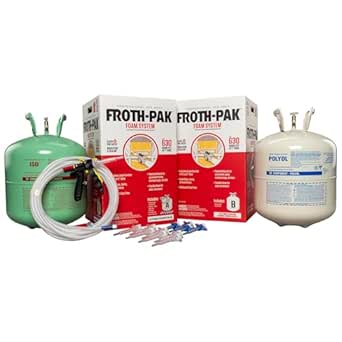 | Best for Larger Roof Projects | Foam type: Closed-cell, two-component polyurethane | Coverage: Up to 630 sq ft at 1-inch thickness | R-value: 6.2 per inch; 12.2 at 2 inches | VIEW LATEST PRICE | See Our Full Breakdown |
| Great Stuff Gaps & Cracks Insulating Foam Sealant, 12 oz, Case of 12 |  | Best Value for Repeated Small Repairs | Material: Polyurethane foam | Pack quantity: 12 cans | Can size: 12 oz | VIEW LATEST PRICE | See Our Full Breakdown |
| Magic Chems Closed-Cell Spray Foam Insulation Kit, 18-Pack, 25.4 oz |  | Best Accessory-Ready Can Kit | Foam type: Closed-cell polyurethane | Package quantity: 18 cans | Can volume: 25.4 fl oz (750 ml) each | VIEW LATEST PRICE | See Our Full Breakdown |
| Loctite Tite Foam Gaps & Cracks Spray Foam Sealant, White, 12 oz |  | Best for a Single Visible Repair | Material: Polyurethane | Can size: 12 oz | Maximum gap size: 1 inch | VIEW LATEST PRICE | See Our Full Breakdown |
| roof insulation and air sealing product | Foam type |
|---|---|
| FROTH-PAK 200 Closed-Cell Spra | Two-component closed-cell polyurethane |
| FROTH-PAK 630 Closed-Cell Spra | Two-component polyurethane spray foam |
| DAP Wall and Cavity Foam with | One-component polyurethane |
| Sthovd 9-Inch Foam Closure Str | — |
| NKYJSJLY 12-Can Closed-Cell Sp | Closed-cell polyurethane spray foam |
| FROTH-PAK 630 Closed-Cell Spra | Closed-cell, two-component polyurethane |
| Great Stuff Gaps & Cracks Insu | — |
| Magic Chems Closed-Cell Spray | Closed-cell polyurethane |
| Loctite Tite Foam Gaps & Crack | — |
More Details on Our Top Picks
FROTH-PAK 200 Closed-Cell Spray Foam Insulation Kit with 9 ft Hose
For a limited roof air-sealing job that needs more than a bead from an aerosol can, I’d choose the FROTH-PAK 200. Its two-component closed-cell foam combines insulation and air sealing, with a stated R-6.2 per inch and coverage up to 200 square feet at one inch. The nine-foot hose and mix of fan and cone nozzles give more control around roof-to-wall junctions and penetrations than the single-can DAP Wall and Cavity Foam, while the roughly 30-second cure helps keep work moving.
The tradeoff is scale: this kit is a poor match for insulating a large roof area, where the FROTH-PAK 630 offers substantially more coverage. It also takes careful preparation; PPE is not included, and the delivery requires a customer signature. I’d reserve it for targeted jobs rather than whole-roof projects.
Pros:- Combines air sealing and insulation with a stated R-6.2 per inch.
- Includes fan and cone nozzles for different application areas.
- Foam cures in about 30 seconds.
- Bonds to wood, drywall, masonry, and other listed surfaces.
Cons:- Coverage is limited to up to 200 square feet at one inch, making it less suited to large jobs than the FROTH-PAK 630.
- Required personal protective equipment is not included.
- Customer signature is required for delivery.
Best for: Homeowners or contractors sealing a modest number of roof junctions, penetrations, or other localized gaps who want closed-cell foam and multiple nozzle options.
Not ideal for: Buyers insulating a large roof area or anyone unable to supply suitable protective equipment and manage a two-component spray system.
- Foam type:Two-component closed-cell polyurethane
- Coverage:Up to 200 sq ft at 1 inch thick
- R-value:6.2 per inch; 12.2 at 2 inches
- Maximum thickness:2 inches
- Cure time:About 30 seconds
- Hose length:9 ft
- Included application parts:Applicator, hose, 4 fan nozzles, and 8 cone nozzles
- Certifications:Green Circle Certified, LEED v4 compliant, and ICC listed
Our verdict“Choose the FROTH-PAK 200 for targeted roof air sealing and insulation, not for covering a broad roof area.”
FROTH-PAK 630 Closed-Cell Spray Foam Insulation Kit
When a roof project covers more than a few isolated gaps, the FROTH-PAK 630 is the stronger fit in this group. Its stated capacity of up to 630 board feet gives it a clear scale advantage over the FROTH-PAK 200, while the closed-cell foam supplies insulation and air sealing in one application. The listed R-value is 6.2 per inch, and the foam cures in about 30 seconds. That combination suits larger runs around attic spaces, roof junctions, and building penetrations better than the single-can DAP Wall and Cavity Foam.
There are two practical catches. Protective equipment is required but not included, and the hose length is inconsistent in the supplied product details: the title says 30 feet, while the kit contents list 15 feet. I’d confirm the included hose before planning access or reach. This is more kit than a small patch needs.
Pros:- Up to 630 board feet of coverage for larger jobs.
- Provides closed-cell insulation and air sealing in one application.
- Stated R-6.2 per inch and about 30-second cure time.
- Listed as Class A fire-rated up to 2 inches thick.
Cons:- Required personal protective equipment is not included.
- Product details conflict on hose length, listing both 30 ft and 15 ft.
- Its larger capacity is unnecessary for small, isolated air-sealing repairs.
Best for: Contractors or experienced DIYers sealing multiple roof, attic, or crawl-space areas who need more foam capacity than a small kit provides.
Not ideal for: First-time users handling a small repair, or buyers who need a confirmed hose reach and do not already have suitable protective equipment.
- Foam type:Two-component polyurethane spray foam
- Coverage:Up to 630 board feet
- R-value:6.2 per inch; 12.2 at 2 inches
- Cure time:About 30 seconds
- Hose length:Conflicting listings: 30 ft in title; 15 ft in kit contents
- Included components:Part A and Part B tanks, applicator and hose assembly, 8 cone nozzles, 4 fan nozzles, petroleum jelly packet, and instructions
- Color:Off-white
Our verdict“Pick the FROTH-PAK 630 for larger roof and attic projects if you can confirm the hose length and provide your own protective equipment.”
DAP Wall and Cavity Foam with Wide Spray Applicator, 20 oz.
The DAP Wall and Cavity Foam makes the most sense when a roof-related repair is small, accessible, and better served by a one-component can than by a tank-and-hose kit. Its wide-spray applicator helps cover openings or cavities without setting up the larger FROTH-PAK 200 system, and the product is listed for areas including attics, rim joists, and crawlspaces. An aged R-value of 4.1 at one inch is useful insulation, though lower than the 6.2-per-inch figure listed for either FROTH-PAK kit.
That convenience has limits. A single 20-ounce can is not a substitute for the broader coverage of the FROTH-PAK 630, and full cure takes about four hours rather than roughly 30 seconds. I’d use it for discrete gaps, not a large roof insulation job, and follow the stated application temperature range.
Pros:- One-component aerosol format avoids the tanks and setup of the FROTH-PAK kits.
- Wide-spray applicator includes flow control.
- Listed for wall cavities, rim joists, attics, crawlspaces, and other areas.
- Class A fire-rated.
Cons:- Aged R-value of 4.1 at one inch is below the 6.2-per-inch figure listed for FROTH-PAK products.
- Single 20-ounce container is not suited to extensive roof coverage.
- Full cure takes about four hours.
Best for: DIYers sealing a few accessible attic, rim-joist, or roof-adjacent gaps who prefer a single-can applicator over a two-component kit.
Not ideal for: Buyers insulating broad roof areas, seeking higher stated R-value per inch, or needing foam to cure quickly.
- Foam type:One-component polyurethane
- Container size:20 oz
- Aged R-value:4.1 at 1 inch
- Tack-free time:7–12 minutes
- Full cure time:About 4 hours
- Application temperature:40°F to 120°F
- Applicator:Wide-spray applicator with flow control
Our verdict“Choose DAP for a few accessible air-sealing tasks, but use a higher-capacity kit for larger roof insulation work.”
Sthovd 9-Inch Foam Closure Strips for Metal Roofs, Classic Rib Profile, 10 Pack
Unlike the spray foams in this roundup, the Sthovd closure strips address a specific roofing detail: gaps where a classic-rib metal roof profile can admit drafts, rain, or snow. Their shaped polyurethane foam is intended to fit that profile, making them a more targeted weather-blocking choice than the DAP Wall and Cavity Foam, which is applied into cavities and gaps. For a compatible metal roof, a closure strip can block openings without spraying foam into the roofing assembly.
The fit is also the main limitation. These are described for a classic rib profile, so I would not assume they suit other metal panel shapes. The listed total length is only three feet, which may cover a short section rather than a full roof edge. Compared with the FROTH-PAK 200, this product is specialized and limited in reach, but simpler for its intended profile-matching task.
Pros:- Profile-specific shape is intended for classic-rib metal roofing.
- Helps block drafts, rain, and snow at compatible openings.
- Provides a targeted alternative to spraying foam into roof-profile gaps.
- Polyurethane foam is listed for metal roof insulation and weatherproofing.
Cons:- Compatibility is described for a specific roof profile.
- Listed total length is only 3 feet.
- Does not provide the broad cavity coverage of spray foam kits such as the FROTH-PAK 200.
Best for: Metal-roof owners with a classic-rib profile who need a short run of shaped foam closure to help block weather and drafts.
Not ideal for: Buyers with standing-seam or other unmatched roof profiles, or anyone needing broad insulation coverage or long runs of closure material.
- Material:Polyurethane foam
- Quantity:10 pieces
- Total length:3 ft
- Dimensions:9 in x 9 in
- Roof profile:Classic rib
- Recommended use:Metal roof insulation and weatherproofing
- UPC:730849826652
Our verdict“Choose these strips only when your metal roof has a matching classic-rib profile and the short listed length meets the job.”
NKYJSJLY 12-Can Closed-Cell Spray Foam Insulation Kit with Applicator Gun
The NKYJSJLY 12-can kit stands apart from the FROTH-PAK tank systems by using individual cans and including an applicator gun, cleaner, goggles, coverall, and gloves. That package may appeal to a DIYer who wants a collection of supplies for repeated smaller sealing jobs rather than one large two-component setup. The manufacturer states coverage up to 240 board feet and an approximate R-value of 8.24 at a two-inch layer, though actual results depend on application thickness and conditions.
Compared with the single-can DAP Wall and Cavity Foam, this kit includes more cans and application accessories; compared with the FROTH-PAK 630, its stated coverage is lower and it does not offer the same described tank capacity. The listed coverage and R-value are manufacturer claims, so I would plan conservatively and apply carefully. The kit’s 12 cans also mean more individual containers to handle during a job.
Pros:- Includes 12 cans plus an applicator gun and foam cleaner.
- Goggles, coverall, and gloves are included in the listed kit contents.
- Designed to seal gaps and provide thermal and sound insulation.
- Manufacturer states up to 240 board feet of coverage.
Cons:- Coverage and insulation performance depend on application thickness and conditions.
- The stated coverage is below the FROTH-PAK 630’s up to 630 board feet.
- Handling 12 separate cans may be less convenient than using a tank system for a continuous larger job.
Best for: DIYers tackling several small gaps or penetrations who want multiple cans, an applicator gun, cleaner, and basic protective items in one kit.
Not ideal for: Buyers covering a large roof area, relying on predictable job-wide output, or expecting included gear alone to replace a careful review of safety requirements.
- Foam type:Closed-cell polyurethane spray foam
- Number of cans:12
- Can size:30.1 oz (850 ml) each
- Stated coverage:Up to 240 board feet
- Approximate R-value:8.24 at a 2-inch layer
- Included accessories:Foam gun, foam cleaner, goggles, coverall, and gloves
- Item weight:26.6 lb
- Model number:B-12PK
Our verdict“Pick this kit for repeated smaller sealing tasks where its included accessories are useful, not for large-scale roof coverage.”
FROTH-PAK 630 Closed-Cell Spray Foam Insulation Kit with 15-Foot Hose
For broad roof-deck or attic air-sealing work, I rank the FROTH-PAK 630 ahead of can-based options because its two-component system covers up to 630 square feet at 1-inch thickness and supplies a stated R-value of 6.2 per inch. The included 15-foot hose gives more reach than the shorter-hose FROTH-PAK 200, which can reduce repositioning around a larger work area. It also cures in about 30 seconds, useful when the application plan calls for moving through sections quickly.
The tradeoff is the greater setup and safety burden: protective equipment is not included, and ventilation is required before re-entry. Its Class A fire rating applies up to 2 inches, not to every possible thickness. I’d choose it for substantial, accessible areas rather than a handful of small cracks.
Pros:- Coverage of up to 630 square feet at 1-inch thickness suits larger projects.
- Stated R-value of 6.2 per inch combines insulation with air sealing.
- 15-foot hose offers more reach than the FROTH-PAK 200’s 9-foot hose.
- Fast cure and included fan and cone nozzles support varied application areas.
Cons:- Protective equipment is required but not included.
- Occupant re-entry requires proper ventilation and a stated one-hour wait.
- Class A fire rating is specified only for applications up to 2 inches thick.
Best for: Roofing contractors or experienced DIYers insulating and air-sealing a large, accessible roof area who can supply protective equipment and manage ventilation.
Not ideal for: People sealing only a few small gaps, or anyone without the protective equipment, ventilation plan, and application experience needed for a two-component spray foam kit.
- Foam type:Closed-cell, two-component polyurethane
- Coverage:Up to 630 sq ft at 1-inch thickness
- R-value:6.2 per inch; 12.2 at 2 inches
- Hose length:15 ft
- Cure time:About 30 seconds
- Occupant re-entry:1 hour with proper ventilation
- Compatible materials:Drywall, masonry, metal, rigid foam, and wood
- Included components:Part A and Part B tanks, applicator, hose, 4 fan nozzles, 8 cone nozzles, petroleum jelly packet, and instructions
- Certifications and compliance:Green Circle Certified, LEED V4 compliant, and ICC listed
Our verdict“Choose this kit for larger roof insulation and air-sealing jobs if you can handle its safety and ventilation requirements.”
Great Stuff Gaps & Cracks Insulating Foam Sealant, 12 oz, Case of 12
I’d pick the Great Stuff Gaps & Cracks case when roof work involves many small openings rather than a continuous insulated surface. Twelve cans let a homeowner tackle several rounds of air sealing without relying on a two-component rig like the FROTH-PAK 630. The foam fills gaps up to 1 inch, adheres to common building materials, and works indoors or outdoors—useful for sealing discrete penetrations and cracks around an attic or roof assembly.
Its limits are clear: this is not a substitute for broad-area roof insulation, and each can is restricted to relatively narrow gaps. The expanding foam may need trimming after application. Compared with the single-can Loctite Tite Foam, the case is better suited to repeated repairs, but it means storing and handling more cans.
Pros:- Twelve cans provide supplies for repeated small air-sealing tasks.
- Fills gaps up to 1 inch and helps block drafts and insects.
- Adheres to wood, metal, masonry, glass, and most plastics.
- Usable indoors and outdoors, with a six-minute tack-free time and 30-minute trimming time.
Cons:- Not designed to insulate large roof areas as efficiently as a high-coverage kit.
- Limited to gaps up to 1 inch.
- Expanding foam can require trimming after application.
Best for: Homeowners sealing multiple small roof, attic, or exterior gaps over one or more repair sessions who want ready-to-use cans instead of a larger spray system.
Not ideal for: Buyers insulating a broad roof deck or filling gaps wider than 1 inch; a case of cans is less suitable than a high-coverage kit for those jobs.
- Material:Polyurethane foam
- Pack quantity:12 cans
- Can size:12 oz
- Maximum gap size:Up to 1 inch
- Compatible materials:Wood, metal, masonry, glass, and most plastics
- Use:Indoor and outdoor
- Tack-free time:6 minutes
- Trimming time:30 minutes
- Water resistance:Water resistant
Our verdict“Choose the 12-can case for repeated small-gap repairs, not for insulating a large roof surface.”
Magic Chems Closed-Cell Spray Foam Insulation Kit, 18-Pack, 25.4 oz
The Magic Chems 18-can kit sits between single-can sealants and the larger two-component FROTH-PAK 630. Its 18 cans, foam gun, cleaner, and nozzle tips make it a more equipped option for filling multiple cracks and gaps, while the included coverall, goggles, gloves, and mask reduce the need to source basic protective gear separately. The product is also described as providing thermal and acoustic insulation, so it can serve more than a draft-blocking role in smaller roof and attic tasks.
Coverage is stated as up to 360 square feet, below the FROTH-PAK 630’s 630-square-foot figure, and full cure takes 24 hours. That slower cure calls for patience before trimming or disturbing the foam. I’d favor this kit for varied, medium-scale sealing work, but not when fast turnaround or a clearly specified R-value is the priority.
Pros:- Eighteen cans and a foam gun support repeated applications.
- Includes gun cleaner, nozzle tips, and basic protective gear.
- Designed to provide thermal and acoustic insulation while sealing gaps.
- Lists compatibility with a broad range of common building materials.
Cons:- Full cure takes up to 24 hours.
- Stated coverage of up to 360 square feet is less than the FROTH-PAK 630.
- No R-value is provided in the product data.
Best for: DIYers handling multiple small-to-medium roof and attic sealing jobs who want a foam gun, cleaner, nozzle tips, and basic protective gear in one package.
Not ideal for: Buyers seeking a stated R-value, the quickest return to work, or the higher stated coverage of the FROTH-PAK 630.
- Foam type:Closed-cell polyurethane
- Package quantity:18 cans
- Can volume:25.4 fl oz (750 ml) each
- Coverage:Up to 360 sq ft
- Full cure time:24 hours
- Water resistance:Water resistant
- Compatible materials:Wood, metal, concrete, brick, PVC, OSB, drywall, and other listed surfaces
- Included accessories:Foam gun, gun cleaner, nozzle tips, coverall, goggles, nitrile gloves, safety mask, and user guide
Our verdict“Choose this kit for multi-area sealing when the included application accessories and protective gear matter more than fast curing or a published R-value.”
Loctite Tite Foam Gaps & Cracks Spray Foam Sealant, White, 12 oz
For one small roof or attic leak path, I’d choose Loctite Tite Foam over buying a multi-can case like Great Stuff Gaps & Cracks. Its single 12-ounce can is aimed at gaps up to 1 inch, and the cured foam can be sanded and painted—a useful finish option where a repair remains visible. It also resists water and UV exposure, which gives it an advantage over choosing a sealant solely for indoor cracks when the repair is exposed to outdoor conditions.
This is a focused gap-filler, not a roof-insulation system: it has no stated coverage area or R-value, and its white cured color may show against darker materials. Unlike the FROTH-PAK 630, it is easier to reserve for a small repair, but it cannot match that kit’s broad-area coverage.
Pros:- Fills and insulates gaps up to 1 inch.
- Water-resistant and resistant to UV exposure.
- Adheres to wood, metal, concrete, masonry, PVC, and drywall.
- Cured foam can be sanded and painted.
Cons:- Single 12-ounce can is suited to small repairs, not broad roof insulation.
- No coverage area or R-value is specified in the product data.
- White foam may remain visible if left unpainted.
Best for: Homeowners making a one-off repair to a visible gap up to 1 inch who want foam that can be sanded and painted after curing.
Not ideal for: Anyone insulating a large roof area, seeking a published R-value, or needing a finish that naturally blends with dark or unfinished materials.
- Material:Polyurethane
- Can size:12 oz
- Maximum gap size:1 inch
- Color:White
- Water resistance:Water resistant
- Use:Indoor and outdoor
- Compatible materials:Wood, metal, concrete, masonry, PVC, and drywall
- Finish:Can be sanded and painted after curing
- Dimensions:2.56 x 2.56 x 7.87 in
Our verdict“Choose this can for a small, visible gap repair where paintability matters more than large-area coverage.”
How We Picked
I ranked these products by how well their format and intended use match common roof insulation and air-sealing tasks: insulating larger sections, sealing isolated gaps, or closing openings specific to metal roofing. I also weighed practical factors such as kit scale, hose or applicator reach, ease of controlling the application, and the risk of buying more product than a job needs. A product designed for a narrow task can rank well for that task without being the right choice for a whole roof.
The order reflects usefulness across the widest range of roof projects first, then favors options that serve a clear, narrower need. The FROTH-PAK 630 earns the overall position for larger insulation work; the 200-size kit is a more contained alternative. The 15-foot-hose kit is differentiated by access, while can sealants and closure strips rank for targeted repairs rather than broad coverage. Product labels and project requirements should be checked before purchase, since roof assemblies, local building rules, and application conditions can change what is appropriate.
| roof insulation and air sealing product | Foam type |
|---|---|
| FROTH-PAK 200 Closed-Cell Spra | Two-component closed-cell polyurethane |
| FROTH-PAK 630 Closed-Cell Spra | Two-component polyurethane spray foam |
| DAP Wall and Cavity Foam with | One-component polyurethane |
| Sthovd 9-Inch Foam Closure Str | — |
| NKYJSJLY 12-Can Closed-Cell Sp | Closed-cell polyurethane spray foam |
| FROTH-PAK 630 Closed-Cell Spra | Closed-cell, two-component polyurethane |
| Great Stuff Gaps & Cracks Insu | — |
| Magic Chems Closed-Cell Spray | Closed-cell polyurethane |
| Loctite Tite Foam Gaps & Crack | — |
Factors to Consider When Choosing Best Roof Insulation And Air Sealing Products
Choosing roof products starts with diagnosing the job, not choosing a foam kit by size. I’d separate broad insulation work from air leaks and roof-profile gaps, then check how the proposed material fits the existing roof assembly. These factors can help prevent wasted material and problems that a larger application cannot solve.
1. Identify Whether You Need Insulation or Just an Air Seal
Air leakage and inadequate insulation can produce similar comfort complaints, but they call for different fixes. A small gap around a penetration may need sealant; a broad under-insulated area calls for a planned insulation approach. Sealing every opening without understanding the roof’s ventilation and moisture path can trap damp air or alter how the assembly dries. Check where the leak is and whether it is connected to an attic, a roof seam, or an opening around wiring or plumbing. Don’t use a handful of cans as a substitute for calculating insulation coverage across a large surface. Match the product type to the problem before estimating quantity.
2. Match Product Scale to the Job
Two-part kits are built for more substantial applications, while one-can sealants are easier to direct at small, irregular gaps. Buying more capacity than needed can leave you with unused material and a rushed application; buying too little can create inconsistent coverage across a larger project. Measure the areas to be treated and account for the shape and depth of the gaps rather than relying only on a broad surface-area estimate. A roof with many narrow penetrations may use less material than a large open section, even if the work takes longer. For a multi-stage job, check the product’s instructions on working time and reuse before planning the sequence. The right scale is the smallest format that can complete the task as directed.
3. Check Roof Assembly and Moisture Management
Foam can affect how heat and moisture move through a roof, so a product’s insulation value alone does not determine whether it belongs in a particular assembly. Roofs differ in ventilation, sheathing, existing insulation, and climate exposure. Adding an air-impermeable layer in the wrong location can limit drying and contribute to moisture problems. Before covering a large area, check local code requirements and guidance for the roof type, and seek qualified advice when the assembly is unclear. This is especially relevant when adding insulation over existing materials or applying foam directly to roof sheathing. A smaller repair product may be safer for a clearly localized gap than an unplanned full-surface application.
4. Choose Applicator Reach and Control for the Work Area
Access changes how accurately a product can be applied. A longer hose can help reach awkward areas, but it does not remove the need to prepare the surface and control the foam. Can applicators are convenient around small openings, though a wide spray pattern may be harder to manage in tight spaces. For metal roofing, profile-matched closure strips can close recurring rib-shaped gaps without asking a general foam to bridge a long, shaped opening. Consider whether you can see and reach the full seam, and whether overspray or expansion could affect nearby parts. A product that is easy to direct at the work area may reduce cleanup and missed sections.
5. Plan Safety, Preparation, and Cleanup
Spray foam application requires more preparation than many buyers expect. Read the manufacturer’s directions for protective equipment, ventilation, temperature limits, substrate preparation, and curing before opening a kit or can. Mask nearby surfaces because cured foam can be difficult to remove without damaging finishes. Arrange tools and materials first so you are not searching for supplies while the product is active. If the work involves a large roof area, difficult access, or an occupied space with limited ventilation, professional installation may be a better fit than a do-it-yourself kit. The easiest product to buy is not always the easiest one to apply safely.
6. Know When to Pay for a Specialized Solution
Paying for a larger kit makes sense when the project genuinely needs broad coverage or repeated application, not simply because a larger package appears more capable. A longer hose may be worthwhile when reach is the main obstacle; it adds less value on an open, easy-to-access surface. Profile-specific closure strips serve a distinct purpose on compatible metal roofs and may be a better fit than forcing foam into a long rib gap. For isolated cracks, a standard can may offer more control with less setup. Compare the product’s intended use with the shape, location, and extent of the repair. Specialized products earn their place when they solve a fit or access problem that general-purpose materials do not.
Frequently Asked Questions
Should I use a two-part spray foam kit or a can of foam for my roof?
Choose based on the size and shape of the work, not just the product’s insulation claims. A two-part kit is more suited to larger or repeated applications, while a can is easier to direct at a small crack or isolated penetration. Using a can across a broad roof area may be inefficient, and using a large kit for one small gap can create unnecessary setup and leftover material. Check the product instructions for the substrates and application conditions it supports. If the repair affects a large part of the roof assembly, confirm that the material is appropriate before applying it.
Can I use spray foam to seal gaps beneath a metal roof?
It depends on the gap’s location and shape. The Sthovd strips in this roundup are made for a classic rib profile, so they are a more direct match for compatible metal-roof corrugations than a general-purpose foam. Foam may suit some irregular openings, but it can be difficult to apply neatly along a long, repeated profile. Check the roof profile and the closure strip dimensions before ordering. Also confirm that the chosen method will not interfere with drainage, ventilation, or the roof manufacturer’s assembly details.
Is a longer hose worth choosing for a spray foam kit?
A longer hose can help when the work area is hard to reach or when moving the kit closer would interrupt application. It is less useful on a clear, accessible surface where a shorter hose already provides control. Reach should not be confused with coverage: a longer hose does not make a kit suitable for a larger area or fix an incorrect application plan. Compare the access route, working position, and product instructions before paying attention to hose length. For a small, easy-to-reach repair, a more compact kit may be the simpler choice.
Can I add roof spray foam over existing insulation?
Do not assume that new foam can be applied over any existing insulation. The materials and roof assembly affect adhesion, drying potential, ventilation, and how moisture behaves. Identify what is already installed and where the roof’s air and vapor control layers are before covering anything. Manufacturer instructions may also limit which substrates are suitable. If you cannot confirm that the layers are compatible, ask a qualified insulation or roofing professional before proceeding.
How do I decide how much foam to buy for roof repairs?
Start by measuring the number and size of the areas rather than estimating from the roof’s total footprint. Small, scattered leaks may be better served by individual cans, while broad, continuous work may call for a larger kit. Allow for the shape and depth of each gap, but follow the manufacturer’s coverage information instead of assuming all products expand or apply alike. Keep the work sequence in mind so the amount can be used according to the product directions. If the estimate is close, verify the coverage details and application limits before choosing a kit size.
Conclusion
For broad insulation work, I’d choose the FROTH-PAK 630 as the best overall, with the 15-foot-hose version better suited to difficult access. The FROTH-PAK 200 is my best value for smaller projects where a large kit would be excessive, while the larger multi-can kits suit buyers planning repeated, localized applications. For beginners handling a small, visible gap, a can sealant such as Great Stuff or Loctite is a more approachable format than a two-part kit, provided the product fits the job. Owners of compatible classic-rib metal roofs should look at the Sthovd closure strips for profile-shaped gaps. Before choosing any product for a large roof area, confirm that it fits the assembly and follow its application and safety instructions.