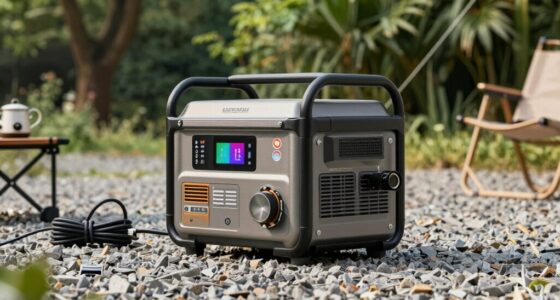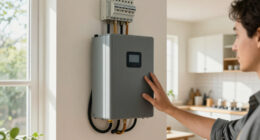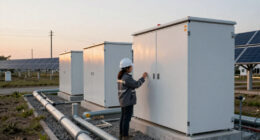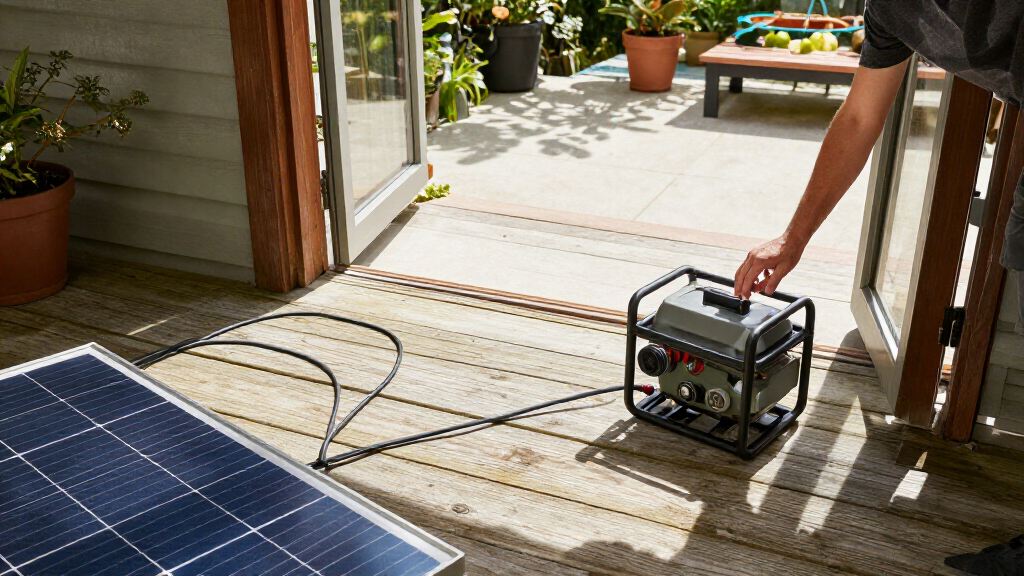
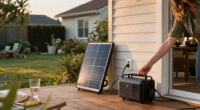
Choosing a solar-powered backup generator means deciding how much of your home needs power when the grid fails. A portable solar generator pairs a battery with an inverter and can recharge from solar panels; it is suited to essential devices, outdoor use, and short outages. A whole-home solar battery backup system is installed alongside household electrical equipment and can supply selected circuits or, when sized and configured for it, much of the home. It usually costs substantially more and may require professional installation.

Get backup power and energy gear delivered free with Prime
- Fast, free delivery on millions of items
- Prime Video, Amazon Music and more included
- Member-only deals all year

Anker SOLIX C1000 Gen 2 Portable Power Station with 200W Solar Panel
- ✔ Battery capacity: 1,024Wh
- ✔ Battery chemistry: LiFePO4
- ✔ Rated output: 2,000W

ZeroKor 300W Portable Power Station with 60W Solar Panel
- ✔ Maximum output: 300W
- ✔ Solar panel: 60W monocrystalline
- ✔ Panel conversion efficiency: 20.5%

Jackery Explorer 300 Portable Power Station, 292Wh
- ✔ Capacity: 292Wh
- ✔ Weight: 7.5 pounds
- ✔ Battery chemistry: LiFePO4
The main tradeoff is flexibility and lower upfront cost versus greater capacity and more seamless household backup. Choose a portable unit if you can prioritize a few devices and want equipment that can move with you. Choose a whole-home system if outages regularly disrupt essential household circuits and your budget and installation options support a fixed system. Neither option guarantees unlimited power: usable energy, output limits, solar conditions, and installation design determine what actually stays on.
At a Glance
| Criteria | Portable solar generator | Whole-home solar battery backup system | Winner |
|---|---|---|---|
| Upfront cost and installation | Usually lower cost; many units are ready to use with compatible panels, though larger setups cost more. | Typically a much larger investment; electrical design and professional installation are common. | A |
| Power for household loads | Best for selected devices and modest loads; inverter output and battery capacity limit what can run at once and for how long. | Can back up selected household circuits or more of the home when properly sized; simultaneous loads and outage duration still depend on capacity. | B |
| Portability and other uses | Can be moved between rooms, taken camping, or used at a work site. | Fixed installation; not suited to travel or moving between locations. | A |
| Solar recharging | Can recharge from compatible portable panels; recharge speed depends on panel capacity, sunlight, and input limits. | May recharge from rooftop solar when the system is designed to do so; performance depends on the array, controls, and conditions. | Depends |
| Outage convenience | Requires choosing and connecting devices, and managing the unit’s charge. | Can switch to backup automatically or through installed controls, depending on system design. | B |
| Expansion and integration | Some models accept extra batteries or panels, but expansion and household integration vary by product. | Can be designed around household circuits and rooftop solar; adding capacity depends on equipment compatibility and installation. | B |
| Best fit | Short outages, renters, essential-device backup, and users who value mobility. | Frequent outages, larger household loads, and owners seeking integrated home backup. | Depends |
Anker SOLIX C1000 Gen 2 Portable Power Station with 200W Solar Panel
The Anker SOLIX C1000 Gen 2 is the clear step-up pick in this group. Its 1,024Wh LiFePO4 battery and 2,000W rated output give it substantially more room to support multiple devices or more demanding equipment than either 300W-class alternative. The under-10-ms UPS switchover also makes it the only listed model specifically positioned for keeping sensitive equipment connected through a brief power interruption.Solar capability is strong on paper: the station can accept up to 600W of solar input, and a 200W bifacial panel is included. That gives the owner a path to expand solar input with compatible panels, but the included panel does not use the unit’s full input capacity. The station and panel ship separately, so the setup may not arrive as one complete package. At 24.9 pounds, it is portable in the sense that it can be moved, but it is less convenient to carry routinely than the 7.5-pound Jackery.We rank it first because no other option here offers comparable capacity, output, or UPS functionality. It is the most suitable choice when backup needs extend beyond phones and small electronics. Still, its panel arrangement and weight matter: choose the ZeroKor if compact outdoor use and an included starter panel matter more than power, or the Jackery if low carry weight is the priority.
Pros:
- 1,024Wh LiFePO4 battery offers far more stored energy than the two compact alternatives.
- 2,000W rated output and nine ports support a broader mix of equipment.
- Accepts up to 600W solar input and includes a 200W bifacial panel.
- UPS switchover under 10 ms can help keep connected equipment powered during brief outages.
Cons:
- At 24.9 pounds, it is less convenient to carry than the Jackery Explorer 300.
- The included 200W panel is below the station’s 600W maximum solar input.
- Power station and solar panel ship separately.
Best for: Households that need a portable backup source for a wider mix of devices and value UPS switchover and higher output.
Not ideal for: Buyers who need a very light station, a fully self-contained single shipment, or only a small power source for basic electronics.
Bottom line: Choose the Anker when backup capacity and output matter more than carrying weight or a single-package solar setup.
“Choose the Anker when backup capacity and output matter more than carrying weight or a single-package solar setup.”
ZeroKor 300W Portable Power Station with 60W Solar Panel
The ZeroKor 300W stands out for including a 60W monocrystalline solar panel with the power station. That makes it the most immediately solar-ready choice in this roundup: buyers do not need to find a compatible panel before trying solar recharging. Its multiple AC, USB, and DC connections also make it practical for phones, lights, and other modest electronics at a campsite or during a short outage.Its limit is clear in the name: 300W maximum output keeps this in the small-load category. The Anker can handle a much broader range of equipment, and the Jackery also offers 300W rated output with a 292Wh battery and lighter body. The ZeroKor’s supplied details do not state battery capacity, making runtime comparisons difficult. Solar convenience comes with a care requirement, too: the panel junction box is not waterproof and must be kept dry.For a buyer who wants a panel included and expects to power smaller devices, this is the most straightforward package. It has built-in protections and a temperature-controlled fan, but the instructions recommend keeping the battery around 60–80% for storage and avoiding long periods without charging. Pick the Jackery if its specified 292Wh capacity and light weight are more important than receiving a panel in the box.
Pros:
- Includes a 60W monocrystalline solar panel with 20.5% stated conversion efficiency.
- Offers AC, USB, and DC connections for a variety of small devices.
- Can recharge from an AC outlet, a 12V car outlet, or a compatible solar panel.
- Includes short-circuit, over-current, over-voltage, overload, and overheating protection.
Cons:
- 300W maximum output rules out many higher-power appliances.
- The solar panel junction box must be kept dry.
- Storage guidance calls for maintaining the battery at 60–80% and avoiding prolonged periods without charging.
Best for: Campers and occasional outage planners who want an included solar panel for charging small electronics and lights.
Not ideal for: Anyone planning to run higher-power appliances, seeking a clearly specified battery capacity, or leaving the solar panel exposed to wet conditions.
Bottom line: Choose the ZeroKor for an included starter panel and modest loads, provided its 300W ceiling and panel care requirements fit your plans.
“Choose the ZeroKor for an included starter panel and modest loads, provided its 300W ceiling and panel care requirements fit your plans.”
Jackery Explorer 300 Portable Power Station, 292Wh
At 7.5 pounds, the Jackery Explorer 300 is the easiest of these three stations to carry between a car, campsite, and home. Its 292Wh battery, two AC outlets, USB-A and USB-C ports, and 120W car port make it a defined compact option for smaller devices. Compared with the ZeroKor, its stated capacity helps buyers estimate stored energy more clearly, but it does not include a solar panel.The Jackery’s LiFePO4 battery is rated for over 4,000 charge cycles before reaching 70% capacity, which may appeal to buyers expecting regular use over time. It offers 300W rated output and 600W peak output, so it remains in the same broad power class as the ZeroKor rather than challenging the Anker’s 2,000W rating. Solar charging is supported, with stated charge times depending on panel size, but the compatible panel is an additional piece to source.This is our compact pick for someone who values a low carry weight and wants a clearly specified 292Wh capacity. It is less convenient as an out-of-the-box solar kit than the ZeroKor, and it cannot match the Anker for backup range. Buyers should choose it for portability and modest loads, not as a substitute for a higher-capacity home backup system.
Pros:
- At 7.5 pounds, it is the lightest station in this comparison.
- 292Wh capacity and six-device connectivity are clearly specified.
- LiFePO4 battery is rated for over 4,000 cycles before reaching 70% capacity.
- Supports solar charging and includes USB-C PD up to 100W.
Cons:
- Solar panel is not included, unlike the ZeroKor and Anker packages.
- 300W rated output limits use with higher-power devices.
- Its 292Wh capacity is far below the Anker’s 1,024Wh.
Best for: People who want a light, clearly specified 292Wh station for travel, camping, or short backup needs and can arrange a compatible solar panel separately.
Not ideal for: Buyers who want a solar panel included, need more than 300W rated output, or want substantial home backup capacity.
Bottom line: Choose the Jackery when easy carrying and a defined compact capacity matter more than an included panel or broader backup capability.
“Choose the Jackery when easy carrying and a defined compact capacity matter more than an included panel or broader backup capability.”
As an Amazon Associate we earn from qualifying purchases.
Key Differences
The largest practical difference is the boundary of the backup. A portable unit powers devices plugged into its outlets, so you decide what matters and may need to unplug or rotate loads. A home battery system can feed circuits through installed equipment, making it easier to keep chosen parts of the house operating. That does not mean every whole-home system can run every appliance: air conditioning, electric heating, ovens, and other high-draw loads can exceed a system’s output or drain its stored energy quickly.
Cost and control pull in opposite directions. Portable generators usually offer a lower-cost way to cover phones, lights, routers, and selected small appliances, and they can serve beyond the home. A fixed battery system costs more but can reduce setup during outages and connect with rooftop solar if designed for it. Paying the premium makes sense when household coverage and automatic operation matter enough to justify installation; it is poor value if the actual need is a few hours of power for a small set of devices.
Solar charging is useful for both, but neither creates dependable energy from panels alone in every situation. Panel output varies with weather, season, placement, and daylight, while the battery has finite storage. Buyers should match storage and inverter output to specific loads and outage duration, then check charging compatibility and installation requirements. For many households, a portable unit is the sensible first step; a whole-home system is justified when outages are frequent or the loads at stake are difficult to manage individually.
Detailed Comparison
Upfront cost and installation (Portable solar generator wins — major)
Portable unit wins; the gap is major. It generally costs less and can be used without household electrical work, although larger battery packs and panels add expense. A whole-home setup involves a larger equipment and installation bill. The practical question is whether household integration is worth paying a substantial premium for.
Power for household loads (Whole-home solar battery backup system wins — major)
Whole-home system wins for breadth; the gap is major when sized appropriately. It can serve installed circuits and support more simultaneous household use. A portable generator is better treated as a power source for selected devices; its outlets, inverter rating, and stored energy set firm limits. A home system still needs careful sizing and may not sustain high-load appliances for long.
Portability and other uses (Portable solar generator wins — major)
Portable unit wins; the gap is major. It can be carried to where power is needed and used away from home, which a fixed battery cannot do. That mobility also means the owner handles placement, connections, and load choices during an outage.
Solar recharging (moderate difference)
Depends on the equipment and conditions; no universal winner. Both can accept solar charging when paired with compatible hardware. A whole-home system may use rooftop panels through its installed controls, while portable models can be paired with movable panels. Actual recharge time depends on sunlight, panel capacity, and system input limits, so buyers should compare specifications for their expected conditions.
Outage convenience (Whole-home solar battery backup system wins — moderate)
Whole-home system wins; the gap is moderate to major. Installed controls can supply selected circuits automatically, depending on the design. A portable unit requires the user to connect devices and monitor remaining charge. For someone comfortable rationing power, that is manageable; for a household seeking less hands-on backup, the fixed system is more convenient.
Expansion and integration (Whole-home solar battery backup system wins — moderate)
Whole-home system generally wins; the gap is moderate. It can be designed to work with selected circuits and rooftop solar, though adding storage later depends on compatibility. Some portable models also support extra batteries or panels, but the available expansion and household connection options differ widely. Confirm the specific equipment’s limits before treating expansion as guaranteed.
Best fit by household need (major difference)
Depends on the outage and the user. Portable equipment is the stronger fit for modest loads, mobility, or a limited budget. A fixed battery is better for frequent outages and households that need selected circuits kept on with less manual setup. The deciding factor is not the label but the loads, runtime, and installation the buyer actually needs.
Portable solar generator: Pros and Cons
Pros:
- Lower entry cost for essential-device backup.
- Portable for home, travel, or outdoor use.
- Can be paired with compatible solar panels without integrating into the house wiring.
Cons:
- Limited output and stored energy restrict simultaneous loads and runtime.
- Users must connect devices and manage power during an outage.
- Solar recharge speed depends on panel size, sunlight, and unit input limits.
Whole-home solar battery backup system: Pros and Cons
Pros:
- Can supply selected household circuits with less hands-on setup.
- Can be designed to integrate with rooftop solar.
- Offers more household coverage when capacity and output are sized for the intended loads.
Cons:
- Higher purchase and installation cost.
- Fixed in place and unsuitable for travel.
- Does not automatically mean every appliance can run or that backup will last through a long outage.
Who Should Choose What
Choose Portable solar generator if:
- You mainly need phones, lights, internet equipment, and a few modest loads.
- You rent, move often, or want backup power for travel as well as home.
- You prefer a lower-cost system and are willing to prioritize and connect devices yourself.
Choose Whole-home solar battery backup system if:
- Outages are frequent and keeping selected household circuits available matters.
- You own the property and want installed backup with less manual setup.
- You have rooftop solar or plan a compatible system and can justify the higher installed cost.
Skip both if: Skip both if you need uninterrupted operation of high-demand equipment for long outages but have not confirmed the required inverter output, battery capacity, solar input, and installation design. Size a system around those loads first.
Value for Money
A portable solar generator is usually better value when the goal is a defined set of essential devices. It avoids paying for fixed household integration and can be useful outside outage situations. The value falls if its capacity is too small for the loads you intend to run or if you need to buy substantial extra batteries and panels to meet those needs.
Pay more for a whole-home battery system when automatic or circuit-level backup has real value for your household, outages are common, or moving power manually is impractical. The premium pays for capacity, installed controls, and integration, not unlimited runtime. Compare the complete installed cost, the circuits covered, usable storage, output rating, and solar compatibility. If you only need a router, lighting, and device charging, the whole-home premium is unlikely to pay off.
Final Verdict
For most buyers seeking basic outage coverage, choose a portable solar generator: it costs less, handles essential devices, and remains useful away from home. Choose a whole-home battery system when you own the property, outages are frequent, and keeping selected circuits running with less manual work is worth a much larger investment. The biggest deciding factor is the household load you need to support, for how long. Check capacity and inverter output against real appliances before buying; solar charging cannot make an undersized battery perform like a larger one.
Frequently Asked Questions
Can a portable solar generator power a refrigerator?
Possibly, if its inverter can handle the refrigerator’s startup demand and its battery can supply the energy needed for the desired runtime. Check both ratings and account for other devices drawing power at the same time.
Does a whole-home battery keep the entire house running?
Not automatically. The installer may configure only selected circuits, and high-demand appliances can exceed output limits or use stored energy quickly. Confirm which circuits are backed up and what loads can run together.
Can either system recharge during a power outage?
Yes, if compatible solar panels are available and conditions allow. Cloud cover, short winter days, panel placement, and equipment input limits affect how much energy can be collected. Solar charging may not keep pace with household use.
Is a solar generator the same as a fuel-powered generator?
The term usually refers to a battery power station paired with solar panels. It stores energy and supplies power through an inverter; it does not burn fuel. Its runtime depends on stored energy and recharging, rather than a fuel tank.