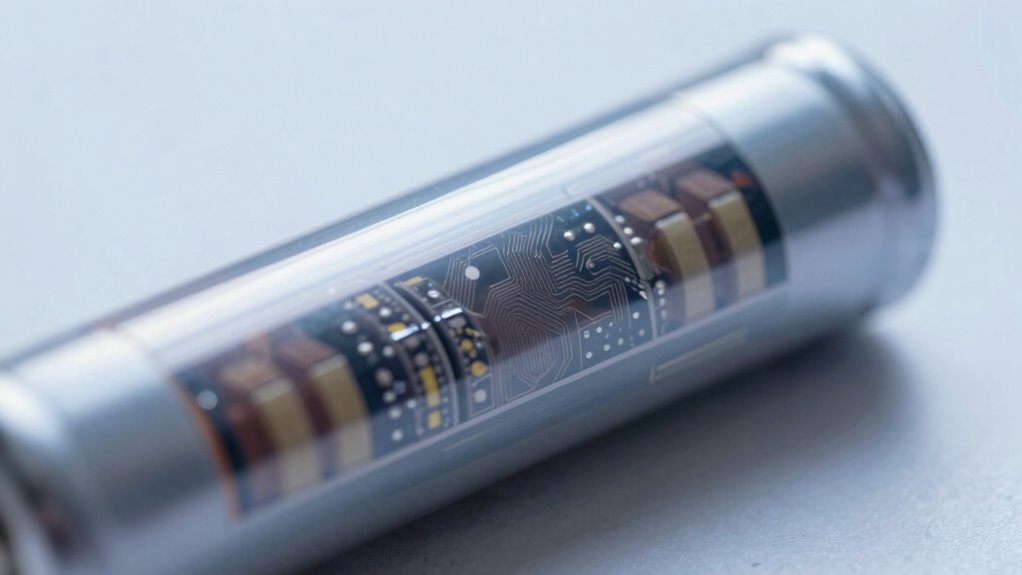

Your C-Rate plays a hidden but essential role in how well your battery performs. It measures how fast your battery charges or discharges relative to its capacity, impacting speed, safety, and lifespan. High C-Rates can boost power delivery but risk overheating or damage if not managed properly. Different chemistries respond uniquely, making proper protocols and systems critical. Keep exploring to discover how balancing these factors can maximize your battery’s potential and longevity.
Listen free for 30 days with Audible
Thousands of audiobooks and originals — cancel anytime.
As an affiliate, we earn on qualifying purchases.
Key Takeaways
- C-Rate determines how quickly a battery charges or discharges, directly impacting performance and efficiency.
- Different chemistries respond uniquely to C-Rate variations, affecting capacity and stability.
- Proper C-Rate management, via protocols and BMS, prevents overheating and prolongs battery lifespan.
- High C-Rates enable rapid power delivery but can accelerate degradation if not properly controlled.
- Balancing C-Rate with chemistry and safety protocols optimizes battery performance and longevity.

Have you ever wondered how quickly a battery can deliver its energy? The answer lies in understanding the concept of C-Rate, a key factor influencing battery performance. C-Rate essentially measures how fast a battery charges or discharges relative to its capacity. For example, a 1C rate means the battery discharges its entire capacity in one hour, while a 2C rate does so in half an hour. This measurement helps you determine whether a battery can meet your power demands efficiently without risking damage or reducing lifespan. The C-Rate doesn’t just impact how quickly you get energy out; it also interacts with the battery’s chemistry, affecting overall performance and longevity. Different battery chemistries respond uniquely to high or low C-Rates, so understanding this relationship is critical for optimizing usage. Lithium-ion batteries, for example, can handle higher C-Rates better than some older chemistries, making them suitable for applications requiring rapid charging or high power output. Your choice of battery chemistry influences how well it maintains capacity and stability under various C-Rate conditions, which is why selecting the right chemistry is indispensable for your specific needs. Additionally, understanding the interaction between C-Rate and chemistry can help extend the overall lifespan of your batteries. Proper charging protocols play an important role here as well. Proper charging techniques can allow you to safely push a battery to higher C-Rates without compromising its health. For instance, manufacturers often specify recommended C-Rates for different applications to prevent overheating and ensure safety. Fast-charging protocols are designed to increase the C-Rate temporarily, but they come with strict guidelines to prevent overheating or over-stressing the cells. If you ignore recommended charging protocols, you risk damaging the battery, shortening its lifespan, or even causing safety hazards. Proper battery management systems can help monitor and control C-Rate limits, ensuring safe operation. Conversely, adhering to appropriate charging protocols ensures the battery can sustain higher C-Rates when needed, providing rapid power delivery without sacrificing long-term performance. It’s not just about how fast you charge or discharge; it’s about balancing speed with the battery’s chemistry and design to maximize efficiency and lifespan.
As an affiliate, we earn on qualifying purchases.
Frequently Asked Questions
How Does C-Rate Affect Battery Lifespan Over Time?
Higher c-rates accelerate battery degradation because they cause increased heat and stress during charging and discharging cycles. Your usage patterns play an essential role—frequently charging or discharging at high rates shortens your battery’s lifespan. To maximize longevity, it’s best to use lower c-rates when possible, reducing stress and heat buildup, which helps slow down battery degradation over time.
What Is the Optimal C-Rate for Different Battery Chemistries?
Ever wondered what the ideal C-rate is for different chemistries? For lithium-ion batteries, staying around 1C balances performance with electrode degradation and electrolyte stability. Fast charging at higher C-rates accelerates electrode wear, while too low C-rates may underutilize the battery’s capacity. For other chemistries like lithium-polymer or solid-state, lower C-rates often preserve longevity by minimizing stress on electrode materials and maintaining electrolyte integrity.
Can C-Rate Influence Battery Safety and Thermal Management?
Yes, c-rate can influence battery safety and thermal management. Higher c-rates generate more heat, increasing the risk of thermal runaway if not properly managed. You need to follow safety protocols, like effective cooling systems and strict charging limits, to prevent overheating. Managing c-rate is vital for maintaining safe operation and avoiding dangerous situations caused by excessive heat buildup within the battery.
How Does C-Rate Impact Charging and Discharging Efficiency?
You notice your battery charges faster, but at high c-rates, charging speed sacrifices performance, leading to potential heat buildup. Conversely, during discharging, a high c-rate may cause instability, reducing energy transfer effectiveness. Balancing c-rate ensures ideal charging speed without compromising discharging stability. When you manage c-rate wisely, your battery performs more reliably, delivering faster charge times and stable discharges, ultimately enhancing overall efficiency and lifespan.
Are There Industry Standards for C-Rate Testing Protocols?
Yes, industry standards exist for c-rate testing protocols to evaluate battery capacity and longevity. Organizations like IEC and UL set specific guidelines, guaranteeing consistent testing of charge cycles and performance at various c-rates. These standards help you compare battery performance reliably, assess how different c-rates affect capacity over time, and optimize battery usage for longevity and efficiency. Following these protocols ensures your batteries meet safety and performance benchmarks.
As an affiliate, we earn on qualifying purchases.
Conclusion
Understanding the C-rate isn’t just about numbers; it’s about revealing the full potential of your battery. When you grasp its hidden role, you’re empowered to make smarter choices, ensuring your device runs longer and performs better. Don’t let the unseen factors hold you back—embrace the knowledge that can transform your experience. After all, isn’t it worth knowing the secret that keeps your world moving smoothly? The power is in your hands—literally.
battery management system for lithium batteries
As an affiliate, we earn on qualifying purchases.
As an affiliate, we earn on qualifying purchases.
high C-rate rechargeable batteries
As an affiliate, we earn on qualifying purchases.
As an affiliate, we earn on qualifying purchases.
NFL season / tailgating Picks
team gear
As an affiliate, we earn on qualifying purchases.