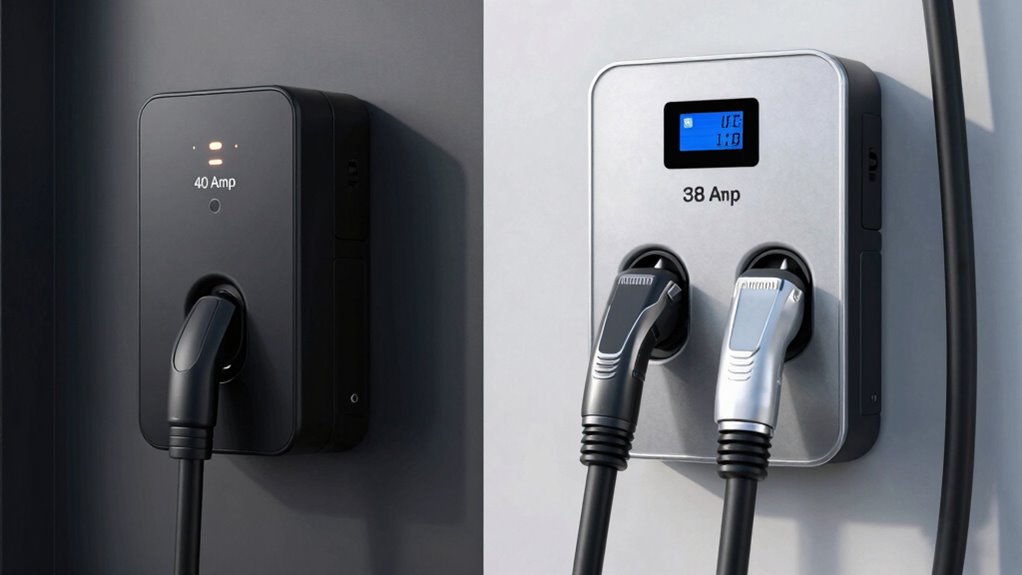

A 40 amp EV charging setup offers steady, reliable power suitable for most residential needs, using a 50-amp circuit breaker and standard wiring. In contrast, a 48 amp system provides faster charging by delivering more power and requires a 60-amp breaker with possibly heavier wiring. While the 48 amp setup is ideal for quick top-offs or larger daily driving ranges, it can involve higher installation costs and upgrades. Keep exploring to discover which option best fits your electrical capacity and future needs.

Get backup power and energy gear delivered free — and shop member deals
- Fast, free delivery on millions of items
- Access to Prime Big Deal Days deals on October 6–7
- Prime Video, Amazon Music and more included
Key Takeaways
- 48 amp chargers deliver faster charging speeds than 40 amp chargers, reducing overall charging time.
- 48 amp setups require a 60-amp circuit breaker and potentially heavier wiring, unlike 40 amp systems that use a 50-amp breaker.
- 40 amp chargers are simpler and less costly to install, while 48 amp setups may need electrical panel upgrades.
- 40 amp chargers are compatible with standard outlets, whereas 48 amp chargers need dedicated circuits for higher current.
- Upgrading to 48 amp can future-proof electrical infrastructure but involves increased installation complexity and cost.

When choosing an EV charging setup, understanding the differences between 40 amp and 48 amp systems is essential, especially since they impact charging speed and compatibility. These amperage options determine how quickly your vehicle charges and what kind of electrical setup you’ll need for installation. The main difference lies in their charging speeds: a 48 amp charger can deliver power faster than a 40 amp charger, reducing your overall charging time. This is particularly beneficial if you need to top off your EV quickly or have a longer daily driving range. However, the increased charging speed doesn’t come without considerations, especially regarding installation requirements.
Choosing between 40 amp and 48 amp EV chargers affects charging speed and installation needs.
A 40 amp charging system generally provides a steady, reliable charge suitable for most residential needs. It’s compatible with standard 240-volt outlets and doesn’t demand substantial upgrades to your electrical system. If your home’s electrical panel is relatively modern and has sufficient capacity, installing a 40 amp charger can be straightforward and less costly. On the other hand, a 48 amp setup pushes more current into your vehicle, requiring a dedicated circuit capable of handling higher loads. This often means upgrading your electrical panel or wiring, which can add to the installation costs and complexity. Additionally, understanding electrical infrastructure can help ensure your electrical infrastructure is prepared for future upgrades or additional home office needs. Moreover, considering electrical capacity can help you plan for potential future electrical demands, ensuring your system remains efficient and safe.
The installation requirements are crucial to consider. A 40 amp system typically needs a 50-amp circuit breaker, which is common in many homes. You might need minor adjustments but generally won’t face significant electrical upgrades. Conversely, a 48 amp system usually requires a 60-amp circuit breaker, and your wiring might need to be heavier gauge to safely carry the increased current. These upgrades ensure safety and compliance with electrical codes but can increase the installation timeline and expense. Furthermore, considering future expandability can be advantageous when planning your electrical upgrades, especially if you anticipate adding more electrical loads later. Being aware of power capacity and how it aligns with your household’s current and future needs is vital for a seamless setup. Despite the differences, both setups need proper grounding and adherence to local electrical codes. It’s advisable to have a certified electrician evaluate your home’s wiring before choosing either system. Remember, the faster charging offered by the 48 amp setup is a clear advantage if your household can support it, but it’s essential to weigh this benefit against the potential increase in installation requirements.
As an affiliate, we earn on qualifying purchases.
Frequently Asked Questions
Can a 40 Amp Charger Handle High-Speed Charging?
A 40 amp charger can handle high-speed charging, but its power capacity is lower than that of a 48 amp setup. When using a charging station with a 40 amp capacity, you’ll experience faster charging than standard levels, but it won’t be as quick as a 48 amp station. Your vehicle’s compatibility and the station’s power capacity determine the charging speed, so make certain both match your needs for peak performance.
Are 48 Amp Setups Compatible With All Electric Vehicle Models?
A 48 amp setup isn’t compatible with all electric vehicle models because vehicle compatibility depends on the charging station standards and your car’s charging capabilities. Some EVs may require specific connectors or maximum amperage limits, so it’s essential to check your vehicle’s specifications. Before installation, verify that your EV supports 48 amp charging and confirm the charging station meets the necessary standards for safe and efficient charging.
Do Higher Amperage Setups Require Special Wiring or Circuit Breakers?
Yes, higher amperage setups like 48 amps typically require special wiring requirements and circuit breaker specifications. You’ll need thicker wiring to handle the increased current safely and a compatible circuit breaker that can support the higher load. It’s essential to follow local electrical codes and consult a professional electrician to guarantee proper wiring and breaker specifications, preventing potential overloads or safety hazards during charging.
How Does Charging Speed Differ Between 40 Amp and 48 Amp Setups?
You’ll notice that charging speed is faster with a 48 amp setup compared to a 40 amp one, as it delivers more power to your vehicle. This means quicker charging times when your charger is compatible with higher amperages. Keep in mind, higher amperage setups also enhance power efficiency, but make sure your vehicle and wiring are compatible to maximize benefits without risking safety.
Is There a Cost Difference Between Installing 40 Amp and 48 Amp Chargers?
Cost-conscious consumers commonly confront compatibility concerns and installation costs when choosing between 40 amp and 48 amp chargers. Generally, you’ll find that installing a 48 amp setup tends to be pricier due to increased electrical requirements and potential upgrades. However, the difference isn’t drastic. You should weigh the higher installation costs against faster charging benefits, ensuring your electrical system can handle the higher amperage to avoid compatibility concerns.
As an affiliate, we earn on qualifying purchases.
Conclusion
Imagine plugging into a charger that feels like a gentle stream, steadily refilling your car’s energy. Whether it’s 40 amps or 48 amps, each setup is like a different flow of power—one a calm river, the other a lively creek. Your choice shapes your journey, fueling your adventures and dreams. So, pick the one that best fits your pace, and let your electric vehicle carry you smoothly down the road, energized and ready for whatever’s ahead.
As an affiliate, we earn on qualifying purchases.
As an affiliate, we earn on qualifying purchases.
Fall Picks
fall essentials
As an affiliate, we earn on qualifying purchases.