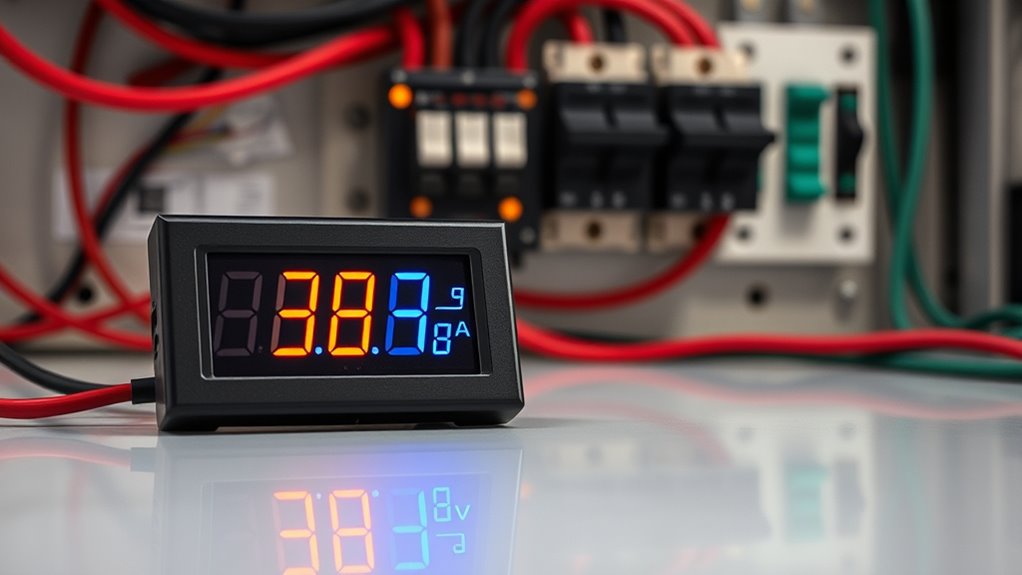
To calculate the load for a 50A EV circuit, start with the charger’s power requirements, typically around 40A for a standard Level 2 charger. Apply the NEC guideline of 125%, which means sizing the breaker around 50A to handle continuous loads safely. Remember to include other electrical loads like lighting and outlets, and consider factors like power factor and efficiency. If you want to guarantee your setup is accurate and compliant, keep exploring this topic further.
Key Takeaways
- Calculate the EV charger’s continuous load at 125% per NEC guidelines, typically around 50A for a 40A charger.
- Include other electrical loads such as lighting and outlets to determine total circuit demand.
- Consider the charger’s power factor and efficiency to refine current and load estimates.
- Ensure the total load does not exceed the 50A circuit capacity, possibly adjusting or redistributing loads.
- Incorporate safety margins for future load increases and use manufacturer specifications for accurate calculations.
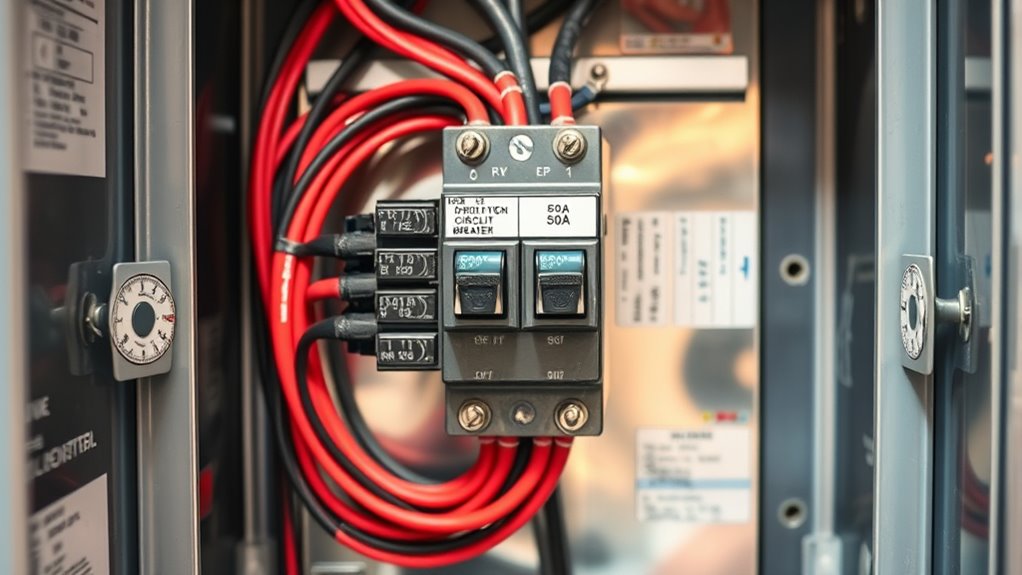
When designing a 50A EV circuit, accurate load calculations are crucial to guarantee safety and compliance with electrical codes. One of the key aspects to consider is the charging station efficiency, as it directly impacts the overall load you’ll need to accommodate. An efficient charging station minimizes energy waste, but it still draws substantial current, which must be correctly accounted for to prevent overloads. By understanding the typical power draw of your EV charger, you can better estimate the total load and ensure your circuit is properly sized.
Proper load calculations help you determine the appropriate circuit breaker size, ensuring your setup can handle peak demands without nuisance tripping or, worse, risking electrical hazards. For a 50A circuit, you generally choose a breaker rated close to that capacity, but you need to consider the continuous load the charger will draw. Since the National Electrical Code (NEC) recommends sizing circuit breakers at 125% of continuous loads, if your charger is rated at 40A, you’d multiply that by 1.25, resulting in a breaker size of around 50A. This calculation guarantees the breaker can handle sustained current without tripping unnecessarily, maintaining both safety and functionality.
Proper load calculations ensure your breaker handles continuous EV charger demands safely and reliably.
When calculating the load, don’t forget to factor in other potential electrical loads on the same circuit, such as lighting or outlets, which could influence the total demand. Add these loads together with the EV charger’s estimated power draw to get a complete picture of what your circuit must support. If your total exceeds the 50A capacity, you’ll need to either upgrade your wiring and breaker or distribute the load across multiple circuits. Remember, overloading a circuit can lead to overheating or electrical fires, so precision in these calculations is essential.
Incorporating charging station efficiency into your load calculations also means considering the charger’s power factor—how effectively it uses electricity—which can affect the actual current draw. Some chargers operate more efficiently than others, slightly reducing the load on your circuit. Using manufacturer specifications and electrical standards, you can refine your calculations to reflect real-world conditions more accurately. Additionally, understanding the contrast ratio and how it impacts image quality in related applications can be useful in comprehensive electrical system planning for multimedia setups.
Ultimately, correct load calculations and appropriate circuit breaker sizing are the backbone of a safe, reliable EV charging setup. They help you avoid unnecessary trips, reduce wear on electrical components, and ensure your charging station performs optimally. By carefully evaluating your total load and factoring in charging station efficiency, you create a safer, more efficient electrical environment that supports your EV needs now and into the future.
Frequently Asked Questions
Can I Install a 50A EV Circuit Outdoors?
Yes, you can install a 50A EV circuit outdoors, but you’ll need to make certain it’s properly protected. Use a weatherproof enclosure to shield your electrical components from the elements and run weatherproof wiring to prevent damage from moisture. Proper grounding and following local electrical codes are essential. By doing so, your outdoor installation will be safe, durable, and compliant with electrical standards, ensuring reliable charging for your EV.
What Safety Precautions Are Needed for High-Amperage EV Circuits?
Think of your high-amperage EV circuit as a powerful river that needs careful guarding. You must install ground fault protection to prevent shocks and ensure safety. Overcurrent protection devices, like circuit breakers, act as dams, stopping surges before they cause damage. Always verify proper grounding, avoid exposed wiring, and use outdoor-rated equipment. These precautions maintain your circuit safe, reliable, and ready to handle the surge of power.
How Does Ambient Temperature Affect Load Calculations?
Ambient impact and temperature fluctuations directly influence your load calculations because higher temperatures can diminish conductor capacity, causing potential overheating. When temperatures vary, you need to adjust your calculations to account for the reduced capacity in hot conditions and increased capacity during cooler periods. This ensures your EV circuit remains safe and compliant, preventing overloads and maintaining reliable performance despite changing ambient temperatures.
Can I Use a Standard Breaker for a 50A Circuit?
You can’t just use any standard breaker for a 50A circuit; breaker compatibility and load distribution are essential. Make sure the breaker is rated for 50 amps and designed for EV circuits to prevent overloads or trips. Using an incorrect breaker risks safety and code violations. Always verify the breaker’s specifications match your load requirements, and consult local electrical codes to guarantee proper load distribution and protection.
What Are the Code Requirements for EV Circuit Grounding?
You need to follow the grounding requirements outlined in the NEC to guarantee code compliance for your EV circuit. This includes properly grounding the EV charging station using a grounding conductor and ensuring the circuit is equipped with an approved grounding electrode system. Proper grounding helps prevent electrical shock hazards and protects your system. Always verify that your installation meets local code requirements and manufacturer instructions for safety and compliance.
Conclusion
Understanding the load calculations for a 50A EV circuit is like mapping out the heartbeat of your charging station. By accurately evaluating your electrical needs, you ensure smooth and safe operation, avoiding surprises down the line. Remember, proper calculations are the compass guiding you through the electrical landscape, preventing overloads and ensuring reliability. With this knowledge, you’re not just installing a circuit—you’re laying a solid foundation for reliable electric vehicle charging.