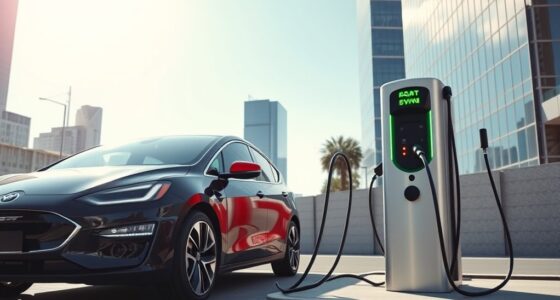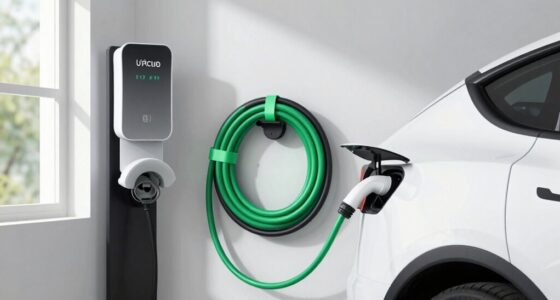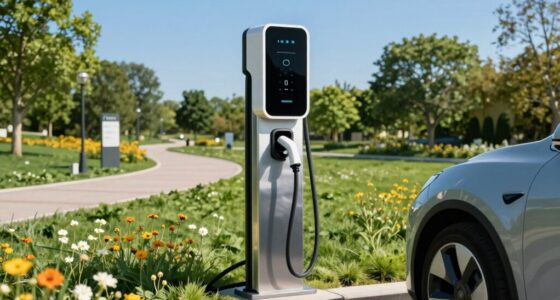
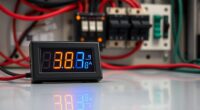
To accurately calculate your home charging costs, start by finding your vehicle’s energy efficiency in kWh per mile. Multiply the miles you plan to drive by that number to estimate total kWh needed. Then, check your utility’s electricity rate, considering any time-of-use rates to find the true cost per session. By understanding your vehicle’s efficiency and rate variations, you can better manage your charging expenses—discover more tips to optimize your charging routine.

Get backup power and energy gear delivered free — and shop member deals
- Fast, free delivery on millions of items
- Access to Prime Big Deal Days deals on October 6–7
- Prime Video, Amazon Music and more included
Key Takeaways
- Calculate your vehicle’s energy consumption per mile using its efficiency (kWh/mile) to estimate actual charging costs.
- Determine your utility’s current electricity rates, especially off-peak vs. peak, for accurate cost calculations.
- Multiply the vehicle’s energy use (kWh) by your local rate to find the true cost of a full charge.
- Monitor your charging habits and vehicle efficiency regularly to refine your actual energy expenditure.
- Use tools or utility plans that favor off-peak rates to minimize the kWh cost you actually pay during charging.

Charging your electric vehicle at home can be a convenient and cost-effective way to keep your car ready for the road, but understanding the true costs involved is essential. One of the most important factors to evaluate is how much energy your vehicle actually consumes during charging. This depends on your car’s battery efficiency, which determines how effectively it converts electrical energy into stored power. If your vehicle has a high battery efficiency, you’ll get more miles per kilowatt-hour (kWh), meaning you use less energy to reach your desired range. Conversely, lower efficiency results in higher energy consumption, increasing your overall charging cost. Knowing your vehicle’s efficiency helps you estimate the true energy costs and avoid surprises on your electricity bill.
Another key element is your energy tariffs, which can vary considerably depending on your utility provider and the time of day. Many energy providers offer different rates for peak and off-peak hours. Charging during off-peak times can save you money, especially if your tariff is lower during these periods. To make the most of your home charging, it’s wise to review your energy plan and consider scheduling your charging sessions accordingly. Some utilities also offer specialized EV rates, which can further reduce costs. Always check the specifics of your energy tariffs so you understand exactly what you’re paying per kWh. This knowledge empowers you to optimize your charging schedule and reduce expenses. Additionally, understanding energy consumption patterns can help you identify the most cost-efficient times to charge. Regularly monitoring your consumption can help you fine-tune your estimates and ensure you’re not overpaying.
As an affiliate, we earn on qualifying purchases.
Frequently Asked Questions
How Does Time-Of-Use Pricing Affect Charging Costs?
Time-of-use rates substantially impact your charging costs by charging more during peak hour pricing and less during off-peak times. When you charge your EV during off-peak hours, you save money because electricity is cheaper. If you charge during peak hours, costs increase due to higher rates. Planning your charging schedule around these rates helps you reduce expenses and makes your home charging more economical.
Are There Incentives for Installing Home Chargers?
Yes, there are incentives for installing home chargers. You might qualify for rebates or tax credits that help cover the charger location setup and installation process costs. These incentives make it more affordable to set up a home charging station, so you can conveniently charge your EV overnight or whenever needed. Check local programs and utility offers to maximize your savings and guarantee a smooth installation process.
How Does Battery Efficiency Impact Overall Charging Expenses?
Think of your EV battery like a sponge; as it degrades, it becomes less efficient at holding power, increasing your charging costs. Higher battery efficiency means you get more range per charge, reducing frequent charges and expenses. Faster charging speeds often generate more heat, which can accelerate battery degradation over time, impacting overall cost. So, maintaining good battery health helps you save money on charging in the long run.
What Maintenance Costs Are Associated With Home Charging Stations?
You should expect some maintenance costs for your home charging station, including regular checks for charging station upkeep and potential electrical system upgrades. Over time, you might need to replace worn-out components or upgrade your electrical system to support higher charging demands. Staying on top of these costs helps ensure your charging station remains safe and efficient, preventing unexpected issues that could lead to more expensive repairs down the line.
Can Solar Power Reduce Home Charging Costs Significantly?
Yes, solar power can substantially reduce your home charging costs. By taking advantage of solar rebates, you lower installation expenses, while grid integration allows you to use your solar energy efficiently, often charging your vehicle at no extra cost during peak sunlight hours. This setup minimizes reliance on the grid, cutting your electricity bills and making EV charging more affordable and sustainable over time.
electric vehicle charging station
As an affiliate, we earn on qualifying purchases.
As an affiliate, we earn on qualifying purchases.
Conclusion
Understanding your home charging costs isn’t just about numbers; it’s about imagining each kilowatt-hour as a drop of fuel fueling your daily adventures. When you grasp the math, you’re fundamentally filling your electric vehicle’s tank with precision, avoiding surprises. Think of it as planting seeds for savings—each calculated charge helping your wallet grow. With this knowledge, you can confidently navigate your energy use, making every charge a step toward smarter, more efficient driving.
smart EV charger with scheduling
As an affiliate, we earn on qualifying purchases.
As an affiliate, we earn on qualifying purchases.
electric vehicle home charging cable
As an affiliate, we earn on qualifying purchases.
As an affiliate, we earn on qualifying purchases.
Fall Picks
fall essentials
As an affiliate, we earn on qualifying purchases.