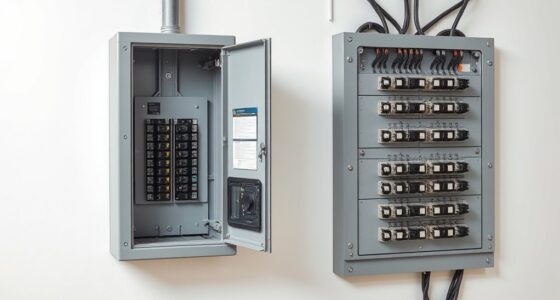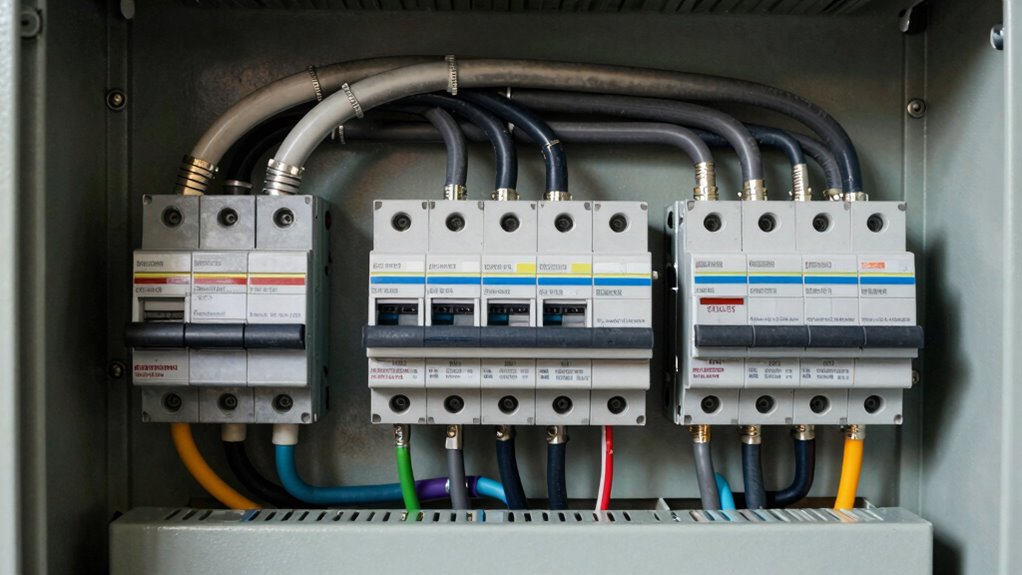

Branch circuits deliver power from the panel to outlets, fixtures, and appliances in your building, while feeders connect the main panel to subpanels or major loads, handling higher currents. Service conductors run from the utility connection directly to the main panel. Feeders typically supply multiple branch circuits, and service conductors carry the full load of the entire system. Understanding these distinctions and how each is sized guarantees your system remains safe and efficient—more details await if you keep exploring.

Get backup power and energy gear delivered free — and shop member deals
- Fast, free delivery on millions of items
- Access to Prime Big Deal Days deals on October 6–7
- Prime Video, Amazon Music and more included
Key Takeaways
- Branch circuits distribute power to outlets and fixtures, while feeders connect the main panel to subpanels or major loads.
- Service conductors run from the utility connection to the main panel, supplying the entire building’s electrical system.
- Feeders carry higher current loads than branch circuits and typically connect to subpanels or large equipment.
- Branch circuits originate from the panelboard and serve individual circuits within a building.
- Service conductors are usually the largest conductors, designed to handle the building’s maximum load safely.
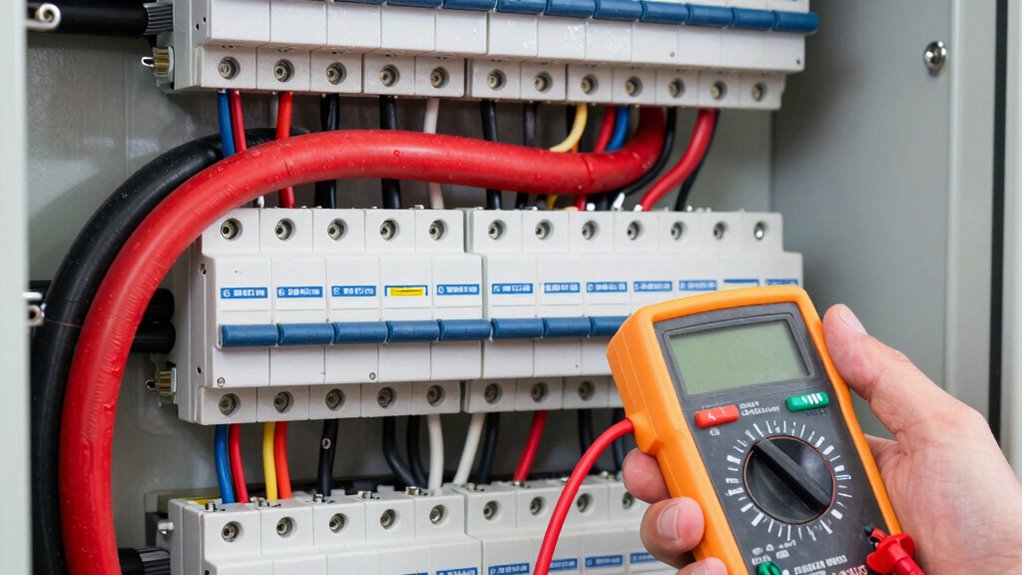
Understanding the difference between branch circuits, feeders, and service conductors is essential for anyone working with electrical systems. These components each play a vital role in delivering power safely and efficiently, but they have distinct functions and characteristics. When planning or troubleshooting an electrical system, you need to perform accurate load calculations to determine the appropriate conductor sizing for each segment. This process ensures that conductors are not only properly rated but also conforms to safety standards, preventing potential hazards. Proper electrical safety measures, including correct conductor sizing and protective gear, are crucial to prevent accidents and ensure reliable operation.
Branch circuits are the final pathways that distribute electricity to outlets, fixtures, or appliances in a building. They originate from the panelboard and are designed to carry a specific load based on the connected devices. Proper conductor sizing for branch circuits depends on these load calculations, which consider the total expected current and voltage drop. Selecting the correct wire gauge prevents overheating and guarantees compliance with electrical codes, keeping your system safe and reliable.
Branch circuits deliver power to outlets and appliances, requiring proper sizing for safety and code compliance.
Feeders are the larger conductors that carry electricity from the main service panel or distribution point to subpanels or other major components. Unlike branch circuits, feeders handle higher currents and must be sized accordingly. When determining conductor sizing for feeders, you again rely on load calculations, but these calculations often involve a broader scope, considering the total connected load across multiple branch circuits. Proper sizing of feeders is crucial because they must deliver power over longer distances without significant voltage drops, which can impair device operation.
Service conductors are the conductors that run from the utility’s connection point to your main panel. They are typically the largest in size because they carry the full load supplied to the building. The sizing of service conductors is critical; they must be capable of handling the maximum expected load safely. When performing load calculations for service conductors, you take into account the entire building’s electrical demand, which helps determine the right conductor size and breaker ratings to prevent overloads and guarantee safety.
electrical wire gauge for branch circuits
As an affiliate, we earn on qualifying purchases.
As an affiliate, we earn on qualifying purchases.
Frequently Asked Questions
How Do Branch Circuits Differ in Residential Versus Commercial Buildings?
You’ll find that branch circuits in residential buildings typically handle lighter loads with less complexity, while in commercial buildings, they’re designed to support larger, more diverse loads, accounting for load diversity. Commercial circuits often require bigger wiring and more circuit breakers to manage the higher power demands safely. Load diversity in commercial settings helps optimize the system, ensuring circuits aren’t overloaded while providing the flexibility needed for various equipment and lighting needs.
What Materials Are Commonly Used for Service Conductors?
You’ll find copper and aluminum are the most common materials for service conductors. Copper offers excellent conductor insulation and resists conductor corrosion, making it ideal for long-term durability. Aluminum is lighter and more affordable but needs proper insulation to prevent corrosion and guarantee safety. Both materials are chosen based on electrical load requirements and environmental conditions, with insulation protecting against moisture, corrosion, and physical damage to maintain reliable power delivery.
How Does Load Calculation Affect Conductor Sizing?
Imagine you’re wiring a new home and need to determine conductor size for a 100-amp service. Your load calculation considers appliances, lighting, and voltage drop, ensuring the conductors can handle the total load safely. Proper load calculation influences conductor sizing by accounting for voltage drop and insulation ratings, preventing overheating and ensuring safety. If the load is underestimated, conductors may be undersized, risking damage and electrical hazards.
Are There Specific Codes Governing Feeder Installation?
Yes, there are specific codes governing feeder installation to guarantee safety and reliability. You must follow the National Electrical Code (NEC) or local regulations, which specify requirements for conductor sizing, protection, and routing. Confirming code compliance during feeder installation helps prevent electrical hazards, overloads, and fires. Always check the latest code updates and consult with a licensed electrician to make sure your installation meets all necessary standards.
What Safety Considerations Are Unique to Each Type of Conductor?
Think of safety as the backbone of your electrical system. For branch circuits, you need to focus on proper insulation to prevent shorts, and guarantee grounding methods are correct to protect against faults. Feeders, handling larger loads, require extra insulation and robust grounding to prevent overloads or fires. Always follow code requirements, keep insulation intact, and verify grounding methods are securely in place to keep everyone safe.
As an affiliate, we earn on qualifying purchases.
Conclusion
In understanding the differences, you’ll see that branch circuits, feeders, and service conductors each serve distinct, dedicated duties. By balancing, bundling, and bridging these basic building blocks, you guarantee safe, steady, and sound electrical systems. Remember, recognizing the role, routing, and regulation of each component helps you harness harmony in your home or workspace. Keep these key concepts clear, and your electrical expertise will shine, ensuring safety and satisfaction with every circuit you create.
As an affiliate, we earn on qualifying purchases.
electrical load calculation tools
As an affiliate, we earn on qualifying purchases.
As an affiliate, we earn on qualifying purchases.
Halloween Picks
halloween
As an affiliate, we earn on qualifying purchases.