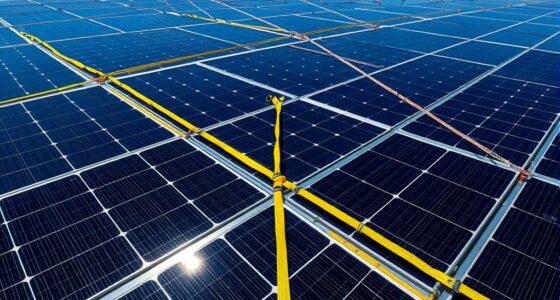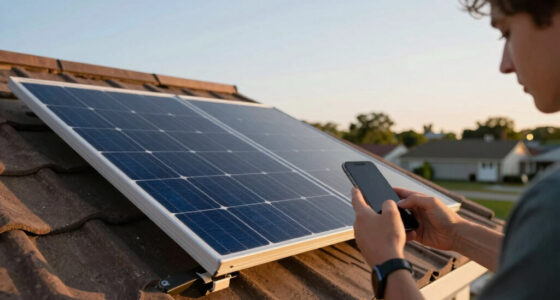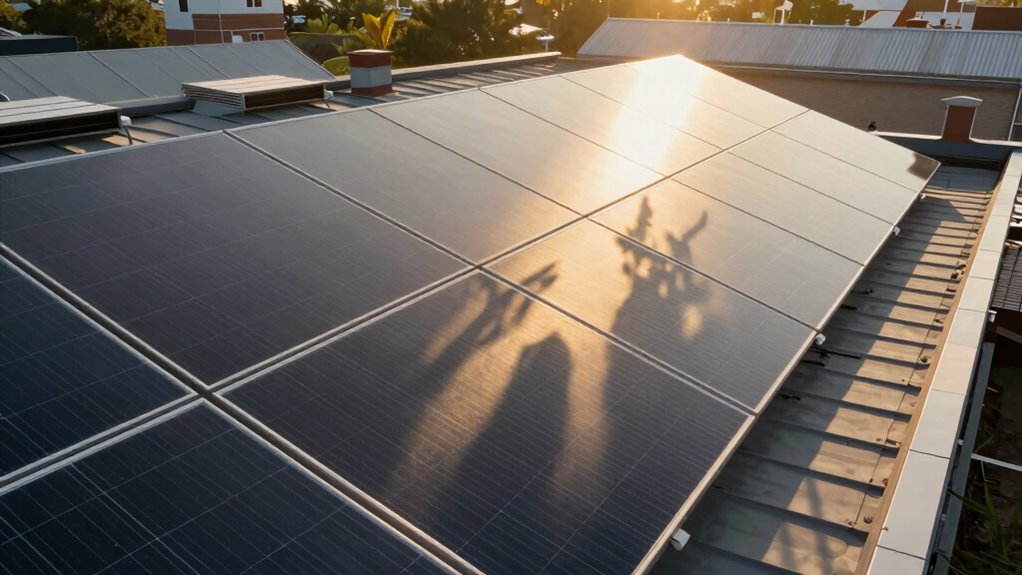
Many new solar buyers overlook how shading and placement can reduce your system’s output, even if panels seem clear. Partial shading from trees or buildings impacts efficiency more than you might expect, and it doesn’t need to block entire panels. Proper site assessment and strategic placement are essential to avoid costly adjustments later. By understanding how heat and shade affect performance, you can maximize your energy gains and save money—stick with us to learn more.
Key Takeaways
- New buyers often overlook how even minimal shading can drastically reduce solar panel efficiency.
- Many underestimate the impact of heat buildup on panels, which can decrease energy output over time.
- Placement decisions frequently neglect future obstructions like growing trees or new structures.
- Buyers may not consider that shading affects individual panel strings differently, reducing overall system performance.
- Proper site assessment and shading analysis are often skipped, leading to costly adjustments later.

Shade is another essential element that many overlook. Even partial shading from trees, nearby buildings, or other obstructions can greatly decrease your system’s output. Shade doesn’t have to block the entire panel to impact efficiency; it can cause a phenomenon called “mismatch loss,” where shaded cells drag down the performance of the entire panel. To avoid this, you should evaluate shading techniques carefully before installation. Trim overhanging branches, choose a site with minimal obstructions, or opt for microinverters or power optimizers that can mitigate shading effects by allowing each panel or cell to operate independently. Proper shading assessments and strategic pruning or placement can make a big difference in guaranteeing your system works at its best. Recognizing potential shading issues early can save you from costly adjustments later on. Additionally, understanding solar panel technology can help you select systems better equipped to handle shading challenges.

ZIBOO FT-2000W Solar Panel Tester MPPT Meter – 2000W Max Power, 150V/35A PV Module Tester for Voc/Isc, Open Circuit Voltage & Short Circuit Current, with Backlight & Data Hold
- Maximum Power Measurement: Measures up to 2000W Pmax
- Voltage and Current Range: Voc 12-150V, Isc 35A
- High Accuracy: ±0.8% measurement precision
As an affiliate, we earn on qualifying purchases.
As an affiliate, we earn on qualifying purchases.
Frequently Asked Questions
How Does Shading Affect Solar Panel Efficiency Over Time?
Shading can considerably reduce your solar panel efficiency over time by creating uneven shade patterns that cause parts of your panels to work less effectively. This uneven exposure accelerates panel degradation, shortening their lifespan and decreasing output. To prevent this, make sure your panels are placed where shading is minimal throughout the day, especially during peak sunlight hours. Proper placement helps maintain ideal efficiency and prolongs your panels’ performance.
What Are the Long-Term Maintenance Needs for Shaded Panels?
Shaded panels require ongoing maintenance, including regular inspections to identify any new or persistent shading issues. Shade mitigation strategies, like trimming nearby branches or installing barriers, help optimize performance. Maintenance scheduling should account for seasonal changes, as growth or debris can increase shading over time. By proactively addressing these factors, you guarantee your panels stay efficient, reducing long-term energy costs and maximizing your solar investment.
Can Shading Be Completely Avoided in Dense Urban Areas?
Shading can’t be completely avoided in dense urban areas due to urban shadows and building obstructions. You might think you can sidestep this issue, but tall structures and narrow streets create consistent shade, reducing solar efficiency. While you can optimize panel placement to minimize shading, some loss is inevitable. Embracing these limitations helps you better plan your solar system, ensuring you get the most out of your investment despite urban shadows.
How Do Seasonal Changes Impact Optimal Panel Placement?
Seasonal changes profoundly impact your solar panel placement. In summer, you’ll want to optimize solar panel orientation to maximize sun exposure when the sun is higher, and employ shading mitigation strategies to prevent efficiency loss. During winter, adjusting the angle or tilt can capture lower sun angles. Consider how seasonal variations affect shading and sunlight, ensuring your panels remain efficient year-round by planning for these changes in your placement and shading mitigation efforts.
What Are the Best Practices for Adjusting Panel Angles for Shade?
To adjust panel angles for shade mitigation, you should modify the panel tilt based on seasonal sun paths. In summer, tilt panels less steeply to avoid shade from nearby objects, while in winter, increase tilt to maximize sun exposure. Regularly monitor shading throughout the year, and make angle adjustments as needed to optimize sunlight capture and minimize shading impacts, ensuring your solar system performs efficiently year-round.
microinverters for shading mitigation
As an affiliate, we earn on qualifying purchases.
As an affiliate, we earn on qualifying purchases.
Conclusion
Remember, choosing the right shade and placement can make all the difference in your solar system’s efficiency. For example, a homeowner in Florida initially installed panels without considering shade, only to find their system underperforming during summer afternoons. By adjusting panel angles and trimming nearby trees, they boosted energy output markedly. Don’t overlook these details—careful planning ensures you maximize your solar investment and enjoy consistent, reliable power for years to come.

Metal Solar Angle Guide for Solar Panel – Ideal Solar Tracker Tool Find The Optimal Angle for Solar Panels Tools
- Magnet Adsorption: Non-scratch, easy to move magnet attachment
- Durable Material: Made from aluminum and PC for strength
- Easy to Use: Attach with magnet to solar panel edge
As an affiliate, we earn on qualifying purchases.
As an affiliate, we earn on qualifying purchases.

Solar Light Control Panel Kit 1.2V Solar Light Control Board Charging PCB Solar Lawn Lamp Control Board Set with Instruction Manual
- High Driving Efficiency: Ensures long discharge time and performance
- Compatible with 1.2V NiMH Batteries: Designed for specific battery type
- Built-in 2V Solar Charging Module: Provides charging and protection features
As an affiliate, we earn on qualifying purchases.
As an affiliate, we earn on qualifying purchases.