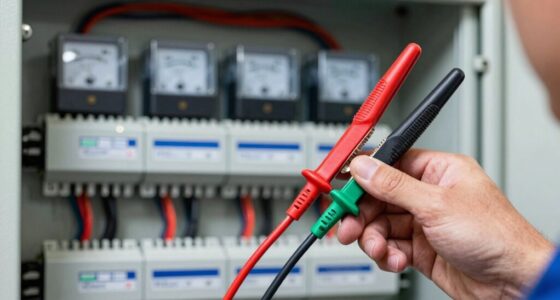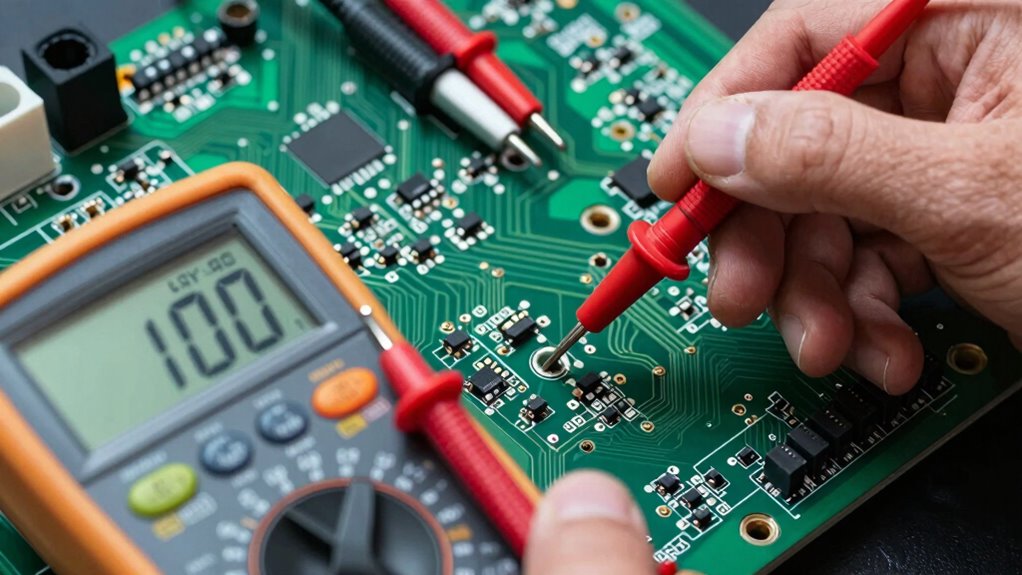

Continuity testing checks if there’s a complete electrical path, giving a quick yes or no answer, often with a beep or light. Resistance testing measures how much a component resists current flow, providing a detailed resistance value in ohms. While continuity confirms the existence of connections, resistance assesses their quality and condition. Both methods are essential for safety and troubleshooting, and exploring further reveals how they work together to keep your circuits reliable.

Get backup power and energy gear delivered free with Prime
- Fast, free delivery on millions of items
- Prime Video, Amazon Music and more included
- Member-only deals all year
Key Takeaways
- Continuity testing checks if a complete electrical path exists, producing a simple yes/no (beep or indicator).
- Resistance testing measures the resistance in ohms, providing detailed data about circuit health.
- Continuity tests are quick, ideal for verifying connections during installation or maintenance.
- Resistance testing applies a small current to assess the quality and condition of components and wiring.
- Continuity confirms connection presence; resistance evaluates connection quality and potential issues.
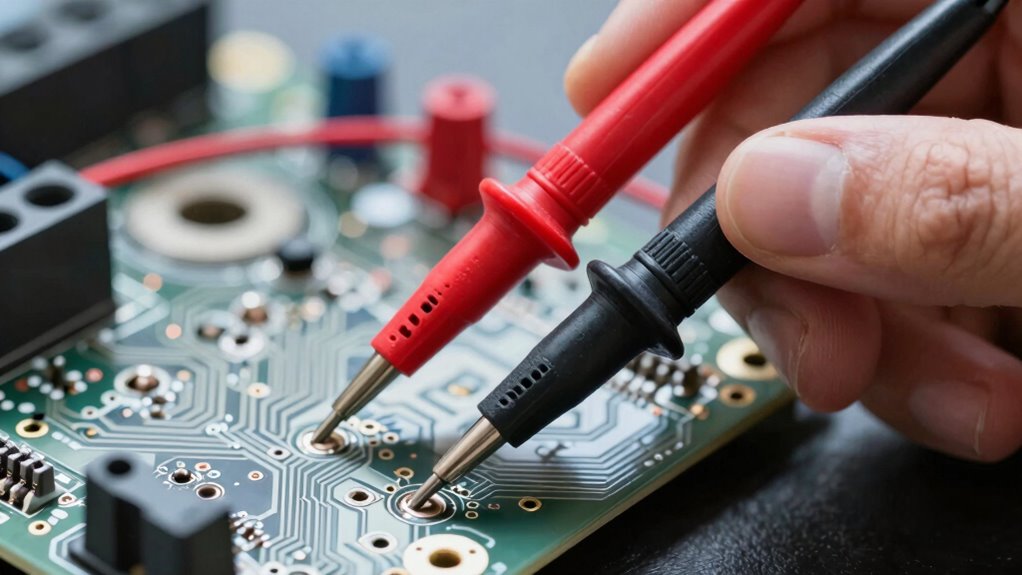
Ever wondered how technicians guarantee electrical circuits are safe and functioning properly? The answer lies in their ability to perform accurate continuity and resistance testing. These tests are essential components of electrical safety, ensuring that circuits are correctly connected and free of faults before they’re energized. To do this effectively, technicians rely on specialized testing equipment designed to measure electrical properties precisely. Understanding the difference between continuity and resistance testing helps you appreciate their roles in maintaining safe and reliable electrical systems.
Continuity testing primarily checks if a complete path exists for current to flow within a circuit. When you perform this test, you’re confirming that wires, connections, and components are properly linked, with no breaks or interruptions. The testing equipment used typically produces a simple beep or a visual indicator when continuity is confirmed, making it quick and easy to identify faults. This kind of testing is especially important during installation or maintenance, where you need to verify that circuits are correctly connected before powering them up. By confirming continuity, you help prevent potential hazards like short circuits or electric shocks, which could occur if a connection is faulty or incomplete. Additionally, understanding the contrast ratio helps technicians evaluate image quality in related visual systems, ensuring safety and performance standards are met. Knowing the testing procedures also allows technicians to perform inspections confidently and accurately, reducing the risk of overlooked faults. Moreover, proper understanding of electrical properties can assist in troubleshooting complex systems more effectively, especially when combined with other diagnostic techniques.
Continuity testing verifies complete electrical paths, preventing faults and ensuring safe, proper circuit connections before powering up.
Resistance testing, on the other hand, measures how much a component or circuit resists the flow of electrical current. When you perform resistance testing, you’re looking for the actual resistance value, usually expressed in ohms. Unlike continuity testing, which only tells you if a connection exists, resistance testing provides detailed information about the quality of that connection and the condition of the components. This type of testing is vital for diagnosing issues like deteriorated wiring, damaged components, or insulation breakdowns. The testing equipment used for resistance measurements is often more sophisticated, capable of applying a small current and measuring the resulting voltage drop to calculate resistance accurately. Understanding how to interpret these resistance values is crucial for preventive maintenance and ensuring long-term system stability.
While both tests serve to guarantee electrical safety and proper operation, they do so in different ways. Continuity testing is quick and straightforward, ideal for verifying connections during installation or troubleshooting obvious faults. Resistance testing, meanwhile, offers a deeper insight into the health of a circuit, allowing technicians to detect subtle problems that might not be apparent through continuity checks alone. By understanding how these tests differ and when to use each, you can better guarantee the safety and reliability of electrical systems. Ultimately, employing the right testing equipment and techniques helps prevent accidents, reduces downtime, and prolongs the lifespan of electrical infrastructure. A solid grasp of these testing methods also enhances system reliability, ensuring consistent performance over time.
digital multimeter for electrical testing
As an affiliate, we earn on qualifying purchases.
As an affiliate, we earn on qualifying purchases.
Frequently Asked Questions
What Tools Are Used for Continuity Testing?
For continuity testing, you mainly use a multimeter or a dedicated continuity tester. These tools help you quickly check insulation integrity and identify broken circuits during circuit troubleshooting. When you connect the probes, a beep or reading confirms a continuous path, ensuring safety and proper function. Using these tools, you can efficiently locate faults, verify connections, and maintain equipment reliability, making them essential for effective electrical diagnostics.
How Does Resistance Testing Affect Circuit Performance?
Resistance testing acts like a health check-up for your circuit, revealing how material degradation and connection stability impact performance. When resistance is high, it’s like a clogged artery, reducing current flow and causing inefficiency. Conversely, low resistance indicates a healthy connection. By regularly testing resistance, you guarantee your circuit’s reliability, preventing unexpected failures and maintaining peak performance. Keep resistance in check, and your circuit will run smoothly like a well-oiled machine.
Can Continuity Testing Detect All Electrical Faults?
Continuity testing can’t detect all electrical faults because it mainly checks for complete electrical paths, so some issues like high-resistance faults or intermittent connections might go unnoticed. Its testing limitations mean you might miss faults that don’t completely break the circuit but still impair performance. While highly useful for basic fault detection, you should use resistance testing for a more thorough assessment, especially when diagnosing complex or subtle issues.
What Safety Precautions Are Necessary During Testing?
During testing, you should wear safety gear like insulated gloves and safety glasses to protect yourself. Guarantee your test environment is dry, well-ventilated, and free of flammable materials to prevent hazards. Always disconnect power sources before testing, follow proper procedures, and use correctly rated equipment. Staying alert and adhering to safety protocols minimizes risks, ensuring your safety while accurately evaluating electrical continuity and resistance.
How Often Should Resistance Testing Be Performed?
You should perform resistance testing regularly, like keeping a watchful eye on your investments, to guarantee voltage stability and insulation integrity. Typically, annual testing suffices for most systems, but severe environmental conditions or critical equipment might need more frequent checks. By staying proactive, you prevent potential failures, safeguarding your equipment and ensuring reliable operation. Regular resistance tests help you catch issues early, maintaining system health and safety.
continuity tester with beep indicator
As an affiliate, we earn on qualifying purchases.
As an affiliate, we earn on qualifying purchases.
Conclusion
So, now you see, continuity and resistance testing aren’t just different—they’re like night and day, fire and ice! Ignoring these differences could turn your project into a disaster zone faster than you can say “short circuit.” Master these tests, and you’ll be the superhero of electrical safety, preventing chaos and saving the day. Trust me, understanding the real deal between continuity and resistance is the secret weapon you need to conquer any electrical challenge!
As an affiliate, we earn on qualifying purchases.
As an affiliate, we earn on qualifying purchases.
Fall Picks
fall essentials
As an affiliate, we earn on qualifying purchases.