Solar-powered security cameras can cut down on charging and wiring, but the right choice depends on how much area you need to cover and whether you want local storage, pan-and-tilt tracking, or a multi-camera system. The eufy Security SoloCam E42 4-Camera Kit is my best overall pick for buyers seeking a coordinated 4K setup, while the REOLINK Argus PT Ultra stands out for a single camera with 4K resolution and pan-and-tilt coverage. For a premium single-camera option, the eufy SoloCam S340 pairs solar power with a dual-lens design. Across the lineup, the main tradeoffs are camera count versus resolution, broad coverage versus fixed views, and local storage versus app or service features. Read on for the full breakdown and guidance on choosing a system that suits your property.

Get backup power and energy gear delivered free with Prime
- Fast, free delivery on millions of items
- Prime Video, Amazon Music and more included
- Member-only deals all year
Key Takeaways
- The E42 kit is the roundup’s strongest all-around system choice: its four 4K cameras suit buyers who want several views covered, rather than one camera with movable framing.
- The Argus PT Ultra and SoloCam S340 serve different single-camera needs: Reolink emphasizes 4K pan-and-tilt coverage, while the S340’s dual-lens setup targets buyers who want more than one perspective from one device.
- Several kits prioritize coverage and local storage over headline resolution: the 4-camera 4MP systems and Soliom 5MP kit may appeal to buyers outfitting multiple areas, but camera count and storage capacity should be weighed against image detail.
- Pan-and-tilt and auto-tracking appear across many picks, but they are not interchangeable: tracking can follow movement, while a fixed camera can provide a more consistent view of a specific entrance or path.
- Solar power does not remove placement constraints: every option still depends on useful sun exposure, dependable wireless connectivity, and a mounting position that captures the area you care about.




| solar powered security camera | Storage | Power | Night vision | Connectivity |
|---|---|---|---|---|
| eufy Security SoloCam E42 4-Ca | — | — | — | Wireless Wi-Fi |
| REOLINK Argus PT Ultra 4K Wire | microSD card, sold separately | — | — | — |
| Gianteye 5G Solar Wireless Out | microSD up to 128 GB, not included, or optional cloud storage | Solar panels with built-in backup batteries | Spotlight color night vision; stated range up to 328 feet | — |
| 2K Solar-Powered Wireless Outd | Optional microSD card, not included, or optional cloud storage | Solar panel with built-in backup battery | Color night vision with spotlight and starlight night vision; stated range up to 328 feet | 2.4 GHz and 5 GHz Wi-Fi |
| Wyze Solar Cam Pan 2K Wireless | — | — | Full-color, with motion-activated spotlight | — |
| Wireless Outdoor Security Came | 128GB local storage in a 4-channel base unit | 5W solar panel and 8000mAh battery per camera | Color, up to 65 feet | 2.4GHz and 5GHz Wi-Fi; base unit also supports Ethernet |
| 4MP Wireless Solar Security Ca | 128GB local, expandable to 256GB | 5W solar panel and 8000mAh battery | Color night vision with 6 LED lights, up to 65 feet | Dual-band 2.4GHz and 5GHz Wi-Fi 6 |
| eufy Security eufyCam C37 2K W | microSD up to 256GB, sold separately, or compatible HomeBase | — | — | 2.4GHz Wi-Fi |
| GALAYOU R6 Solar-Powered Outdo | TF card up to 128GB, sold separately; optional paid cloud | Solar panel with USB-C backup charging | — | 2.4GHz Wi-Fi |
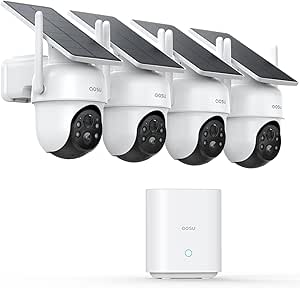
| aosu D1 Classic 4-Camera Wirel | 32GB local storage | Solar powered | Color night vision with LED lights | — |
| SEHMUA 2K Solar Security Camer | — | Solar powered with 6000mAh battery | Color, with white spotlight and IR LEDs | 2.4GHz Wi-Fi; 5GHz not supported |
| GNCC Solar-Powered Outdoor Sec | MicroSD up to 128GB or paid cloud storage | 3W solar panel and 5200mAh rechargeable battery | Color night vision, listed range 26 feet | 2.4GHz Wi-Fi and Bluetooth; 5GHz not supported |
| Soliom 5MP Solar-Powered Wirel | — | Solar powered | Color, with 30-foot listed range | — |
| eufy Security SoloCam S340 3K | 8GB built-in | Solar powered with removable solar panel | Listed range of 6 meters | — |
More Details on Our Top Picks
eufy Security SoloCam E42 4-Camera Kit, 4K Solar Security Camera System
The SoloCam E42 kit is my strongest pick for buyers who want several solar-powered views tied to one recording hub. It includes four 4K cameras, removable solar panels, and a HomeBase 3 with 16 GB of local storage, so it avoids the separate-card requirement of the REOLINK Argus PT Ultra and supports recording even during network outages. The cameras add 360° pan and tilt, AI tracking, facial recognition, and a strobe and siren; that mix is better suited to following activity across a property than a fixed-view setup. The tradeoff is a more involved, screw-in installation and a reliance on direct sun for solar charging. Expandable hub storage is useful, but the included capacity is modest for continuous recording, and the microSD card support requires a separate purchase.
Pros:- Four 4K cameras provide detailed coverage across multiple outdoor areas
- HomeBase 3 offers included local storage and supports recording during network outages
- SolarPlus 2.0 charging can reduce manual battery charging with about two hours of direct sunlight daily
- 360° pan and tilt, AI tracking, facial recognition, strobe, and siren add monitoring and deterrence options
Cons:- The microSD card is not included, and the HomeBase 3 starts with 16 GB of storage
- Solar charging depends on direct sunlight at the panel locations
- Four-camera screw-in installation is more involved than setting up a single camera such as the Wyze Solar Cam Pan
Best for: Homeowners who want four 4K solar cameras, centralized local recording, and the option to expand storage without relying on a cloud plan
Not ideal for: Renters or buyers seeking a simple single-camera setup, or homes where camera locations receive little direct sunlight
- Camera count:4
- Video resolution:4K UHD
- Solar charging:SolarPlus 2.0; approximately 2 hours of direct sunlight daily
- Included storage:HomeBase 3 with 16 GB
- Expandable HomeBase storage:Up to 16 TB
- Camera storage support:Up to 128 GB microSD per camera; cards not included
- Camera movement:360° pan and tilt
- Detection and deterrence:AI motion detection and tracking, facial recognition, strobe light, and siren
- Connectivity:Wireless Wi-Fi
Our verdict“Choose the SoloCam E42 kit if you need four high-resolution solar cameras and hub-based local recording, and can support the installation and sunlight requirements.”
REOLINK Argus PT Ultra 4K Wireless Outdoor Security Camera with Solar Panel
The REOLINK Argus PT Ultra is a strong fit when one outdoor area needs sharp video and adjustable coverage, rather than the multi-camera footprint of the eufy SoloCam E42 kit. Its 4K resolution, 355° pan and 140° tilt let you re-aim the view remotely, while the included 3W solar panel helps keep the battery powered. A motion-activated spotlight supports color night vision, and person, vehicle, and pet detection can make alerts more specific than the human-only detection listed for the Gianteye two-pack. Two-way talk adds a way to respond without going outside. The main compromise is that event recording needs a microSD card bought separately, and there is no included hub storage like eufy’s. It also depends on a suitable Wi-Fi connection and has an IP64 rating.
Pros:- 4K, 8 MP video captures more detail than the 2K Gianteye and four-camera system in this batch
- Included 3W solar panel supports ongoing power for a battery camera
- 355° pan and 140° tilt provide broad remote adjustment
- Spotlight color night vision, two-way talk, and person, vehicle, and pet detection add useful monitoring functions
Cons:- A microSD card is sold separately for local event recording
- IP64 weather resistance is a more limited rating than the IP65 listed for the Wyze and Gianteye cameras
- One camera covers less ground than a multi-camera kit such as the eufy SoloCam E42
Best for: Buyers who need one 4K solar camera with remote pan and tilt for a driveway, yard, or other broad outdoor area
Not ideal for: Households seeking several cameras with included centralized storage, or buyers who do not want to purchase a microSD card separately
- Resolution:4K, 8 MP
- Pan and tilt:355° pan, 140° tilt
- Solar panel:Included 3W panel
- Night vision range:33 feet
- Detection:Person, vehicle, and pet detection
- Storage:microSD card, sold separately
- Wi-Fi:2.4 GHz and 5 GHz
- Weather resistance:IP64
- Video encoding:H.265
Our verdict“Pick the Argus PT Ultra for one adjustable 4K solar camera, but choose a multi-camera kit if you need broader property coverage or included hub storage.”
Gianteye 5G Solar Wireless Outdoor Security Cameras, 2-Pack, 2K with Color Night Vision and 2-Way Audio
The Gianteye two-pack makes sense for buyers who want two solar-powered viewpoints without moving up to the four-camera eufy SoloCam E42 or four-pack 2K system. Both cameras record at 2K, support pan and tilt, and pair spotlight color night vision with two-way audio. Human detection and adjustable sensitivity give buyers some control over which activity triggers alerts, while the built-in backup batteries help keep the cameras running when solar input is limited. It supports both 2.4 GHz and 5 GHz Wi-Fi, unlike the 2.4 GHz-only Wyze Solar Cam Pan. The compromises are the absence of a base station, optional rather than included cloud storage, and a separately purchased microSD card for local recording. Its stated 328-foot night-vision range should not be read as a guarantee of useful detail at that distance.
Pros:- Two cameras offer more placement flexibility than the single-camera REOLINK Argus PT Ultra
- Solar panels and built-in backup batteries support wire-free operation
- 2K video, spotlight color night vision, pan and tilt, and two-way audio cover key monitoring needs
- Supports 2.4 GHz and 5 GHz Wi-Fi, unlike the 2.4 GHz-only Wyze Solar Cam Pan
Cons:- No base station is supported, unlike the eufy SoloCam E42 hub-based kit
- A microSD card is not included, and cloud storage is optional
- Detection is described as human detection, with adjustable sensitivity limited to a 16–29-foot range
Best for: Households that want two independently installed solar cameras with pan-and-tilt control, human alerts, and two-way audio
Not ideal for: Buyers who want included hub storage, a base-station system, or a fully equipped local-recording setup without extra purchases
- Camera count:2
- Resolution:2K (2304 × 1296p)
- Power:Solar panels with built-in backup batteries
- Wi-Fi:2.4 GHz and 5 GHz
- Night vision:Spotlight color night vision; stated range up to 328 feet
- Camera controls:Pan, tilt, and digital zoom
- Detection:PIR and AI human detection; adjustable sensitivity range of 16–29 feet
- Storage:microSD up to 128 GB, not included, or optional cloud storage
- Weather resistance:IP65
Our verdict“Choose Gianteye if two solar cameras and dual-band Wi-Fi matter more than hub-based recording or included storage.”
2K Solar-Powered Wireless Outdoor Security Camera System, 4-Pack
This four-camera 2K system is aimed at buyers who value several viewpoints over the finer image detail of the eufy SoloCam E42’s 4K cameras. Solar panels and built-in backup batteries keep the installation wire-free, while 360° pan-tilt control, AI human detection, and two-way audio make each camera more flexible than a fixed-view unit. Color night vision with a motion-activated spotlight and starlight night vision offer different ways to monitor dim areas. Dual-band Wi-Fi is another advantage over the 2.4 GHz-only Wyze Solar Cam Pan. The savings in resolution come with a storage tradeoff: neither microSD cards nor cloud storage are included, so recording requires an additional choice and potentially extra cost. The listing also gives both IP65 and IP66 weather-resistance claims, so buyers should verify the rating for their intended installation.
Pros:- Four cameras provide broad property coverage without the 4K kit’s higher stated resolution being the priority
- Solar panels and backup batteries support wire-free placement
- 360° pan-tilt, human detection, and two-way audio give the cameras flexible monitoring functions
- Supports both 2.4 GHz and 5 GHz Wi-Fi
Cons:- 2K video offers less resolution than the 4K eufy SoloCam E42 and REOLINK Argus PT Ultra
- microSD cards and cloud storage are both optional rather than included
- The product information gives conflicting IP65 and IP66 weather-resistance claims
Best for: Property owners who need four wire-free cameras with pan-tilt views and are comfortable arranging their own local or cloud recording
Not ideal for: Buyers who prioritize 4K detail, want included recording storage, or need a clearly consistent weather-resistance specification
- Camera count:4
- Video resolution:2K
- Power:Solar panel with built-in backup battery
- Connectivity:2.4 GHz and 5 GHz Wi-Fi
- Camera coverage:360° pan-tilt; PTZ
- Night vision:Color night vision with spotlight and starlight night vision; stated range up to 328 feet
- Detection:PIR and AI human detection
- Storage:Optional microSD card, not included, or optional cloud storage
- Weather resistance:Listed as IP65 and IP66 in the product information
Our verdict“Choose this system for four solar-powered 2K views with pan-tilt control, provided you are willing to supply storage and accept the unclear weather-rating details.”
Wyze Solar Cam Pan 2K Wireless Outdoor Security Camera
The Wyze Solar Cam Pan suits buyers who want one compact camera that can follow movement and actively draw attention to it. Its AI person tracking, 360° pan, 70° tilt, motion-activated spotlight, and 105 dB siren provide more active response features than the Gianteye two-pack, which offers two cameras but no listed siren. Solar power and a built-in microSD slot support a wire-free setup with local recording, though the card is not included. The 2K image is a step below the 4K detail of the REOLINK Argus PT Ultra and eufy SoloCam E42. It also uses 2.4 GHz Wi-Fi only, while both the REOLINK and Gianteye support 5 GHz. Cloud recording and advanced alerts require optional subscriptions, so this is less appealing to buyers seeking included recording features.
Pros:- Compact 10.72-ounce design is easier to place than the multi-camera eufy and four-pack systems
- 360° pan, 70° tilt, and AI person tracking help follow activity across a wide area
- Motion-activated spotlight and 105 dB siren add deterrence features not listed for the Gianteye two-pack
- Supports local microSD storage up to 512 GB
Cons:- 2K resolution captures less detail than the 4K REOLINK Argus PT Ultra and eufy SoloCam E42
- Wi-Fi is limited to 2.4 GHz
- microSD card is sold separately, and cloud recording and advanced alerts require optional subscriptions
Best for: Buyers who want a compact, single solar camera with person tracking, a siren, and local microSD recording
Not ideal for: Households needing several cameras, 4K video, 5 GHz Wi-Fi, or cloud recording and advanced alerts without a subscription
- Resolution:2K
- Pan and tilt:360° pan, 70° tilt
- Solar panel maximum power:1.8 watts
- Motion tracking:AI-powered person tracking
- Night vision:Full-color, with motion-activated spotlight
- Siren:105 dB
- Local storage:microSD up to 512 GB; card sold separately
- Wi-Fi:Wi-Fi 6, 2.4 GHz; 5 GHz not supported
- Weather resistance:IP65
Our verdict“Pick the Wyze Solar Cam Pan for a compact, tracking-focused camera with a siren, but choose a 4K or multi-camera option for sharper or broader coverage.”
Wireless Outdoor Security Camera System, 2-Camera Kit, 4MP, Solar-Powered, 360° PTZ, 128GB Local Storage
This two-camera kit pairs solar charging with a 128GB base unit, so it suits buyers who want ongoing local recording without making cloud storage part of the setup. Its 4MP video, color night vision, and two-way audio make it more feature-rich than the aosu D1 Classic, while the aosu includes four cameras for broader property coverage. The 360° auto-tracking is a useful way to follow movement, but it is off by default and needs to be enabled in the app; motion settings may also need adjusting if you want alerts for more than people. The base supports Wi-Fi or Ethernet, though camera connectivity still depends on suitable Wi-Fi coverage. This is a strong fit for a smaller number of monitored areas, not a four-camera perimeter setup.
Pros:- 128GB base storage supports local loop recording without a required subscription
- Solar panels and 8000mAh batteries support wire-free installation
- 4MP video, color night vision, and two-way audio combine day and night monitoring features
- Base unit can connect by Wi-Fi or Ethernet
Cons:- Auto-tracking is off by default and must be enabled in the app
- Human-only recording is the default, so other motion types require settings changes
- 5GHz Wi-Fi may have weaker reach at longer distances than 2.4GHz
Best for: Homeowners who want two solar-powered cameras, substantial local loop recording, and no required cloud subscription
Not ideal for: Buyers who need four-camera coverage or want tracking and broader motion alerts active without changing app settings
- Camera count:2
- Resolution:4MP
- Storage:128GB local storage in a 4-channel base unit
- Power:5W solar panel and 8000mAh battery per camera
- Night vision:Color, up to 65 feet
- Detection and tracking:PIR and AI human detection; 360° auto-tracking, enabled in app
- Connectivity:2.4GHz and 5GHz Wi-Fi; base unit also supports Ethernet
- Weather resistance:IP66
Our verdict“Choose this two-camera kit if local recording and 4MP solar monitoring matter more than the wider coverage of the four-camera aosu D1 Classic.”
4MP Wireless Solar Security Camera System, 4-Cam Kit with 128GB Local Storage, PTZ Auto Tracking, Color Night Vision, Alexa Compatible
For buyers who need to cover several sides of a property, this kit’s four solar-powered cameras and expandable hub offer a more complete starting point than the two-camera system in this roundup. The 128GB encrypted local storage avoids a required cloud plan, and the hub can support up to eight cameras if coverage needs grow. Its 4MP video, color night vision, and cross-camera tracking make it a more feature-heavy multi-camera choice than the aosu D1 Classic, which has four cameras too but only 32GB of local storage. The tradeoff is setup attention: auto-tracking and some detection options are disabled by default, and the 5GHz band can lose reach across a large property. Check camera placement and Wi-Fi coverage before choosing the faster band.
Pros:- Four cameras provide broader property coverage from the outset
- 128GB encrypted local storage is expandable to 256GB without relying on cloud storage
- Solar panels and 8000mAh batteries support wire-free camera placement
- Hub supports up to eight cameras and cross-camera event tracking
Cons:- Auto-tracking and some motion settings require manual activation in the app
- 5GHz Wi-Fi can have less range than 2.4GHz, which may limit placement
- Four cameras require more careful solar exposure and network planning than a two-camera kit
Best for: Owners of larger homes who want four solar-powered viewpoints, local hub recording, and room to add cameras
Not ideal for: Buyers with weak Wi-Fi across their property or anyone who wants tracking and detection settings ready without app configuration
- Camera count:4
- Resolution:4MP
- Storage:128GB local, expandable to 256GB
- Power:5W solar panel and 8000mAh battery
- Night vision:Color night vision with 6 LED lights, up to 65 feet
- Detection and tracking:AI human detection, PIR motion sensor, 360° PTZ auto-tracking, cross-camera tracking
- Connectivity:Dual-band 2.4GHz and 5GHz Wi-Fi 6
- Hub capacity:Supports up to 8 cameras
Our verdict“Pick this kit over the aosu D1 Classic when larger local storage and camera expansion matter more than a simpler four-camera setup.”
eufy Security eufyCam C37 2K Wireless Outdoor Solar Security Camera
The eufyCam C37 stands out for a detachable 3W solar panel, which lets the camera and panel sit in different positions when a sunny mounting spot is not the best viewing angle. It combines 360° pan-and-tilt with AI detection for people, vehicles, and pets, a broader subject range than the human-focused detection described for the two-camera 4MP system in this roundup. Its 2K label and 4MP effective video resolution are paired with a 15fps frame rate, so it is better suited to general property monitoring than buyers prioritizing higher frame rates. Unlike the bundled systems from aosu and other kit options, this is a single camera and local recording requires a separately purchased microSD card or compatible HomeBase. It also works on 2.4GHz Wi-Fi only.
Pros:- Detachable solar panel allows more flexible positioning for sunlight and camera view
- 360° pan-and-tilt with automatic tracking follows activity around the camera
- AI detection covers people, vehicles, and pets
- Local recording is available through a microSD card or compatible HomeBase
Cons:- MicroSD card is sold separately, and HomeBase is another route to local storage
- Cloud storage is not supported
- Connects only to 2.4GHz Wi-Fi
Best for: Homeowners who need one camera with a solar panel that can be mounted separately from the camera
Not ideal for: Buyers who want a multi-camera kit, built-in local storage, cloud recording, or 5GHz Wi-Fi support
- Resolution:2K; 4MP effective video resolution
- Field of view:360°
- Frame rate:15 frames per second
- Solar panel:Detachable 3W
- Storage:microSD up to 256GB, sold separately, or compatible HomeBase
- Connectivity:2.4GHz Wi-Fi
- Detection:AI detection for people, vehicles, and pets with automatic subject tracking
- Mounting:Wall or ceiling
Our verdict“Choose the C37 over the bundled aosu D1 Classic if you need flexible panel placement for one camera and accept arranging storage separately.”
GALAYOU R6 Solar-Powered Outdoor Security Camera, 1 Pack
The GALAYOU R6 is a straightforward single-camera solar option for buyers who want pan-and-tilt monitoring without committing to a multi-camera hub system. Its 2K video, human detection, motion tracking, siren, and two-way audio cover the main interactive monitoring needs, while the USB-C port gives you a backup charging method when sunlight is limited. Compared with the eufyCam C37, the R6 offers USB-C backup charging and a siren, but the C37 can detect vehicles and pets and has a detachable panel for more flexible positioning. The R6’s included event access is limited to short alert clips and snapshots; ongoing local recording requires a separately purchased TF card, while cloud backup requires a paid plan. It also relies on 2.4GHz Wi-Fi.
Pros:- Solar power with USB-C backup charging gives a second way to keep the camera running
- 344° pan and 85° tilt support broad single-camera coverage
- 2K video, color night vision, and human detection support day-and-night alerts
- Two-way audio and a remotely triggered siren add ways to respond to activity
Cons:- TF card for local storage is not included, and cloud backup requires a paid plan
- Included history is limited to two-day access to 10-second alert videos and five-day snapshot history
- Works only with 2.4GHz Wi-Fi
Best for: Renters or homeowners who need one solar-powered camera with pan-and-tilt, two-way audio, and USB-C backup charging
Not ideal for: Buyers who need included continuous local storage, multi-camera coverage, or detection for vehicles and pets
- Camera count:1
- Resolution:2K HD
- Power:Solar panel with USB-C backup charging
- Pan and tilt:344° pan and 85° tilt
- Detection:PIR motion detection and human detection
- Storage:TF card up to 128GB, sold separately; optional paid cloud
- Connectivity:2.4GHz Wi-Fi
- Weather resistance:IP65
Our verdict“Pick the R6 over the eufyCam C37 if USB-C backup and a siren matter more than broader person, vehicle, and pet detection.”
aosu D1 Classic 4-Camera Wireless Outdoor Security Camera Kit with Solar Power
The aosu D1 Classic is the more coverage-focused pick: four solar-powered cameras and 360° viewing make it a better starting point for monitoring several approaches than the two-camera system reviewed here. Its 32GB base storage supports local loop recording without a subscription, but that is a smaller recording pool than the 128GB hubs in the other multi-camera kits. That difference matters when several cameras capture activity at once. The D1 adds automatic motion tracking, color night vision, two-way audio, and cross-camera event tracking, giving owners a coordinated view rather than four isolated feeds. The tradeoffs are its Wi-Fi dependence, screw-in installation, and plastic enclosure. Choose it for broad coverage and straightforward local recording; look to the 4MP four-camera kit if higher resolution and more storage take priority.
Pros:- Four cameras provide broad coverage from a single system
- 32GB local storage supports loop recording without a required subscription
- 360° viewing and automatic motion tracking help follow activity
- Two-way audio and cross-camera event tracking add coordinated monitoring
Cons:- 32GB storage is substantially less than the 128GB hubs in competing four-camera kits
- Requires Wi-Fi connectivity for system operation
- Screw-in mounting requires drilling, and the enclosure is plastic
Best for: Homeowners who want four solar-powered camera viewpoints and subscription-free local loop recording in one kit
Not ideal for: Buyers who need larger local storage, higher than 2K resolution, or an installation that avoids drilling
- Camera count:4
- Resolution:2K (3MP)
- Storage:32GB local storage
- Recording:Local loop recording; up to 4 months stated
- Power:Solar powered
- Field of view:360°
- Night vision:Color night vision with LED lights
- Smart home compatibility:Amazon Alexa, Google Assistant, SmartThings
Our verdict“Choose the D1 Classic over the two-camera 4MP system when four viewpoints matter more than higher resolution and larger local storage.”
SEHMUA 2K Solar Security Cameras Wireless Outdoor (2-Pack), 360° Pan/Tilt WiFi Camera with Color Night Vision, PIR Alarm, and 2-Way Audio
The SEHMUA two-pack makes sense for buyers who want solar-powered pan-and-tilt coverage at two locations without building a larger system. Its 2K video and 360° movement let each camera scan a broad area, while the removable solar panel and 6000mAh battery are aimed at reducing routine charging. Color night vision, spotlight, infrared LEDs, and two-way talk add useful ways to check or respond to activity. Compared with the GNCC camera, SEHMUA supplies two cameras and a larger stated battery, while GNCC lists a siren and an IP65 rating. The tradeoffs are 2.4GHz-only Wi-Fi, a microSD card sold separately, and 4X digital zoom that may soften distant details. This is a practical pick for covering separate approaches, not for buyers seeking dual-band connectivity or included local storage.
Pros:- Two cameras cover separate areas from one purchase.
- 360° pan-and-tilt movement broadens each camera’s viewing area.
- 6000mAh battery and solar power support less frequent manual charging.
- Color night vision combines a spotlight with infrared LEDs.
Cons:- Does not support 5GHz Wi-Fi.
- MicroSD card is not included, and local storage capacity is limited to 128GB.
- 4X digital zoom can reduce detail when viewing distant activity.
Best for: Households that want two solar-powered cameras for separate entrances or outbuildings and can use a 2.4GHz Wi-Fi network.
Not ideal for: Buyers with only 5GHz Wi-Fi, or anyone who wants a microSD card included or clearer long-distance zoom.
- Camera quantity:2
- Video resolution:2K
- Power:Solar powered with 6000mAh battery
- Coverage:360° pan and tilt
- Connectivity:2.4GHz Wi-Fi; 5GHz not supported
- Night vision:Color, with white spotlight and IR LEDs
- Local storage:MicroSD card up to 128GB; card not included
- Audio:Two-way talk
Our verdict“Choose SEHMUA if you need two solar-powered pan-and-tilt cameras and can accept 2.4GHz Wi-Fi and separately purchased storage.”
GNCC Solar-Powered Outdoor Security Camera with 360° View and Color Night Vision
The GNCC solar camera suits buyers who want more than an alert when motion occurs: its spotlight, siren, and two-way audio provide several ways to react from the app. The 3W panel and 5200mAh battery support wireless placement, while 355° horizontal and 90° vertical rotation cover a wide scene. Against the SEHMUA two-pack, GNCC is a single-camera option with a listed IP65 rating and a siren, but it records at 1080p rather than 2K and has a smaller stated battery. Its recording is event-triggered, with 8–16-second clips, so it is not a continuous-recording solution and does not track motion. Local microSD is available up to 128GB, but the card is not included; AI recognition and cloud storage require a paid subscription. Choose it for deterrence features, not subscription-free smart recognition.
Pros:- Siren and spotlight add direct deterrence options alongside motion alerts.
- 3W solar panel and 5200mAh battery support wireless outdoor use.
- 355° horizontal and 90° vertical rotation cover a broad area.
- Offers microSD recording as an alternative to cloud storage.
Cons:- Records motion-triggered clips rather than continuous video, and does not track motion.
- Only supports 2.4GHz Wi-Fi.
- MicroSD card is not included; AI recognition and cloud storage require paid plans.
Best for: Owners of a driveway, gate, or side entrance who want a solar-powered camera with a siren and app-based two-way talk.
Not ideal for: Buyers who need continuous recording, motion tracking, 5GHz Wi-Fi, or AI recognition without a paid subscription.
- Video resolution:1080p Full HD
- Power:3W solar panel and 5200mAh rechargeable battery
- Rotation:355° horizontal, 90° vertical
- Night vision:Color night vision, listed range 26 feet
- Connectivity:2.4GHz Wi-Fi and Bluetooth; 5GHz not supported
- Recording:Event-triggered clips, 8–16 seconds
- Storage:MicroSD up to 128GB or paid cloud storage
- Weather resistance:IP65
- Audio and deterrence:Two-way audio, siren, and spotlight
Our verdict“Pick GNCC for solar-powered event alerts with a siren and spotlight, but skip it if you need continuous footage or subscription-free AI features.”
Soliom 5MP Solar-Powered Wireless Outdoor Security Camera System, 4-Camera Kit
For buyers who want to cover several sides of a property without relying on cloud storage, the Soliom four-camera kit has a clear advantage: its included base provides 32GB of encrypted local storage and loop recording without a subscription. Each 5MP camera offers 360° pan-and-tilt motion tracking, color night vision, and magnified zoom, while dual-band Wi-Fi avoids the 2.4GHz-only limitation of the SEHMUA and GNCC cameras. That makes this system better suited to a multi-camera layout and households with 5GHz Wi-Fi. The tradeoffs are the space and setup involved in managing four cameras and a base, plus a listed operating range that starts at 32°F; it is not specified for below-freezing operation. Solar charging still depends on adequate sunlight, so shaded mounting locations may need planning.
Pros:- Four 5MP cameras support broad property coverage.
- Included 32GB base offers encrypted local storage and loop recording without a subscription.
- Dual-band 2.4GHz and 5GHz Wi-Fi gives more network flexibility than SEHMUA or GNCC.
- 360° motion tracking and magnified zoom help follow activity.
Cons:- Listed operating temperature begins at 32°F, limiting fit for freezing conditions.
- Solar charging depends on access to sunlight.
- A four-camera kit with a base requires more installation and system management than a single camera.
Best for: Property owners seeking four solar-powered cameras, local encrypted recording without a subscription, and dual-band Wi-Fi.
Not ideal for: Buyers with below-freezing outdoor conditions, limited installation space, or a preference for a simple single-camera setup.
- Camera quantity:4
- Camera resolution:5MP
- Power:Solar powered
- Coverage:360° pan and tilt with motion tracking
- Wi-Fi:Dual-band 2.4GHz and 5GHz
- Included storage:32GB encrypted local storage on Soliom Base
- Recording:Loop recording; supports up to 2 months
- Night vision:Color, with 30-foot listed range
- Weather resistance:IP65
Our verdict“Choose Soliom for multi-area coverage and included subscription-free local storage, provided your mounting sites get sun and stay within its listed temperature range.”
eufy Security SoloCam S340 3K Dual-Lens Solar Security Camera
The eufy SoloCam S340 stands out for buyers who need to inspect activity at a distance: its dual-lens system pairs 3K + 2K video with 8× zoom, a step beyond the 4X digital zoom listed for the SEHMUA cameras. Its 360° pan-and-tilt coverage, AI detection and tracking, and removable solar panel bring broad monitoring without a separate multi-camera kit. Built-in 8GB storage also means there is local recording capacity in the box, unlike SEHMUA and GNCC, which require a separately supplied microSD card for local storage. The tradeoffs are that 8GB is a fixed, relatively limited capacity compared with the Soliom system’s 32GB base, and the listed night-vision range is 6 meters. Product details specify motion-only alerts, so this is not the choice for continuous recording.
Pros:- Dual lenses provide 3K + 2K video and 8× zoom for checking distant activity.
- 360° pan-and-tilt coverage with AI detection and tracking.
- Removable solar panel allows flexible placement.
- Built-in 8GB storage avoids needing a separate card to start recording locally.
Cons:- Listed night-vision range is 6 meters.
- Built-in storage is limited to 8GB, below the included 32GB Soliom base.
- Product information specifies motion-only alerts rather than continuous recording.
Best for: Homeowners who want one solar-powered camera with strong zoom, dual-lens detail, and built-in local storage for a focused area.
Not ideal for: Buyers needing long-range night vision, a multi-camera kit, expandable local storage, or continuous recording.
- Camera type:Dual-lens
- Video resolution:3K + 2K
- Zoom:8×
- Coverage:360° pan and tilt
- Power:Solar powered with removable solar panel
- Storage:8GB built-in
- Night vision:Listed range of 6 meters
- Mounting:Wall mount; screw-in installation
- Compatibility:Smartphone and Amazon Alexa
Our verdict“Choose the S340 when zoom and dual-lens detail matter more than storage capacity, longer-range night vision, or multi-camera coverage.”
How We Picked
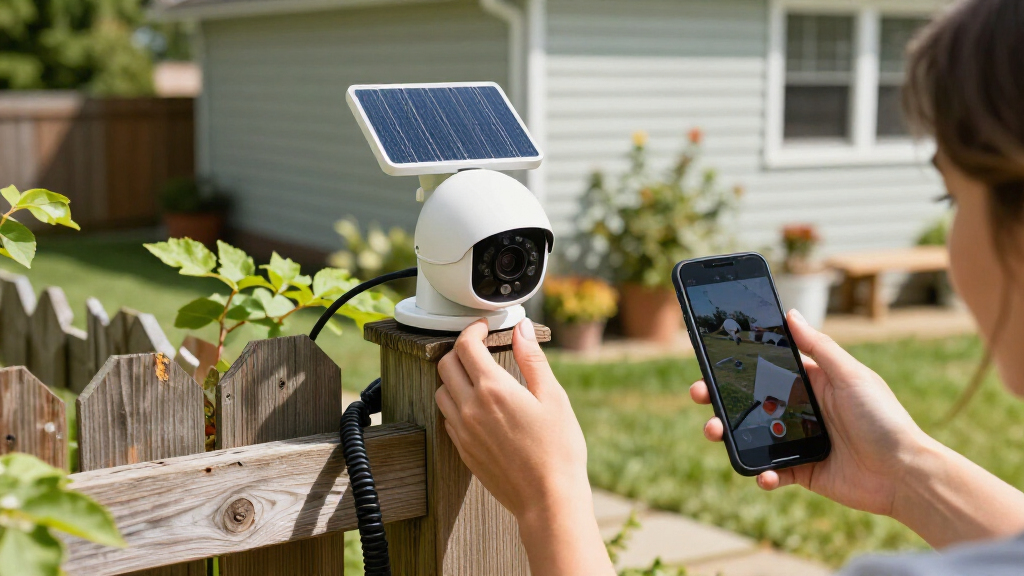
I ranked these cameras around the decisions that matter most for a solar-powered setup: usable coverage, image detail, power and mounting practicality, storage approach, and how well each configuration fits a real property. A multi-camera kit can offer better coverage for a house with several entry points, while a single pan-and-tilt camera may make more sense for a yard that needs one flexible view. I also weighed listed features such as color night vision, motion tracking, two-way audio, and local storage as tools for particular needs, not automatic signs of better performance.
The eufy SoloCam E42 kit ranks first for its combination of 4K resolution and four-camera coverage. The Reolink Argus PT Ultra and eufy SoloCam S340 follow as distinct single-camera alternatives, while value-focused and less established multi-camera kits rank lower when buyers may need to verify storage, app support, network compatibility, and included solar hardware. A product’s place here reflects how clearly its stated setup fits a buyer need; specifications alone cannot settle questions such as real-world solar charging or wireless range.
| solar powered security camera | Weather resistance |
|---|---|
| eufy Security SoloCam E42 4-Ca | — |
| REOLINK Argus PT Ultra 4K Wire | IP64 |
| Gianteye 5G Solar Wireless Out | IP65 |
| 2K Solar-Powered Wireless Outd | Listed as IP65 and IP66 in the product information |
| Wyze Solar Cam Pan 2K Wireless | IP65 |
| Wireless Outdoor Security Came | IP66 |
| 4MP Wireless Solar Security Ca | — |
| eufy Security eufyCam C37 2K W | — |
| GALAYOU R6 Solar-Powered Outdo | IP65 |
| aosu D1 Classic 4-Camera Wirel | — |
| SEHMUA 2K Solar Security Camer | — |
| GNCC Solar-Powered Outdoor Sec | IP65 |
| Soliom 5MP Solar-Powered Wirel | IP65 |
| eufy Security SoloCam S340 3K | — |
Factors to Consider When Choosing Solar Powered Security Cameras
Choosing a solar camera is as much a site-planning decision as a camera decision. I’d start by mapping where the sun reaches, where your Wi-Fi works reliably, and which areas need their own uninterrupted view.
Match Camera Count to the Property, Not the Box
Count the places you need to monitor separately: a front door, driveway, side gate, and backyard may each need a dedicated angle. A multi-camera kit can be a better fit than a rotating camera if you need simultaneous views, since one camera cannot point in two directions at once. Conversely, a single pan-and-tilt model can cover a larger open area without mounting several devices. A common mistake is buying a multi-camera system before checking whether each proposed mounting spot has usable sunlight and Wi-Fi. Sketch the camera positions first, then choose the smallest system that covers them without leaving blind spots.
Check Sun Exposure Across the Seasons
A solar panel’s usefulness depends on direct sunlight at its actual mounting location, not just the general weather in your area. Roof overhangs, trees, walls, and winter sun angles can reduce exposure even when a spot looks bright in summer. A remote panel can help when the camera needs to sit in shade, but only if the panel can be mounted in a sunny position within its cable reach. Do not assume that a solar-powered label means a camera will never need attention or backup charging. Before buying, inspect the site at different times of day and consider how much maintenance you are willing to do during darker months.
Choose Resolution for the Distance You Need to Identify
Higher resolution can preserve more detail, but it does not guarantee that a face or license plate will be identifiable from far away or in poor light. Field of view, camera placement, motion blur, night illumination, and the distance to the subject all shape the usable image. A broad overview camera may be helpful for seeing activity across a yard, while a narrower view pointed at a doorway can capture more relevant detail there. Think about what you need footage to show, rather than choosing by resolution number alone. If identification matters, aim the camera close to the likely approach path and avoid mounting it too high or too far back.
Decide Whether You Need Fixed Views, Pan-and-Tilt, or Tracking
A fixed camera keeps a reliable view of a chosen area, which can be useful for doors and gates where activity is predictable. Pan-and-tilt models can sweep a larger space, but their view may point elsewhere when an event occurs unless the camera returns to a useful preset. Auto-tracking can follow movement, though moving objects, pets, or repeated background activity may prompt unwanted recordings or camera movement. For a property with several important entrances, multiple fixed cameras may provide more dependable simultaneous coverage than one movable unit. Choose movement features for open spaces, not as a substitute for placing cameras at every important approach.
Understand Storage, Connectivity, and Alerts Before Mounting
Local storage can reduce reliance on a cloud service, but check whether the storage is built into a hub or camera, whether it can be expanded, and what happens if the device is damaged or disconnected. Wireless cameras also need a stable signal at the mounting point; a strong connection indoors does not guarantee coverage at a distant wall or detached garage. App notifications and motion zones can help reduce nuisance alerts, but they require time to tune around sidewalks, trees, and neighboring activity. Confirm what features work without a subscription and whether recordings remain accessible during an internet outage. These checks can prevent a camera from meeting its listed specification while failing the daily task you bought it for.
Pay More for a Specific Capability, Not a Longer Feature List
Extra cameras make sense when they cover distinct areas, and advanced optics are useful when one device must handle more than one viewing angle. Local storage is valuable if you want to retain footage without depending on a paid cloud plan, while two-way audio matters only if you expect to speak through the camera. Avoid paying for features that do not solve a real problem at your property, especially if the app, storage terms, or solar panel arrangement remain unclear. Lower-cost kits may cover more locations, but buyers should check their network requirements, recording options, and support details before committing to a system-wide setup. Spending more is most defensible when the added capability improves coverage or reduces a recurring inconvenience.
Frequently Asked Questions
Can a solar security camera keep working through cloudy weather or winter?
It may continue operating for a time from its battery, but solar charging can slow when sunlight is limited. The result depends on the panel’s exposure, the camera’s power use, and how often motion triggers recording. Shaded mounting points and short winter days can make a meaningful difference. Check the manufacturer’s guidance for charging and battery behavior, and plan a backup charging routine if the camera protects an important entrance. A camera mounted in a sunny spot is a safer choice than relying on a panel that will receive only indirect light.
Is a four-camera kit better than buying one pan-and-tilt camera?
Choose a multi-camera kit when you need separate areas monitored at the same time, such as the front entry and side gate. A pan-and-tilt camera may suit one open space where a movable view can cover more ground than a fixed angle. It cannot show multiple directions at once, though, and its current position may not capture another area when activity happens. Also compare installation effort, Wi-Fi coverage, and whether every camera has a viable solar location. The better choice is the one that covers your actual approach paths without depending on a camera to be pointed the right way.
Do I need a subscription to view recordings from these cameras?
That depends on the specific model and which recording features you want. Some systems advertise local storage, while others may offer extra cloud features or require an account for certain functions. Before buying, check whether event recording, playback, notifications, and storage access work without a paid plan. Also find out where local footage is saved and whether a hub, memory card, or separate component is required. Subscription terms can change, so use the current product documentation rather than assuming every feature is included.
Will a solar camera work if my Wi-Fi signal is weak outside?
Solar power does not improve the wireless connection, so a camera may still miss alerts or struggle to send footage when the signal is weak. Test Wi-Fi at the intended mounting spot before installing the camera, ideally with a phone or another device. A garage, masonry wall, long distance, or separate outbuilding can interfere with reception. You may need a mesh access point or a different camera position, and you should check whether the model supports your network band. A strong signal where you view the app indoors is not proof of a reliable connection at the camera.
Should I prioritize 4K resolution or a camera with pan-and-tilt coverage?
Prioritize resolution when the camera’s view is already aimed at a specific area and you want finer detail in that frame. Choose pan-and-tilt when the main challenge is covering a broad space from one mounting point. Movement does not guarantee that the camera will capture every event, and higher resolution cannot compensate for a poor angle or distant subject. Consider the scene first: a doorway often benefits from a stable, targeted view, while an open yard may benefit from adjustable coverage. If you need both detail and simultaneous views of several locations, separate cameras may be a better fit than expecting one device to do everything.
Conclusion
For most buyers seeking a multi-camera setup with strong stated resolution, I’d start with the eufy Security SoloCam E42 4-Camera Kit as the best overall pick. The 2K Solar-Powered Wireless Outdoor Security Camera System, 4-Pack is a value-oriented option for covering several areas, while buyers comparing kits should verify storage, support, and network details before choosing. For a premium single camera, the eufy SoloCam S340 suits those who want a dual-lens design; the REOLINK Argus PT Ultra is a better match for buyers who favor 4K pan-and-tilt coverage. Beginners may prefer starting with a single-camera option such as the eufyCam C37 rather than installing a full kit at once. If your priority is broad movement coverage, compare the PTZ and auto-tracking kits; if you need separate entrances watched at the same time, choose a multi-camera system. In every case, confirm sun exposure and Wi-Fi at each mounting point before settling on a model.
Black Friday Picks

Philips Hue Play Floor Lamp, RGBWWIC LED, 53 Inch, Black
As an affiliate, we earn on qualifying purchases.