For most households, the EcoFlow DELTA 3 Max is the best overall portable power station for home backup in this lineup, pairing a 2,048Wh battery with a more useful reserve than compact models. The Jackery HomePower 3600 Plus stands out for longer backup needs, while the BLUETTI Elite 100 V2 is a more manageable option for essential devices and shorter outages. The main tradeoff is between capacity and appliance coverage on one side and weight, cost, and storage space on the other. Small units can keep phones and routers running but are not substitutes for large backup systems. Read on for the full comparison and help matching a unit to the devices you need to keep powered.

Get backup power and energy gear delivered free with Prime
- Fast, free delivery on millions of items
- Prime Video, Amazon Music and more included
- Member-only deals all year
Complete the kit


Key Takeaways
- The 2,048Wh EcoFlow DELTA 3 Max is the strongest middle ground in this group: it offers more reserve than the 1,024Wh class without reaching the 3,000Wh-plus capacity of the largest options.
- The Jackery HomePower 3600 Plus and BLUETTI Elite 300 lead on listed capacity, making them better candidates for longer outages, but their larger batteries are a less convenient fit for buyers prioritizing easy storage and movement.
- Several models cluster around 1,000Wh, including the EcoFlow DELTA 3 Classic, BLUETTI Elite 100 V2, and Jackery Explorer 1000 v2; compare output, charging, and portability rather than treating similar capacity as equivalent.
- The 192Wh DaranEner, 292Wh Jackery Explorer 300, 288Wh BLUETTI Elite 30 V2, and 88Wh MARBERO serve limited backup roles such as phones, lights, or a router, not broad household coverage.
- Model names alone can obscure meaningful differences: the Anker SOLIX S2000 listings include different stated output and bundled configurations, so verify the exact model and specifications before choosing.
| EcoFlow DELTA 3 Max Portable Power Station, 2048Wh LFP Battery |  | Best Overall for Longer Home Outages | Battery capacity: 2048Wh | Battery type: LiFePO4 (LFP) | AC output: 2400W | VIEW LATEST PRICE | See Our Full Breakdown |
| EcoFlow DELTA 3 Classic Portable Power Station, 1024Wh, 1800W |  | Best for Fast-Refill Backup | Battery capacity: 1024Wh | Battery chemistry: LiFePO4 | AC output: 1800W | VIEW LATEST PRICE | See Our Full Breakdown |
| DaranEner 192Wh Portable Power Station with LiFePO4 Battery |  | Best Compact Emergency Companion | Battery capacity: 192Wh | Battery type: LiFePO4 | AC output: 300W continuous / 600W peak | VIEW LATEST PRICE | See Our Full Breakdown |
| BLUETTI Elite 100 V2 Portable Power Station, 1024Wh, 1800W |  | Best Mid-Size Home Backup | Battery capacity: 1024Wh | Battery type: LiFePO₄ | AC output: 1800W | VIEW LATEST PRICE | See Our Full Breakdown |
| BLUETTI Elite 300 Portable Power Station, 3014.4Wh |  | Best for Extended Outages and RV Backup | Battery capacity: 3014.4Wh | Battery type: LiFePO4 | Battery cycle life: 6000+ cycles | VIEW LATEST PRICE | See Our Full Breakdown |
| Jackery Explorer 1000 v2 Portable Power Station |  | Best Lightweight Mid-Capacity Pick | Battery capacity: 1,070Wh | Battery type: LFP | Surge peak: 3,000W | VIEW LATEST PRICE | See Our Full Breakdown |
| Anker SOLIX S2000 Portable Power Station with Power Strip |  | Best for Fridge Backup | Capacity: 2,010Wh | Peak power: 3,000W | Battery type: LiFePO4 (LFP) | VIEW LATEST PRICE | See Our Full Breakdown |
| LIBRIDS Portable Power Station 640Wh, 1200W Surge, Solar Generator with 4 AC Outlets |  | Best Compact UPS Pick | Capacity: 640Wh | Running output: 600W | Surge output: 1,200W | VIEW LATEST PRICE | See Our Full Breakdown |
| Jackery HomePower 3600 Plus Portable Power Station, 3584Wh, 3600W |  | Best for Extended Home Backup | Battery capacity: 3,584Wh | Output wattage: 3,600W | Voltage: 120V | VIEW LATEST PRICE | See Our Full Breakdown |
| LIBRIDS C600 Portable Power Station, 640Wh, 600W |  | Best for Flexible Recharging | Capacity: 640Wh | Surge power: 1,200W | Battery type: LiFePO4 | VIEW LATEST PRICE | See Our Full Breakdown |
| Jackery Explorer 300 Portable Power Station, 292Wh |  | Best Compact Pick | Capacity: 292Wh | Peak output: 600W | Battery chemistry: LiFePO4 | VIEW LATEST PRICE | See Our Full Breakdown |
| Portable Power Station, 500W, 519.48Wh |  | Best Value for Small Essentials | Capacity: 519.48Wh | AC output: 500W pure sine wave; 2 outlets, 110V | USB-A: 3 QC3.0 ports, up to 18W each | VIEW LATEST PRICE | See Our Full Breakdown |
| Anker SOLIX S2000 Portable Power Station, 2,010Wh, 1,500W |  | Best Mid-Size Home Backup | Battery capacity: 2,010Wh | Battery type: LiFePO4 | Continuous output: 1,500W | VIEW LATEST PRICE | See Our Full Breakdown |
| BLUETTI Elite 30 V2 Portable Power Station, 288Wh, 600W |  | Best Compact UPS Backup | Capacity: 288Wh | Continuous output: 600W | Power Lifting Mode: Up to 1,500W | VIEW LATEST PRICE | See Our Full Breakdown |
| MARBERO Portable Power Station 88Wh, 120W Surge, Solar Generator |  | Best for Emergency Electronics | Capacity: 88Wh | Running power: 80W | Surge power: 120W | VIEW LATEST PRICE | See Our Full Breakdown |
| portable power stations for home backup | Battery type | Weight | Battery capacity |
|---|---|---|---|
| EcoFlow DELTA 3 Max Portable P | LiFePO4 (LFP) | — | 2048Wh |
| EcoFlow DELTA 3 Classic Portab | — | — | 1024Wh |
| DaranEner 192Wh Portable Power | LiFePO4 | 5.73 lbs | 192Wh |
| BLUETTI Elite 100 V2 Portable | LiFePO₄ | 25 lbs | 1024Wh |
| BLUETTI Elite 300 Portable Pow | LiFePO4 | 58 lbs | 3014.4Wh |
| Jackery Explorer 1000 v2 Porta | LFP | 23.8 lb | 1,070Wh |
| Anker SOLIX S2000 Portable Pow | LiFePO4 (LFP) | 35.7 lb | — |
| LIBRIDS Portable Power Station | LiFePO4 | — | — |
| Jackery HomePower 3600 Plus Po | — | 77.2 lb | 3,584Wh |
| LIBRIDS C600 Portable Power St | LiFePO4 | 16.3 lb | — |
| Jackery Explorer 300 Portable | — | 7.1 lb listed; 7.5 lb in description | — |
| Portable Power Station | — | — | — |
| Anker SOLIX S2000 Portable Pow | LiFePO4 | — | 2,010Wh |
| BLUETTI Elite 30 V2 Portable P | LFP | — | — |
| MARBERO Portable Power Station | — | 3.2 lb | — |
More Details on Our Top Picks
EcoFlow DELTA 3 Max Portable Power Station, 2048Wh LFP Battery
I’d put the EcoFlow DELTA 3 Max first for households that need more than a short electronics backup. Its 2048Wh LFP battery offers twice the stored energy of the DELTA 3 Classic, while 2400W output and X-Boost up to 3400W give it more room for higher-draw appliances. That added capacity can stretch backup time, but actual runtime depends on the load. Fast charging to 80% in 1.13 hours helps when grid power returns briefly, and its sub-10ms transfer time suits devices that should stay powered through an outage. App control adds convenient monitoring. The tradeoffs are practical: the solar panel is extra, and the listed three outlets may call for a power strip when several devices need direct connections. I’d choose it over the smaller DELTA 3 Classic for longer outages, not for a lighter, simpler setup.
Pros:- 2048Wh LFP capacity provides more stored energy than the 1024Wh DELTA 3 Classic
- 2400W output with X-Boost up to 3400W supports a broader range of demanding loads
- Reaches 80% charge in 1.13 hours
- Sub-10ms transfer time and app control support backup monitoring
Cons:- Solar panel is not included
- Only three outlets are listed, limiting direct connections for multiple appliances
Best for: Households that want substantial battery capacity for several essential loads and value quick recharging between outages.
Not ideal for: Buyers who need many built-in AC outlets or expect to recharge from solar without purchasing a separate panel.
- Battery capacity:2048Wh
- Battery type:LiFePO4 (LFP)
- AC output:2400W
- X-Boost output:Up to 3400W
- Charging time:0–80% in 1.13 hours
- Transfer time:Less than 10ms
- Outlets:3
- Warranty:5 years
Our verdict“Choose the DELTA 3 Max if longer household backup and higher output matter more than outlet count or an included solar panel.”
EcoFlow DELTA 3 Classic Portable Power Station, 1024Wh, 1800W
The EcoFlow DELTA 3 Classic makes sense when quick recovery between outages matters more than keeping a large energy reserve. Its 1024Wh LFP battery and 1800W output can handle a useful set of household essentials, while AC charging reaches 80% in 45 minutes. That speed can help if power returns for only a short window. Its under-10ms backup switch and app control also suit users who want a station ready for electronics without constant manual checks. Compared with the DELTA 3 Max, this model stores half as much energy and has lower rated output, so it is less suited to extending backup across a longer outage. A further limitation is battery expansion: it is not compatible with the named DELTA 2 or DELTA 3 Series Smart Extra Batteries. Solar charging is supported, but the panel is optional.
Pros:- Reaches 80% charge from AC in 45 minutes
- 1800W output with X-Boost up to 2600W supports a range of household loads
- Under-10ms backup transfer supports sensitive electronics
- LiFePO4 battery chemistry
Cons:- 1024Wh capacity provides less outage energy than the DELTA 3 Max
- Solar panel is optional rather than included
- Not compatible with DELTA 2 Smart Extra Battery or DELTA 3 Series Smart Extra Battery
Best for: Home users who need quick AC recharging and backup for essential electronics or a limited set of appliances.
Not ideal for: Households planning long outages or future capacity expansion, since its 1024Wh battery is smaller and the listed extra batteries are incompatible.
- Battery capacity:1024Wh
- Battery chemistry:LiFePO4
- AC output:1800W
- Surge output:3600W
- X-Boost output:Up to 2600W
- AC charging:0–80% in 45 minutes
- Solar charging:2.5 hours with an optional 500W solar panel
- UPS transfer time:Under 10ms
Our verdict“Pick the DELTA 3 Classic if fast AC recharging and a manageable backup reserve matter more than long runtime or expansion options.”
DaranEner 192Wh Portable Power Station with LiFePO4 Battery
The DaranEner 192Wh is a small backup companion, not a substitute for the larger stations in this roundup. At 5.73 pounds, it is easier to move between rooms or keep ready for a phone, router, or other modest load than the 25-pound BLUETTI Elite 100 V2. Its 300W continuous output and dual AC outlets offer more than USB-only emergency charging, while the 60W USB-C PD port can serve compatible devices. The LiFePO4 battery rated for 3500+ cycles favors repeated use over time. Capacity is the clear limit: 192Wh and 300W output rule out high-power appliances such as hair dryers and rice cookers, and the solar input tops out at 60W. I’d treat it as a portable essentials unit for brief interruptions, not as a way to run several household appliances through an extended outage.
Pros:- Compact 5.73-pound design is easier to carry than the BLUETTI Elite 100 V2
- LiFePO4 battery is rated for more than 3500 charge cycles
- Dual AC outlets plus USB-C PD and USB-A provide varied charging connections
- Built-in LED flashlight includes SOS mode
Cons:- 192Wh capacity and 300W continuous output are unsuitable for high-power appliances
- Solar panels and car charging cables are not included
- Requires periodic recharging every 1–2 months for maintenance
Best for: People who want a lightweight backup for phones, small electronics, and modest loads they can carry between rooms.
Not ideal for: Households seeking refrigerator or other high-power appliance backup, or enough stored energy for a long outage.
- Battery capacity:192Wh
- Battery type:LiFePO4
- AC output:300W continuous / 600W peak
- USB-C output:60W PD
- USB-A output:18W QC3.0
- Weight:5.73 lbs
- Charge cycles:3500+
- Solar input:Maximum 60W DC
Our verdict“Choose the DaranEner for portable backup of small essentials, but move up to a 1024Wh station for meaningful household outage coverage.”
BLUETTI Elite 100 V2 Portable Power Station, 1024Wh, 1800W
The BLUETTI Elite 100 V2 is a balanced choice for essential home loads when a 3,000Wh-class unit would be more than you want to move or store. Its 1024Wh LFP battery and 1800W output put it in the same general capacity tier as the EcoFlow DELTA 3 Classic, while four listed outlets give it more direct connections than that EcoFlow’s specified setup. TurboBoost AC charging reaches 80% in about 45 minutes, and the ≤10ms UPS switch supports electronics that should remain on during a cut. At 25 pounds, it is portable enough to relocate, though not a lightweight carry. Solar, AC, car, lead-acid, and generator charging add flexibility; fast vehicle charging requires a separate Charger 1. Compared with the 3014Wh BLUETTI Elite 300, it gives up extended runtime in exchange for a smaller, lighter unit.
Pros:- 1024Wh capacity and 1800W output suit a range of essential loads
- Four listed outlets offer more direct connections than the EcoFlow DELTA 3 Classic
- Reaches 80% in about 45 minutes with TurboBoost AC charging
- ≤10ms UPS switch and several supported charging sources
Cons:- 25-pound weight may be cumbersome for frequent carrying
- Fast vehicle charging requires a separate BLUETTI Charger 1
Best for: Home users who want a 1024Wh backup station with multiple outlets, fast AC charging, and flexible charging sources.
Not ideal for: Buyers who need long runtime for several appliances or want fast vehicle charging without purchasing an additional charger.
- Battery capacity:1024Wh
- Battery type:LiFePO₄
- AC output:1800W
- Surge output:3600W
- Battery life:Over 4,000 cycles to 80%
- AC charging:About 45 minutes to 80% with TurboBoost
- UPS switchover:≤10ms
- Weight:25 lbs
- Outlets:4
Our verdict“Choose the Elite 100 V2 for a portable mid-size backup setup with four outlets, but opt for the Elite 300 when longer outage runtime is the priority.”
BLUETTI Elite 300 Portable Power Station, 3014.4Wh
For buyers prioritizing stored energy, the BLUETTI Elite 300 stands apart from the 1024Wh options here. Its 3014.4Wh LFP battery gives it substantially more capacity than the BLUETTI Elite 100 V2, while 2400W output and 4800W surge power leave more headroom for demanding loads. The TT-30 outlet and 12V/30A DC output also make it the more RV-oriented pick in this group. A 10ms UPS switch can support critical connected devices, and AC, solar, and car charging provide several ways to replenish it. The compromise is mobility: 58 pounds makes frequent carrying difficult, and only two outlets are listed, so a power strip may be needed for multiple AC devices. I’d favor it over the lighter Elite 100 V2 for longer backup, but not if easy lifting or many direct AC connections comes first.
Pros:- 3014.4Wh capacity provides a much larger reserve than the BLUETTI Elite 100 V2
- 2400W output with 4800W surge power supports higher-demand loads
- TT-30 RV outlet and 12V/30A DC output suit RV backup needs
- Supports AC, solar, and car charging with a 10ms UPS switch
Cons:- 58-pound weight makes frequent carrying difficult
- Only two outlets are listed, limiting direct AC connections
Best for: Households or RV owners who need a large energy reserve, high output, and a TT-30 connection for RV use.
Not ideal for: Buyers who frequently move their station or need more than two built-in AC outlets for simultaneous connections.
- Battery capacity:3014.4Wh
- Battery type:LiFePO4
- Battery cycle life:6000+ cycles
- AC output:2400W
- Surge power:4800W
- RV connection:TT-30 outlet
- DC output:12V/30A
- UPS switch time:10ms
- Weight:58 lbs
Our verdict“Choose the Elite 300 for longer home or RV backup when capacity and output matter more than easy lifting and outlet count.”
Jackery Explorer 1000 v2 Portable Power Station
The Jackery Explorer 1000 v2 suits buyers who need more than a phone-and-router backup but still want a unit they can move without wheels. Its 1,070Wh LFP battery and 1,500W output cover many smaller appliances and essential electronics, while the 23.8-pound weight is easier to manage than the much larger Jackery HomePower 3600 Plus. Three AC outlets and a 100W USB-C port also let you run and charge several devices at once.
The tradeoff is runtime: its capacity is modest beside the 2,010Wh Anker SOLIX S2000, so it is better for targeted backup than powering a household through a long outage. Fast charging can take an hour, but requires enabling emergency mode in the app; solar panels are sold separately. I’d choose it for portability, not for whole-home coverage.
Pros:- 23.8-pound body and foldable handle make it easier to move than the higher-capacity Anker SOLIX S2000.
- LFP battery is rated to retain over 70% capacity after 4,000 charge cycles.
- Three pure sine wave AC outlets and a 100W USB-C port support a useful mix of household electronics.
- App charging modes include a quiet overnight setting.
Cons:- Its 1,070Wh capacity provides less outage runtime than the 2,010Wh Anker SOLIX S2000.
- Solar panel is not included.
- One-hour AC charging requires emergency mode in the app; the default charge time is 1.7 hours.
Best for: People who want a carryable station for a fridge or selected essentials, plus phones and laptops, during shorter outages.
Not ideal for: Households seeking extended appliance runtime or backup for several high-draw devices; its 1,070Wh capacity and 1,500W output set limits.
- Battery capacity:1,070Wh
- Battery type:LFP
- Surge peak:3,000W
- Weight:23.8 lb
- AC outlets:3 pure sine wave
- USB-C output:100W
- AC charging time:1 hour with emergency charging enabled; 1.7 hours by default
Our verdict“Choose the Explorer 1000 v2 if manageable weight matters more than multi-day capacity or broad appliance coverage.”
Anker SOLIX S2000 Portable Power Station with Power Strip
For buyers focused on keeping a refrigerator running, the Anker SOLIX S2000 offers a useful step up from 1kWh-class stations such as the Jackery Explorer 1000 v2. Its 2,010Wh capacity is paired with 1,500W rated output, and the product description claims up to 35 hours of fridge backup. That figure depends on the appliance and conditions, but the larger battery gives you more reserve for an outage than the Jackery’s 1,070Wh.
The included surge-protected power strip adds outlets for a cluster of essentials without making the station itself larger. At 35.7 pounds, though, it is notably less convenient to carry than the Explorer 1000 v2, and its 1,500W output rules out some high-draw appliances. I’d pick it for longer targeted backup, not as a high-output substitute for the Jackery HomePower 3600 Plus.
Pros:- 2,010Wh capacity provides more stored energy than the Jackery Explorer 1000 v2.
- Product description claims up to 35 hours of fridge backup.
- Included 12-outlet power strip has 2,100J surge protection, USB-C, and USB-A ports.
- LiFePO4 battery is specified for a 15-year lifespan and 10,000 cycles.
Cons:- At 35.7 pounds, it is harder to carry than smaller 1kWh-class stations.
- 1,500W rated output may not support large space heaters, microwaves, or other high-draw appliances.
- Its capacity remains well below the expandable Jackery HomePower 3600 Plus for extended or broader home backup.
Best for: Households prioritizing refrigerator backup and several lower-draw essentials, with enough floor space for a 35.7-pound station.
Not ideal for: Buyers who need to run large space heaters, microwaves, or other high-draw appliances, or who need a light unit to carry between floors.
- Capacity:2,010Wh
- Peak power:3,000W
- Battery type:LiFePO4 (LFP)
- Weight:35.7 lb
- Dimensions:11.1 × 12.7 × 8.18 in
- Claimed fridge runtime:Up to 35 hours
- Included power strip:12 AC outlets, 1 USB-C, 2 USB-A; 2,100J surge protection
Our verdict“Pick the S2000 if fridge runtime and convenient outlet access matter more than lightweight portability or high-wattage appliance support.”
LIBRIDS Portable Power Station 640Wh, 1200W Surge, Solar Generator with 4 AC Outlets
The LIBRIDS H1008 is a compact choice for keeping a router, laptop, or other sensitive electronics powered through a brief outage. Its 10ms UPS switching is the key distinction here: it is designed to move connected equipment to battery power quickly when mains power drops. That makes it more specialized for continuity than the Jackery Explorer 1000 v2, which offers greater capacity and a higher 1,500W output for a wider range of backup tasks.
With 640Wh and 600W running output, the H1008 is better suited to modest loads than a refrigerator-and-appliance setup. Its 1.5-hour AC recharge is useful between interruptions, and the LiFePO4 battery is rated for over 4,000 cycles. The indoor-use-only label means it should stay protected from rain and wet conditions. I’d choose it for a small electronics backup station, not for broad household coverage.
Pros:- 10ms UPS switching is designed to help prevent interruptions to connected electronics.
- Pure sine wave AC output is specified for sensitive equipment such as laptops and CPAP machines.
- LiFePO4 battery is rated for over 4,000 cycles.
- 1.5-hour AC charging can shorten downtime between outages.
Cons:- 640Wh capacity and 600W running output limit runtime and appliance choices compared with the Jackery Explorer 1000 v2.
- Product labeling specifies indoor use only, so the unit needs protection from rain and wet conditions.
- Solar panel is not included in the supplied product details.
Best for: Remote workers and households who need a compact UPS-style backup for a router, laptop, CPAP machine, or other modest-load electronics.
Not ideal for: Buyers who need long refrigerator runtime, outdoor operation in wet conditions, or backup for appliances drawing over 600W.
- Capacity:640Wh
- Running output:600W
- Surge output:1,200W
- Battery type:LiFePO4
- UPS switching time:10ms
- AC charging time:1.5 hours
- Output ports:8 total, including 4 AC outlets and USB
- Warranty:5 years
Our verdict“Choose the H1008 for compact, fast-switching backup of sensitive electronics, but skip it if you need substantial appliance runtime.”
Jackery HomePower 3600 Plus Portable Power Station, 3584Wh, 3600W
The Jackery HomePower 3600 Plus is the strongest fit here for buyers who need substantial stored energy and higher output, rather than a station they can lift easily. Its 3,584Wh battery and 3,600W output outclass the 1,500W Jackery Explorer 1000 v2 and Anker SOLIX S2000 on capacity and rated power. Expansion to 21kWh per unit, or 43kWh with multiple units, gives households a path to longer backup that smaller portable models cannot match.
AC, solar, gas-generator, and hybrid charging offer several ways to replenish it, while wheels and a telescopic handle help with rolling it into place. The tradeoff is size: at 77.2 pounds, it is not a carry-up-the-stairs option. It also lists just two outlets, and solar panels are optional. I’d favor it for planned home backup, while buyers needing a lighter everyday portable station should choose a smaller model.
Pros:- 3,584Wh capacity and 3,600W output exceed the Anker SOLIX S2000 and Jackery Explorer 1000 v2.
- Expandable to 21kWh per unit or 43kWh with multiple units for longer backup needs.
- AC, solar, gas-generator, and hybrid charging give households multiple ways to recharge.
- Wheels and a telescopic handle make it easier to reposition than a 77.2-pound lift-only design.
Cons:- At 77.2 pounds, it is heavy to lift and carry.
- Only two outlets are listed, so a separate power strip may be useful for multiple devices.
- Solar panels are optional, adding a separate purchase for solar charging.
Best for: Households preparing for longer outages who want expandable capacity, multiple recharge options, and the ability to roll the station into place.
Not ideal for: People who need a lightweight unit to carry between rooms or floors, or buyers who want many built-in outlets without adding a power strip.
- Battery capacity:3,584Wh
- Output wattage:3,600W
- Voltage:120V
- Expandable capacity:Up to 21kWh per unit or 43kWh with multiple units
- Charging options:Hybrid AC+DC, AC, solar, or gas generator
- Weight:77.2 lb
- Outlets:2
- Warranty:5 years
Our verdict“Choose the HomePower 3600 Plus when expandable capacity and high output matter more than low weight and abundant built-in outlets.”
LIBRIDS C600 Portable Power Station, 640Wh, 600W
The LIBRIDS C600 shares the H1008’s 640Wh capacity and 600W rated output, but its clearest home-backup advantage is charging flexibility. It accepts AC, solar through an XT60 connection, car charging, and a gas generator, making it a practical fit for buyers who may need to recharge away from a wall outlet. Like the H1008, it includes 10ms UPS switching; compared with the Jackery Explorer 1000 v2, however, its lower capacity and output leave less room for larger appliances or longer runtimes.
The metal-bodied unit has four AC outlets, a display, and a stated recharge time as short as 1.5 hours. Those features make it useful as a compact backup hub for electronics and modest loads, not as a substitute for the 2,010Wh Anker SOLIX S2000. At 16.3 pounds, it is compact but not especially light for a 640Wh station. I’d select it over the H1008 when its listed charging inputs suit the backup plan.
Pros:- Four charging methods provide more replenishment options than an AC-only plan.
- 10ms UPS switching supports use with devices that need quick backup power.
- Four AC outlets and a display help organize and monitor connected equipment.
- LiFePO4 battery is stated to exceed 4,000 cycles while retaining over 80% capacity.
Cons:- 600W rated output limits use with high-draw appliances.
- 640Wh capacity is far below the Anker SOLIX S2000 for extended home backup.
- At 16.3 pounds, it may be tiring to carry for longer distances.
Best for: Buyers wanting a small electronics backup station that can recharge from AC, solar, a car, or a gas generator.
Not ideal for: Households expecting it to run high-draw appliances or provide long backup for a refrigerator; output is limited to 600W and capacity to 640Wh.
- Capacity:640Wh
- Surge power:1,200W
- Battery type:LiFePO4
- Charging methods:AC wall outlet, solar via XT60, car charging, gas generator
- Recharge time:As little as 1.5 hours
- UPS switching time:10ms
- Weight:16.3 lb
- Warranty:5-year limited warranty
Our verdict“Choose the C600 if you value several ways to recharge a compact UPS-capable station more than high output or long appliance runtime.”
Jackery Explorer 300 Portable Power Station, 292Wh
The Jackery Explorer 300 makes the most sense for keeping phones, a laptop, and a few small essentials running—not for backing up major home appliances. Its 292Wh capacity and 300W rated output are far below the Anker SOLIX S2000’s 2,010Wh and 1,500W, so it offers much less outage coverage but is easier to carry and store. Two AC outlets plus USB-C, USB-A, and a car port let you share power among different small devices. Solar charging adds flexibility, though the panel is sold separately. The LiFePO4 battery is rated for over 4,000 charge cycles, a useful durability point for regular use. Conflicting listed weights and dimensions make it harder to confirm its fit before buying.
Pros:- Lightweight design is easier to move and store than larger backup stations
- LiFePO4 battery is rated for over 4,000 charge cycles
- AC, USB-C, USB-A, and car-port outputs accommodate several small devices
- Can recharge with compatible solar panels
Cons:- Limited capacity and 300W rated output restrict home-appliance backup
- Solar panel is sold separately
- Product information lists conflicting weights and dimensions
Best for: Apartment dwellers or remote workers who want a carryable backup for phones, a laptop, and other low-wattage essentials.
Not ideal for: Households seeking overnight refrigerator backup or power for high-draw appliances; its 292Wh capacity and 300W rated output are limiting.
- Capacity:292Wh
- Peak output:600W
- Battery chemistry:LiFePO4
- Ports:2 AC outlets, 1 USB-C PD (100W), 2 USB-A, 1 car port (120W)
- Weight:7.1 lb listed; 7.5 lb in description
- Solar charging:80% in about 2.8 hours with a 100W panel, or 7.5 hours with a 40W panel
- Included:Power station, AC adapter, car charger cable, user guide; solar panel not included
Our verdict“Choose the Explorer 300 for portable backup of small electronics, not for keeping major household appliances running.”
Portable Power Station, 500W, 519.48Wh
This 519.48Wh station offers a step up from compact models when an outage plan includes several small devices rather than household appliances. Its 500W pure sine wave inverter and ten listed outlets provide more connection options than the Jackery Explorer 300, while the 18-pound weight makes it less appealing to carry around. Three QC3.0 USB-A ports, a 60W USB-C port, wireless charging, and AC outlets can support a mix of devices at once. Wall, car, and solar charging give it useful flexibility, but a 100W panel is listed as taking six to nine hours in full sun. The 500W limit rules out many high-draw appliances, and AC output can drain the battery if left enabled without a load.
Pros:- 519.48Wh capacity exceeds the Jackery Explorer 300 for longer small-device backup
- Pure sine wave AC output is suited to compatible sensitive electronics
- Ten outlet types include AC, USB-C, USB-A, DC, car, and wireless charging
- Can recharge from a wall outlet, car charger, or compatible solar panel
Cons:- 500W output limit excludes many high-draw appliances
- At 18 pounds, it is less convenient to carry than compact options
- Solar charging is slow with a 100W panel, and the panel is sold separately
Best for: Households that want to charge several phones, tablets, and other modest electronics during an outage and value varied output ports.
Not ideal for: Buyers who need refrigerator or other high-wattage appliance backup, or who want a lightweight station for frequent carrying.
- Capacity:519.48Wh
- AC output:500W pure sine wave; 2 outlets, 110V
- USB-A:3 QC3.0 ports, up to 18W each
- USB-C:1 PD port, up to 60W
- Other outputs:2 DC ports, 1 car port, 1 wireless charger
- Recharge options:Wall outlet, car charger, compatible 100W or 200W solar panel
- Charging time:6–7 hours by wall; 7–8 hours by car; 6–9 hours with a 100W solar panel in full sun
- Weight and dimensions:18 lb; 11.57 × 7.95 × 7.95 in
Our verdict“Pick this model for flexible multi-device backup when a 500W output ceiling and 18-pound weight fit your needs.”
Anker SOLIX S2000 Portable Power Station, 2,010Wh, 1,500W
The Anker SOLIX S2000 is the strongest home-backup fit in this group for buyers who need meaningful appliance runtime without moving up to a much larger station such as the Jackery HomePower 3600 Plus. Its 2,010Wh LiFePO4 battery, 1,500W continuous output, and 3,000W peak output cover far more than the Explorer 300 or BLUETTI Elite 30 V2 can. An under-10-ms UPS switchover can help connected equipment stay powered through a brief interruption, while support for up to 400W solar input gives it a path to recharge during a longer outage. The listing’s refrigerator runtime claim is up to 35 hours, but actual time depends on the appliance and conditions. At 35.7 pounds, it is portable but no longer an easy one-hand carry, and there is no 12V DC port.
Pros:- 2,010Wh LiFePO4 battery offers far more stored energy than the smaller models here
- 1,500W continuous and 3,000W peak output support a broader range of loads
- UPS switchover under 10ms can help maintain power to connected equipment
- Accepts up to 400W solar input and supports six recharge methods
Cons:- No 12V DC port for devices that rely on a direct DC connection
- 35.7-pound weight is less convenient to move than compact options
- Actual refrigerator runtime varies with appliance use and conditions
Best for: Homeowners seeking a mid-size outage station for essential appliances and electronics, with UPS support and solar recharging capability.
Not ideal for: Buyers who need a built-in 12V DC connection, extended whole-home backup, or a station light enough for frequent carrying.
- Battery capacity:2,010Wh
- Battery type:LiFePO4
- Continuous output:1,500W
- Peak output:3,000W
- Solar input:Up to 400W
- Outlets:8
- UPS switchover:Under 10ms
- Weight and dimensions:35.7 lb; 8.19 × 11.1 × 12.7 in
Our verdict“Choose the SOLIX S2000 when you want substantially more outage coverage than compact stations provide but do not need a larger 3,584Wh unit.”
BLUETTI Elite 30 V2 Portable Power Station, 288Wh, 600W
The BLUETTI Elite 30 V2 is a compact option for keeping selected electronics powered through an outage, with a 600W continuous output that exceeds the Jackery Explorer 300’s 300W rating despite similar capacity. Its 288Wh battery still limits how long it can run anything beyond small devices, so the higher output should not be mistaken for long appliance backup. The listed Power Lifting Mode reaches 1,500W, but that is not its standard continuous output. Where it has a clearer home-backup advantage over the Explorer 300, and the much smaller MARBERO 88Wh unit, is its UPS transfer time of up to 10ms. Fast AC charging can reach 80% in 45 minutes. It weighs 9.5 pounds and supports several charging methods, though solar panels are not listed among the included components.
Pros:- 600W continuous output is higher than the Jackery Explorer 300’s 300W rating
- UPS transfer time of up to 10ms supports backup for connected electronics
- AC charging reaches 80% in 45 minutes and full charge in 70 minutes
- Supports AC, solar, car, lead-acid, and generator charging
Cons:- 288Wh capacity limits runtime for appliances and other sustained loads
- 1,500W Power Lifting Mode is not the standard continuous output
- At 9.5 pounds, it is heavier than the Jackery Explorer 300
Best for: Remote workers and households who want a compact UPS-style backup for selected electronics and need more continuous output than a 300W mini station.
Not ideal for: Buyers seeking long refrigerator runtime or backup for multiple high-demand appliances; 288Wh is a small energy reserve.
- Capacity:288Wh
- Continuous output:600W
- Power Lifting Mode:Up to 1,500W
- Battery type:LFP
- UPS transfer time:Up to 10ms
- AC charging time:0–80% in 45 minutes; 0–100% in 70 minutes
- Charging methods:AC, solar, car, lead-acid, generator
- Weight and dimensions:9.5 lb; 9.8 × 7 × 6.6 in
Our verdict“Choose the Elite 30 V2 for quick-charging compact UPS backup, but choose a higher-capacity station for meaningful appliance runtime.”
MARBERO Portable Power Station 88Wh, 120W Surge, Solar Generator
The MARBERO 88Wh is best treated as an emergency electronics pack, not a home appliance backup station. At 3.2 pounds, it is the easiest model here to keep in a drawer or grab during a power cut, but its 80W running power and 88Wh capacity are a fraction of the BLUETTI Elite 30 V2’s 600W output and 288Wh reserve. Eight ports let it serve multiple small devices, and the built-in LED light with SOS mode adds a practical emergency feature. AC charging reaches 80% in two hours, while solar charging is supported. Its 120W surge limit and small battery leave little room for larger loads or extended use; shoppers needing broader backup should step up to the Jackery Explorer 300 or a larger station.
Pros:- 3.2-pound weight makes it the easiest model in this group to store and carry
- Eight output ports support several small devices
- Built-in adjustable LED light includes an SOS mode
- AC charging reaches 80% in two hours
Cons:- 88Wh capacity offers very limited runtime for home-backup use
- 80W running power and 120W surge limit rule out many appliances
- Solar panels are required for solar charging and are not listed as included
Best for: People who want a lightweight emergency kit for phones, small electronics, and light during brief outages.
Not ideal for: Households needing refrigerator backup, longer runtime, or appliances drawing more than its 80W running output.
- Capacity:88Wh
- Running power:80W
- Surge power:120W
- Weight:3.2 lb
- Dimensions:6.5 × 4.6 × 3.1 in
- Output ports:8; AC, DC, USB, and USB-C
- AC recharge time:0–80% in 2 hours
- Safety features:BMS, short-circuit protection, overload protection, temperature control
Our verdict“Choose the MARBERO for a light emergency electronics kit, not as your main source of household backup power.”
How We Picked
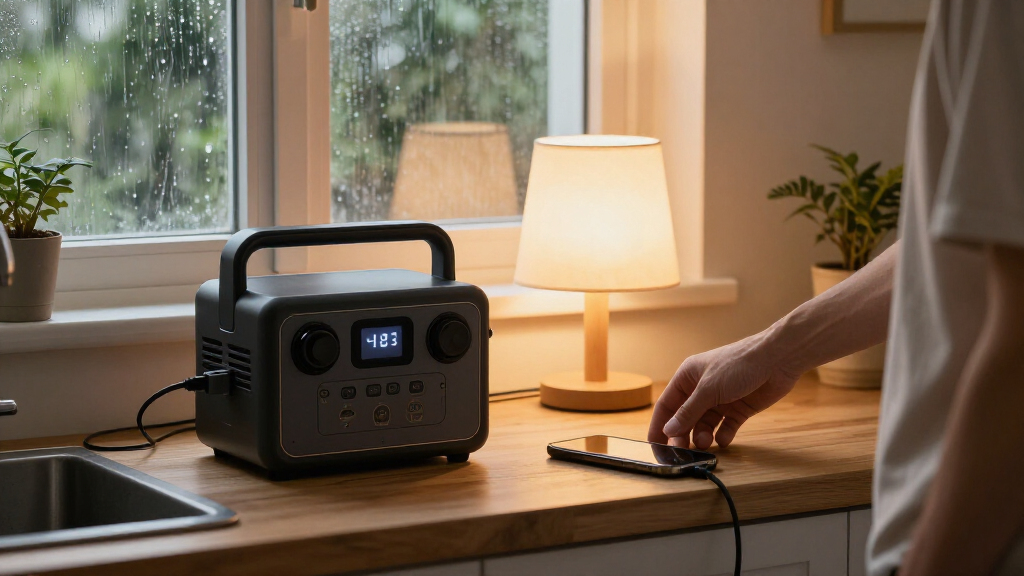
I ranked these stations for outage usefulness at home, not for travel convenience alone. Capacity and AC output mattered because they determine how long a unit can support essential devices and which appliances it may run; I also weighed portability, output versatility, and how clearly the listed specifications support a household backup role. A high capacity does not guarantee that a station can run a particular appliance, so wattage limits and the device’s startup demand remain part of the comparison.
The ranking favors models that balance usable reserve with practical output, then separates larger-capacity options from compact units with narrower roles. The 3,000Wh-plus Jackery and BLUETTI picks rank highly for extended backup potential, while 1,000Wh-class models offer a more manageable compromise. Smaller products appear lower because their capacity limits how much of a household they can support, though they may still suit essential low-power devices. Where product names or listed configurations leave output unclear, I treat that uncertainty as a reason to check the exact version before purchase.
| portable power stations for home backup | Battery type |
|---|---|
| EcoFlow DELTA 3 Max Portable P | LiFePO4 (LFP) |
| EcoFlow DELTA 3 Classic Portab | — |
| DaranEner 192Wh Portable Power | LiFePO4 |
| BLUETTI Elite 100 V2 Portable | LiFePO₄ |
| BLUETTI Elite 300 Portable Pow | LiFePO4 |
| Jackery Explorer 1000 v2 Porta | LFP |
| Anker SOLIX S2000 Portable Pow | LiFePO4 (LFP) |
| LIBRIDS Portable Power Station | LiFePO4 |
| Jackery HomePower 3600 Plus Po | — |
| LIBRIDS C600 Portable Power St | LiFePO4 |
| Jackery Explorer 300 Portable | — |
| Portable Power Station | — |
| Anker SOLIX S2000 Portable Pow | LiFePO4 |
| BLUETTI Elite 30 V2 Portable P | LFP |
| MARBERO Portable Power Station | — |
Factors to Consider When Choosing Portable Power Stations For Home Backup
Choosing a home backup station starts with your outage plan, not the largest battery number on the label. I would decide which devices matter, estimate their combined demand, and then weigh runtime against the realities of placement, charging, and safe operation.
Choose the Loads Before Choosing the Battery
Write down the devices you actually need during an outage: perhaps a modem, phones, lights, a laptop, or a medical device. Add their running wattage, then check whether appliances with motors or compressors need extra startup power. A station’s watt-hour capacity estimates stored energy, while its watt output limits what can run at one time; the two numbers answer different questions. A high-capacity unit can still be a poor match for a device whose power demand exceeds the output limit. Avoid planning around the idea of powering an entire home unless the equipment is designed and installed for that setup. This simple load list can prevent paying for capacity you will not use—or buying a compact unit that cannot run your priority appliance.
Estimate Runtime With a Realistic Reserve
Battery capacity does not translate directly into the same number of watt-hours at every outlet because conversion losses and device behavior affect delivered energy. Treat runtime estimates as planning ranges, not guarantees, and leave a reserve for changing conditions or unexpected needs. A refrigerator cycles on and off, while a router may draw power steadily, so their use patterns differ even when their rated loads seem similar. For a short outage, a 1,000Wh-class station may cover a modest set of essentials; a multi-day plan usually calls for more stored energy, lower consumption, or a way to recharge. Do not count on a small station to run heat, cooking equipment, or other high-draw appliances for long. Prioritize the loads that matter most before estimating how many hours you need.
Match Output to Appliance Startup Needs
Check both continuous AC output and any stated surge rating against the devices you plan to connect. Some appliances briefly draw more power when starting than they do while running, and that initial demand can trip a station even when the average wattage looks acceptable. A power strip does not increase a station’s output capacity; it only provides more places to plug in. For sensitive electronics, confirm that the unit’s AC output and operating guidance suit the equipment, and follow manufacturer instructions. If you want to run several devices at once, add their likely simultaneous loads instead of checking each one in isolation. When specifications are incomplete or listings describe different configurations, verify the precise model before relying on it for backup.
Plan How You Will Recharge During an Outage
A station’s usefulness depends on how you can replenish it after the stored energy runs down. Check its supported charging methods and the time those methods may require; solar recharging depends on panel compatibility, sunlight, weather, and placement. A solar panel’s advertised output is not a promise of constant power, so a cloudy day can change the plan. Grid charging is convenient before an outage, but it cannot help while utility service is unavailable. Think through where panels could sit safely and whether cables can reach the station without creating a trip hazard. If outages in your area last more than a day, charging access and reduced consumption may matter as much as initial battery capacity.
Balance Capacity Against Weight and Storage
Large-capacity stations can support more backup needs, but they take more space and may be harder to move when rooms, stairs, or storage areas are involved. A compact unit can be easier to keep ready near a router or bedside, though its limited reserve makes it less suitable for several devices or long outages. Decide where the station will live and whether one person can move it safely before favoring capacity alone. Leave suitable clearance and follow the manufacturer’s instructions for storage, ventilation, and operating temperature. Also check whether the connections you need are accessible without moving the unit. The best size is the one that fits both your backup plan and your home’s practical limits.
Know When a Portable Station Is Not Whole-Home Backup
Portable power stations are generally best for selected devices and circuits, not automatic, seamless backup of every outlet in a house. Connecting a station to household wiring can create serious hazards if done incorrectly; never feed power into a wall outlet or improvise a connection. If you want to supply home circuits, consult a qualified electrician about compatible transfer equipment and the station’s supported setup. Buyers with large heating, cooling, or cooking loads may need a different backup approach than a portable battery can provide. For essential medical equipment, check both the device manufacturer’s power requirements and the station maker’s guidance, and plan for backup beyond a single battery when needed. Set clear expectations about which loads the station can support before an outage occurs.
Frequently Asked Questions
Can a portable power station run my refrigerator during an outage?
It may, but the answer depends on the refrigerator’s running and startup demand, the station’s AC output, and how long you need it to operate. Check the appliance label or manual for its electrical requirements, then confirm the station can handle both continuous use and startup surge. Battery capacity affects runtime, while output capacity affects whether the refrigerator can start and run at all. Because refrigerators cycle, their actual energy use varies with temperature, door openings, and age. If refrigeration is a priority, test the planned setup before an outage and keep other loads limited.
Is a 1,000Wh power station enough for an overnight outage?
It can be enough for selected low-power essentials, such as a router, phones, lights, and a laptop, but it is not a fixed overnight guarantee. Runtime depends on the combined energy use, conversion losses, and whether any high-draw appliance is added. A refrigerator or medical device can change the calculation substantially, so estimate those loads separately. The EcoFlow DELTA 3 Classic, BLUETTI Elite 100 V2, and Jackery Explorer 1000 v2 sit near this capacity class, but their other specifications and exact configurations still matter. Keep a reserve rather than planning to use every watt-hour on paper.
Should I choose a 3,000Wh-plus station or a smaller model?
A larger battery makes more sense when you need longer runtime, several essential devices, or fewer interruptions to recharge. The Jackery HomePower 3600 Plus and BLUETTI Elite 300 have much more listed capacity than the 1,000Wh-class choices, but larger units also require more storage space and can be less convenient to move. A smaller model may be the better fit when your plan covers only communications, lighting, and personal electronics. Compare the extra capacity with the actual loads you expect to run instead of assuming bigger is always better. If you need high-draw appliances, check output limits as well as battery size.
Can I connect a portable power station to my home’s electrical panel?
Do not connect a station to household wiring with a homemade cable or by plugging it into a wall outlet. Feeding power into a circuit improperly can endanger occupants and utility workers and may damage equipment. Some backup arrangements require compatible transfer equipment and professional installation, and not every portable station supports that role. Ask a qualified electrician to review the station’s instructions and your home’s electrical setup before planning panel backup. If you are only powering individual devices, connect them directly as directed by the manufacturer.
Which models in this roundup make sense for a phone-and-router backup plan?
For a narrow plan focused on phones, lights, or a router, the compact DaranEner 192Wh, Jackery Explorer 300, BLUETTI Elite 30 V2, and MARBERO 88Wh are more aligned with the job than the large-capacity units. Their smaller reserves also mean less flexibility if you later add a refrigerator or several devices. Compare port types, output, and the router’s power needs before choosing among them. The MARBERO’s listed capacity is especially limited, so it is best suited to brief, low-power use rather than extended household backup. If you expect outages to last, stepping up in capacity can reduce how quickly you need to ration power.
Conclusion
Best overall: I would start with the EcoFlow DELTA 3 Max for its 2,048Wh capacity and balanced position between compact stations and the largest batteries. Best value in capability: the EcoFlow DELTA 3 Classic is a sensible fit for buyers who want a 1,024Wh-class backup option without moving to a much larger unit; compare its output and charging features with other models in that class before deciding. Best premium for longer outages: choose the Jackery HomePower 3600 Plus if its 3,584Wh capacity better matches your planned loads and you can accommodate a larger station; the BLUETTI Elite 300 is another high-capacity alternative. Best for beginners: the BLUETTI Elite 100 V2 offers a clear starting point for essential-device backup without requiring a 3,000Wh-plus unit. For a specific compact need such as phones and a router, consider the Jackery Explorer 300 or BLUETTI Elite 30 V2, while treating the smallest units as limited backup rather than whole-home solutions. Before buying any model, match its output to your appliances, estimate realistic runtime, and verify the exact configuration you intend to purchase.
Halloween Picks
halloween
As an affiliate, we earn on qualifying purchases.