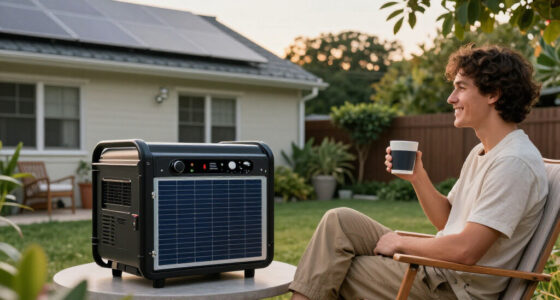
I ranked these power stations by how useful their wireless charging is alongside the rest of the package: capacity, output, portability, charging options and the limits that matter on a trip or during an outage. The POWKEY R600 is my strongest all-round wireless pick, with two 10W pads and 600W output; the BLAVOR 236.8Wh suits outdoor use with a 15W pad and a covered IP67-rated design; and the Jackery Explorer 1000 v2 is the capacity choice if running larger devices matters more than having a specified wireless pad.

Get backup power and energy gear delivered free with Prime
- Fast, free delivery on millions of items
- Prime Video, Amazon Music and more included
- Member-only deals all year
The main tradeoff is that wireless charging is convenient for phones and other compatible devices, but it does not replace AC outlets or USB-C when you need higher output or predictable wired charging. Capacity also changes the decision: the light Akiisolo and R101 Lite are easy to carry, while the Jackery can run far more but weighs 23.8 pounds. I’ve kept the ranking focused on what each model actually offers, including a clear distinction between products with listed wireless charging and the Jackery, whose supplied specifications do not list a wireless pad.
Complete the kit


Key Takeaways
- POWKEY R600 offers the most balanced combination of listed wireless charging, 296Wh capacity and 600W output; its two pads are rated at 10W each.
- BLAVOR has the strongest listed wireless charging rate at 15W, plus an IP67 rating when its silicone cover is closed and a built-in lantern.
- Jackery Explorer 1000 v2 leads on capacity and appliance output, but its supplied specifications do not identify a wireless charging pad.
- Akiisolo GO10Y combines a 192Wh LiFePO4 battery, 3.9-pound weight and UPS feature, but its 100W rated output is for smaller loads.
- R101 Lite is the lightest at 2.5 pounds, but its 89.6Wh capacity makes it a short-use companion rather than a long-running backup.
| POWKEY R600 600W Portable Power Station, 296Wh |  | Best Overall for Wireless Charging | Battery capacity: 296Wh | Maximum output: 600W | AC outlets: 2 x 110V pure sine wave | VIEW ON AMAZON | See Our Full Breakdown |
| BLAVOR 236.8Wh Portable Power Station with 165W Output, Wireless Charging, and Camping Lantern |  | Best for Camping and Outdoor Use | Capacity: 236.8Wh / 64,000mAh | Maximum output: 165W | USB-C ports: 2, 100W bidirectional | VIEW ON AMAZON | See Our Full Breakdown |
| Jackery Explorer 1000 v2 Portable Power Station, 1070Wh, 1500W, Dune White |  | Best for Capacity and Appliance Output | Battery capacity: 1,070Wh | Battery type: LFP | Running output: 1,500W | VIEW ON AMAZON | See Our Full Breakdown |
| Akiisolo GO10Y Portable Power Station, 192Wh LiFePO4 Battery |  | Best Compact Pick with UPS Backup | Capacity: 192Wh | Battery type: LiFePO4 | Surge output: 200W | VIEW ON AMAZON | See Our Full Breakdown |
| R101 Lite Portable Power Station, 89.6Wh, 100W AC Output |  | Best for Minimal Weight and Short Trips | Battery capacity: 89.6Wh | Battery type: LiFePO4 | Weight: 2.5 lbs | VIEW ON AMAZON | See Our Full Breakdown |
| power stations with wireless charging | Battery capacity | AC outlets | Battery type | Weight |
|---|---|---|---|---|
| POWKEY R600 600W Portable Powe | 296Wh | 2 x 110V pure sine wave | — | — |
| BLAVOR 236.8Wh Portable Power | — | — | — | — |
| Jackery Explorer 1000 v2 Porta | 1,070Wh | 3 pure sine wave | LFP | 23.8 lbs |
| Akiisolo GO10Y Portable Power | — | — | LiFePO4 | 3.9 lbs |
| R101 Lite Portable Power Stati | 89.6Wh | 2 | LiFePO4 | 2.5 lbs |
More Details on Our Top Picks
POWKEY R600 600W Portable Power Station, 296Wh
The POWKEY R600 takes my top spot because wireless charging is part of a well-rounded output set rather than the whole pitch. Its two 10W wireless pads let two compatible devices charge without using USB ports, while 296Wh capacity and 600W maximum output give it more range than the compact Akiisolo and R101 Lite. Two pure sine wave AC outlets add flexibility for devices that need a wired connection.
That balance is the reason I place it ahead of the BLAVOR for general use, even though BLAVOR’s single listed pad is faster at 15W and its closed-cover IP67 rating better suits rough outdoor settings. POWKEY instead offers the higher listed output and two wireless charging positions. Its 600W ceiling still rules out appliances that draw more, and the solar panel is sold separately. At 296Wh, it is a middle-ground station, not a long-duration substitute for the 1,070Wh Jackery.
Who should choose it: buyers who want wireless convenience for more than one device, plus enough AC output for a wider range of small electronics. Who should skip it: anyone seeking the fastest listed wireless charging, weather protection, or enough capacity for extended high-draw use. Compared with BLAVOR, POWKEY favors output and dual-pad convenience; compared with Jackery, it makes portability and wireless charging more central.
Pros:- Two 10W wireless charging pads
- 600W maximum output with two pure sine wave AC outlets
- AC, USB, DC and wireless charging options
- Can recharge from a wall outlet, car or compatible solar panel
Cons:- Solar panel is not included
- Devices must draw less than 600W
- 296Wh capacity is limited for extended use
Best for: Buyers who want two wireless charging pads, several wired output types and 600W maximum output in a mid-capacity station.
Not ideal for: People who need a specified 15W wireless pad, a covered IP67 design, or enough battery for prolonged appliance use.
- Battery capacity:296Wh
- Maximum output:600W
- AC outlets:2 x 110V pure sine wave
- Wireless charging:2 x 10W
- Other ports:2 USB-A, 2 USB-C, 2 x 12V DC
- Charging methods:Wall outlet, car port or compatible solar panel
- Recommended solar panel voltage:13–24V
- Solar panel included:No
Our verdict“I recommend the POWKEY R600 as the most balanced choice for buyers who want dual wireless pads without giving up useful AC output.”
BLAVOR 236.8Wh Portable Power Station with 165W Output, Wireless Charging, and Camping Lantern
The BLAVOR stands out for pairing the fastest listed wireless pad here with features aimed at outdoor use. Its 15W pad is rated above the POWKEY’s two 10W pads, and the built-in lantern adds a practical campsite light without taking an extra port. The IP67 rating applies when the silicone cover is closed, which is a useful distinction for buyers expecting dust or water exposure: it is not a reason to leave the ports uncovered.
Capacity is 236.8Wh and maximum output is 165W, so this is a smaller, lower-output option than the POWKEY R600. That makes it better suited to phones, tablets, lights and other modest loads than to appliances that need substantial AC power. Two 100W bidirectional USB-C ports support wired charging and recharging, while solar input is available with a compatible 100W panel sold separately. Compared with the Akiisolo, BLAVOR’s listed wireless pad and covered water-and-dust rating make its outdoor role more specific; Akiisolo counters with a UPS feature and LiFePO4 battery details.
Choose BLAVOR if outdoor convenience, its 15W pad and lantern are priorities. Skip it if you need the higher output or dual wireless positions of POWKEY, or if your use depends on running appliances beyond the 165W rating. The separate solar panel is another piece of kit to account for.
Pros:- 15W wireless charging pad
- IP67-rated when the silicone cover is closed
- Built-in lantern with three brightness settings
- Two 100W bidirectional USB-C ports
Cons:- Maximum output is 165W, below the POWKEY R600
- Compatible 100W solar panel is sold separately
- Wireless charging requires a compatible device and pad positioning
Best for: Campers and outdoor users who want a 15W wireless pad, lantern and covered IP67-rated design for compatible devices and modest loads.
Not ideal for: Buyers who need high-output AC power, two wireless pads or a ready-to-use solar setup.
- Capacity:236.8Wh / 64,000mAh
- Maximum output:165W
- USB-C ports:2, 100W bidirectional
- USB-A ports:2
- Wireless charging:15W
- Lantern runtime:Up to 59 hours on low
- Solar charging:Compatible with a 100W panel, sold separately
Our verdict“I’d choose BLAVOR over the POWKEY for outdoor protection and a faster listed wireless pad, but not for higher-output appliances.”
Jackery Explorer 1000 v2 Portable Power Station, 1070Wh, 1500W, Dune White
The Jackery is the clear choice when battery capacity and AC output matter more than wireless charging. Its 1,070Wh LFP battery and 1,500W running output are far beyond the compact Akiisolo and R101 Lite, and the three pure sine wave AC outlets make it better suited to powering multiple larger devices. A 3,000W surge peak provides additional starting headroom for compatible loads, though buyers still need to check each device’s requirements.
This model ranks behind the POWKEY and BLAVOR for this particular roundup because the supplied specifications do not list a wireless charging pad. I would not buy it on the assumption that a phone can be charged by setting it on the unit. Its strengths are wired power, app control and capacity: quiet overnight and energy-efficiency modes offer useful control, and emergency charging can reach a full charge in one hour when enabled in the app. Default charging is listed at 1.7 hours.
At 23.8 pounds, it is much less convenient to carry than the 3.9-pound Akiisolo or 2.5-pound R101 Lite. Solar compatibility is limited to Jackery panels, which are not included. For a home backup or trip where higher-output devices are the priority, the Jackery is the strongest performer here; for an explicitly wireless-first purchase, POWKEY or BLAVOR is a better match.
Pros:- 1,070Wh capacity and 1,500W running output
- Three pure sine wave AC outlets
- LFP battery rated for over 4,000 cycles while retaining over 70% capacity
- App control includes quiet overnight and energy-efficiency modes
Cons:- Wireless charging is not listed in the supplied specifications
- Solar panels are not included and compatibility is limited to Jackery panels
- Weighs 23.8 pounds
Best for: Buyers prioritizing a large battery, multiple AC outlets and 1,500W running output over a specified built-in wireless pad.
Not ideal for: Anyone shopping specifically for wireless charging, a light carry-on station or third-party solar compatibility.
- Battery capacity:1,070Wh
- Battery type:LFP
- Running output:1,500W
- Surge peak:3,000W
- AC outlets:3 pure sine wave
- USB ports:2 USB-C up to 100W; 1 USB-A
- Weight:23.8 lbs
- Charging time:1 hour with app-enabled emergency charging; 1.7 hours by default
- Solar compatibility:Jackery solar panels only; panel not included
Our verdict“I recommend the Jackery for capacity-led backup and appliance use, but I would select POWKEY or BLAVOR when built-in wireless charging is a must.”
Akiisolo GO10Y Portable Power Station, 192Wh LiFePO4 Battery
The Akiisolo GO10Y is a portable, small-load station with a useful mix of connections, but its supplied specifications do not list wireless charging. That keeps it below the two models that directly meet the roundup’s wireless brief. I include it as a comparison for buyers deciding whether a wireless pad is worth prioritizing over other features: the GO10Y offers a 192Wh LiFePO4 battery, UPS functionality and SOS LED light in a 3.9-pound package.
Its two USB-C ports and two USB-A ports can handle several smaller devices, while one AC outlet supports loads up to the 100W rated output. That is notably less headroom than the POWKEY’s 600W or BLAVOR’s 165W, and the single AC outlet makes simultaneous AC use limited. The battery is rated for over 3,000 charging cycles, a useful longevity detail for a unit kept on hand, but it does not change its low output ceiling.
Compared with the R101 Lite, Akiisolo brings over twice the listed capacity and a UPS feature, while R101 Lite is lighter and provides two AC outlets. Neither product’s supplied details identify a wireless pad. I’d choose Akiisolo for a compact backup role where capacity and UPS operation count; I’d skip it if placing a phone on a pad is a required part of the purchase.
Pros:- Compact 3.9-pound design
- 192Wh LiFePO4 battery rated for over 3,000 charging cycles
- UPS feature for backup power
- Multiple USB, DC and AC connections plus SOS LED light
Cons:- Wireless charging is not listed in the supplied specifications
- 100W rated output limits appliance choices
- Only one AC outlet
Best for: Buyers seeking a light 192Wh backup with a UPS feature, LiFePO4 battery and multiple wired device ports.
Not ideal for: People who require built-in wireless charging or need to run appliances above 100W.
- Capacity:192Wh
- Battery type:LiFePO4
- Surge output:200W
- Ports:1 AC, 2 USB-C, 2 USB-A, 2 DC
- Weight:3.9 lbs
- Dimensions:4.6 x 4.6 x 7 inches
- Warranty:1 year
Our verdict“I’d pick the GO10Y for a compact UPS-style backup, not for wireless charging or higher-draw appliances.”
R101 Lite Portable Power Station, 89.6Wh, 100W AC Output
At 2.5 pounds, the R101 Lite is the easiest unit here to carry, and its seven output ports make the small body useful for charging several devices. Its 89.6Wh LiFePO4 battery, two AC outlets and 100W AC output fit short outings or a compact emergency kit. But it does not meet the wireless focus on the information provided: its specifications do not list a wireless charging pad.
That absence matters when comparing it with the wireless-equipped POWKEY and BLAVOR. Those options offer a way to charge compatible devices without occupying a wired port; R101 Lite instead emphasizes low weight, two AC outlets and USB-C charging. Its USB-C1 supports up to 100W output and 65W input, while a second USB-C port provides up to 30W. Recharging can use AC, USB-C PD, solar or a car socket, with panels sold separately.
The tradeoff is runtime: 89.6Wh is less than half the Akiisolo’s capacity and far below the 236.8Wh BLAVOR. The listed AC output shuts off when battery power drops below 9%, another limit to keep in mind when relying on it for AC-powered devices. I’d take it over heavier options for a light, short-use kit, but buyers wanting built-in wireless charging should move to the POWKEY or BLAVOR instead.
Pros:- Lightweight 2.5-pound design with carry handle
- Seven total ports, including two AC outlets
- LiFePO4 battery with battery-management safety monitoring
- AC, USB-C PD, solar and car-socket recharging options
Cons:- Wireless charging is not listed in the supplied specifications
- 89.6Wh capacity limits runtime
- AC output shuts off when battery power drops below 9%
Best for: Travelers who value the lowest weight, multiple wired ports and a compact station for short-duration charging.
Not ideal for: Buyers who want listed wireless charging, longer runtime or sustained AC use as the battery runs down.
- Battery capacity:89.6Wh
- Battery type:LiFePO4
- Weight:2.5 lbs
- AC output:100W, 200W peak
- AC outlets:2
- USB-C ports:USB-C1: 65W input / 100W output; USB-C2: 30W output
- Total ports:7
- Recharge methods:AC, USB-C PD, solar or car socket
- Warranty:12 months
Our verdict“I recommend the R101 Lite for minimal-weight wired charging, but not as a wireless-first or long-runtime station.”
How We Picked
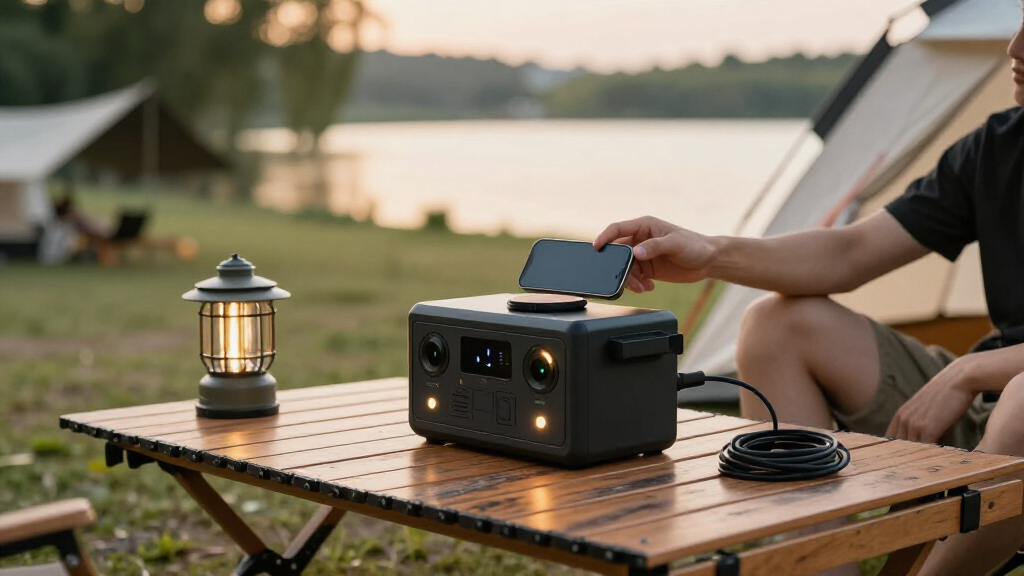
I gave priority to the promise in this roundup: power stations that can wirelessly charge compatible devices, and the practical differences between their wireless pads. The POWKEY and BLAVOR list wireless charging rates, so they rank ahead for buyers who specifically want to set down a phone rather than reach for a cable. The Jackery is included as a capacity-focused comparison, not as a wireless pick: its supplied details do not specify a wireless pad, so buyers should not choose it on that feature.
I also compared battery capacity and output because a wireless pad is only one part of a power station’s usefulness. A 600W rating opens up more small-appliance options than a 100W unit, while a larger battery can keep devices running longer but adds weight. I considered charging and portability features, including the BLAVOR’s covered IP67 rating, Akiisolo’s UPS feature, the Jackery’s app controls, and the R101 Lite’s low weight. Finally, I weighed the stated limitations—such as separate solar panels, output ceilings and missing wireless specifications—so each recommendation has a defined buyer and a clear reason to skip it.
| power stations with wireless charging | Battery type |
|---|---|
| POWKEY R600 600W Portable Powe | — |
| BLAVOR 236.8Wh Portable Power | — |
| Jackery Explorer 1000 v2 Porta | LFP |
| Akiisolo GO10Y Portable Power | LiFePO4 |
| R101 Lite Portable Power Stati | LiFePO4 |
Factors to Consider When Choosing Power Stations With Wireless Charging
I’d choose a power station with wireless charging by starting with the devices I need to run, then checking whether the wireless pad is a genuine listed feature. Among these five, POWKEY and BLAVOR specify wireless charging; the Jackery, Akiisolo and R101 Lite do not in the supplied specifications. That distinction matters more than assuming every broad product listing includes a pad.
Confirm the wireless pad and its rate
Wireless charging works best as a convenient option for compatible phones and small electronics, not as a substitute for every wired output. BLAVOR lists a 15W pad; POWKEY lists two 10W pads. The difference is a choice between a higher listed rate for one device and two charging spots at once. Charging speed can also depend on device compatibility, alignment and operating conditions, so I would not treat the pad’s maximum figure as a guaranteed rate for every phone.
For models without wireless charging specified, plan on USB or AC connections unless the manufacturer confirms otherwise. In this lineup, the Jackery has the strongest capacity but should be treated as a wired-power option based on the supplied details.
Match capacity and output to the load
Watt-hours describe stored energy, while watts describe the output a device can draw. A larger Wh figure generally allows more energy to be supplied over time, but actual runtime depends on the connected device and conversion losses. The R101 Lite’s 89.6Wh and the Akiisolo’s 192Wh suit small devices and shorter sessions. BLAVOR’s 236.8Wh and POWKEY’s 296Wh add capacity, while the Jackery’s 1,070Wh is in a different class for extended use.
Check the station’s output against the device’s draw before buying. R101 Lite and Akiisolo list 100W rated AC output; BLAVOR lists 165W maximum output; POWKEY lists 600W; Jackery lists 1,500W running output. Those numbers make the Jackery the appliance-oriented choice, but its wireless charging details are not specified.
Think about ports, carry weight and setting
Port count matters when several people need power at once, but the right mix matters more than the total. The POWKEY pairs AC outlets with USB, DC and two wireless pads. BLAVOR adds USB-C and a lantern, with an IP67 rating only when its silicone cover is closed. The Akiisolo has a UPS feature for backup use; the R101 Lite trades capacity for a 2.5-pound carry weight and two AC outlets.
Weight changes whether a station feels suitable for frequent carrying or a fixed backup spot. R101 Lite weighs 2.5 pounds and Akiisolo 3.9 pounds, compared with Jackery at 23.8 pounds. POWKEY and BLAVOR sit between these kinds of use cases in their feature mix, but their listed details here do not provide a weight figure. I would verify dimensions and carrying weight against my travel plan before choosing either.
Account for recharging and battery chemistry
Solar input can help away from a wall outlet, but a compatible panel is not included with POWKEY, BLAVOR or Jackery. BLAVOR lists compatibility with a 100W solar panel; POWKEY specifies a recommended 13–24V range; Jackery is compatible only with Jackery solar panels. R101 Lite can recharge by AC, USB-C PD, solar or a car socket, while Akiisolo’s supplied details do not specify solar input.
Battery chemistry and cycle claims can inform a long-term choice, but they do not replace capacity or output checks. Akiisolo lists LiFePO4 and over 3,000 charging cycles; R101 Lite also uses LiFePO4, while Jackery’s LFP battery is rated for over 4,000 cycles while retaining over 70% capacity. The supplied BLAVOR and POWKEY details do not name their battery chemistry, so I would avoid assuming it matches another model.
Decide what you give up for wireless convenience
A wireless pad saves a cable for compatible devices, but it occupies the station’s surface and may be slower or less reliable than a direct USB connection. If I need a phone ready quickly or want to reserve battery for a higher-draw device, wired charging may be a better fit. The POWKEY’s two pads make sharing more practical; BLAVOR’s 15W listing favors one compatible device. Neither feature changes the power station’s AC output ceiling.
My shortlist would be straightforward: choose POWKEY for the most balanced wireless-and-output combination, BLAVOR for outdoor features and its higher listed wireless rate, or Jackery when capacity and AC power outrank a specified wireless pad. Akiisolo and R101 Lite make sense as compact wired alternatives, but I would not count them as confirmed wireless-charging picks.
Frequently Asked Questions
Which power stations in this roundup list wireless charging?
The POWKEY R600 lists two 10W wireless charging pads, and the BLAVOR lists a 15W wireless pad. The supplied specifications for Jackery Explorer 1000 v2, Akiisolo GO10Y and R101 Lite do not list wireless charging, so I would not assume they include it without checking directly with the manufacturer.
Is a 15W wireless pad always faster than a 10W pad?
Not necessarily. BLAVOR lists a 15W pad, while POWKEY lists two 10W pads, but a compatible device must support the rate and wireless charging depends on alignment and operating conditions. I’d treat the listed wattage as a product specification rather than a promise that every phone will charge at that speed.
Can these power stations run household appliances?
It depends on the appliance’s draw and the station’s output limit. Jackery lists 1,500W running output and POWKEY 600W maximum output, while BLAVOR lists 165W and Akiisolo and R101 Lite list 100W AC output. I would check both the device’s running demand and any startup surge against the station’s ratings before connecting it.
Are solar panels included with these models?
No solar panel is listed as included for the POWKEY, BLAVOR or Jackery, and the product details identify compatible solar options separately. R101 Lite supports solar recharging, but its panel is also sold separately. Akiisolo’s supplied specifications do not state solar compatibility, so I would confirm that detail before planning an off-grid setup around it.
Which option is best for a lightweight trip?
The R101 Lite is the lightest listed at 2.5 pounds, with the Akiisolo next at 3.9 pounds. Both have limited AC output, and neither lists wireless charging in the supplied details. For a trip where wireless charging is part of the brief, I’d compare the POWKEY and BLAVOR’s full carry weight and dimensions with the need for their specified pads before choosing.
Conclusion
For the broadest mix of wireless convenience and usable output, I’d choose the POWKEY R600: its two 10W pads and 600W maximum output make it the most balanced wireless pick here. Campers who value a 15W pad, lantern and covered IP67 rating should look at BLAVOR instead, accepting its lower 165W output and separate solar panel. If your priority is capacity and appliance power, Jackery leads by a wide margin, but wireless charging is not listed in its supplied specifications.
For compact backup, the Akiisolo is the better fit when a UPS feature and 192Wh capacity matter; the R101 Lite is the better fit when minimum carry weight and two AC outlets matter more. I would treat both as wired-first options, not confirmed wireless models. The right choice depends on whether the wireless pad is a convenience, a must-have, or less important than runtime and appliance output.