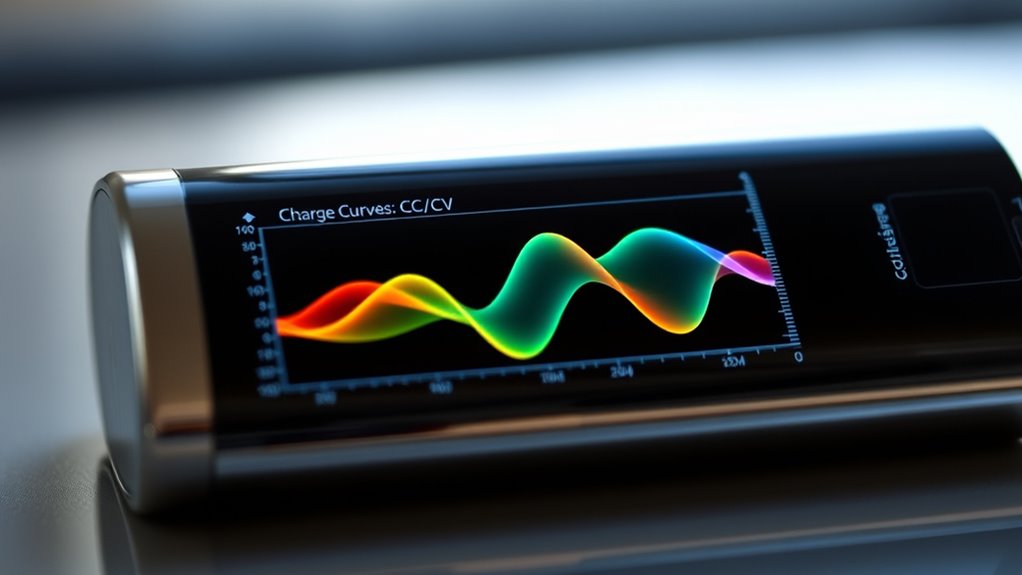

Charge curves, specifically CC/CV (Constant Current / Constant Voltage), describe how your battery charges over time. First, your charger supplies a steady current until about 80% capacity. Then, it switches to a fixed voltage mode, gradually lowering the current as the battery fills up. This process helps protect your battery from damage and extends its lifespan. If you want to understand how these stages work together, there’s more to discover about optimizing your charging method.
Key Takeaways
- Charge curves show how voltage and current change during battery charging over time.
- CC/CV means charging starts with a constant current, then switches to a constant voltage.
- During CC phase, current remains steady; in CV phase, voltage stays fixed while current tapers off.
- Understanding this helps optimize charging speed and prolong battery lifespan.
- Proper management of CC/CV charging minimizes heat and cell stress, maintaining battery health.

Have you ever wondered how the charging process of a battery unfolds over time? When you plug in your device or charge your electric vehicle, a specific pattern occurs that influences the battery’s overall health and charging efficiency. Understanding this pattern, known as the charge curve, reveals how batteries behave during different stages of charging. In simple terms, a charge curve illustrates how voltage and current change as the battery fills up. Recognizing these stages helps you optimize charging to prolong battery life and maintain peak performance.
Most batteries are charged using a method called CC/CV, which stands for constant current and constant voltage. During the initial phase, the charger supplies a steady, maximum current—this is the constant current stage. You’ll notice the battery’s voltage gradually rises as it absorbs energy rapidly. This stage is essential because it charges the battery quickly but must be carefully managed to avoid damaging the cells. If the charging current is too high or sustained for too long, it can hurt the battery health, leading to reduced capacity over time. That’s why modern chargers often regulate this process, ensuring the current remains within safe limits, which helps sustain both battery health and charging efficiency.
Most batteries use CC/CV charging, with a quick initial current, then tapering as they near full capacity to protect their health.
As the battery reaches a specific voltage threshold—usually around 80% capacity—the charger switches to the constant voltage phase. In this stage, the voltage stays fixed, and the current gradually decreases as the battery approaches full charge. This tapering current is important because it prevents overcharging, which could cause overheating or stress on the battery cells. During this phase, the charging process becomes more delicate; a slow decrease in current indicates the battery is nearing full capacity. When the current drops to a minimal level, the battery is considered fully charged. This controlled tapering extends the battery’s lifespan by reducing stress and preventing degradation, consequently improving overall battery health. Additionally, understanding the charge curve can help in selecting the optimal charging equipment and settings for different battery types.
Understanding the charge curve also helps you see why fast charging isn’t always ideal for long-term battery health. While rapid charging might seem convenient, it often pushes the battery through the initial high-current stage quickly, which can generate more heat and strain the cells. Over time, this can diminish the battery’s capacity and reduce charging efficiency. Therefore, a balanced approach—using moderate charging speeds—preserves the battery’s longevity. Recognizing how the charge curve behaves allows you to make smarter decisions about charging habits, ensuring your device or vehicle maintains optimal performance for longer periods. Ultimately, a clear grasp of these stages empowers you to care for your batteries better, extending their usability and efficiency.

SOARAISE Solar Power Bank 48000mAh Wireless Portable Charger with 4 Cables
- High-Efficiency Solar Panels: Charges 5 times faster with 4 panels
- Large 48000mAh Capacity: Extended power for outdoor use
- Multi-Device Compatibility: Supports 7 devices simultaneously
As an affiliate, we earn on qualifying purchases.
Frequently Asked Questions
How Do Temperature Changes Affect Charge Curves?
Temperature changes impact charge curves by affecting thermal effects and voltage stability. When it’s cold, your battery’s internal resistance increases, slowing down charging and reducing capacity. Hot temperatures can cause thermal effects that lead to faster degradation and instability in voltage, risking overcharging or damage. Maintaining ideal temperature ensures voltage stability, allowing your battery to charge efficiently and safely, preserving its lifespan and performance.
Can Different Battery Chemistries Impact Cc/Cv Charging?
Different battery chemistries definitely impact CC/CV charging because their unique battery compositions influence how they handle charge rates and efficiency. You’ll find that some chemistries charge faster or more efficiently, while others require gentler charging to prevent damage. Understanding these differences helps you optimize charging processes, improving overall charging efficiency and prolonging battery life. Always tailor your charging approach based on the specific chemistry to get the best results.
What Are the Signs of Overcharging During Cc/Cv?
Imagine a balloon that’s nearly full, ready to pop—overcharging your battery feels the same. If you notice your battery’s capacity seems to swell or its voltage stability wavers unexpectedly, it’s a sign you’re overcharging during CC/CV. You might also see excessive heat or swelling, like a balloon inflating beyond its limit. Keep an eye on these signs to prevent damage and ensure safe, long-lasting performance.
How Do Age and Cycle Life Influence Charge Curves?
As your battery ages, you’ll notice its cycle life decreases, causing the charge curves to shift. Battery aging leads to faster cycle degradation, which means it reaches full capacity sooner and charges more slowly over time. You might see lower voltage levels during charging and a shortened overall lifespan. These changes indicate the battery’s reduced ability to hold and deliver energy effectively, highlighting the importance of monitoring its health regularly.
Are There Safety Risks Associated With Cc/Cv Charging?
Yes, there are safety risks with CC/CV charging if you don’t follow proper protocols. You need to guarantee battery insulation is intact to prevent short circuits or overheating. Ignoring correct charging protocols can lead to thermal runaway or fires. Always use compatible chargers, monitor temperature, and keep the battery well-insulated to minimize risks. Proper safety measures help prevent accidents and extend your battery’s lifespan.
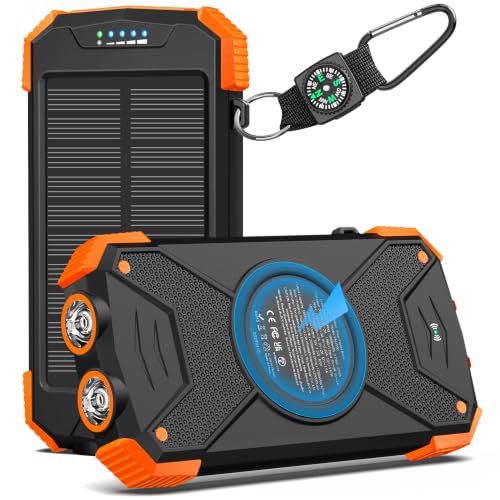
BLAVOR Solar Power Bank 10,000mAh, Portable Wireless Charger, 20W Fast Charging External Battery Pack with USB C for Cell Phones, Solar Panel Charging with Dual Flashlight for Camping
- Trusted Brand with Outdoor Focus: Over 10 years of solar power expertise
- Fast Charging with USB-C: 20W output charges iPhone 15 in 30 mins
- Simultaneous Device Charging: Supports 3 devices at once
As an affiliate, we earn on qualifying purchases.
Conclusion
Understanding CC/CV charge curves is like having a map for a journey—you’ll know exactly when to switch gears. By recognizing the different stages, you can charge your battery safely and efficiently, just like following a clear path through a forest. Remember, mastering these curves helps you avoid overcharging and extends your battery’s life. Keep these insights in mind, and charging will become as smooth as gliding down a gentle slope.

YELOMIN 38800mAh Solar Power Bank, Portable Charger USB-C Fast Charging Compatible with iPhone Samsung, Dual LED Flashlight Battery Pack, 3 Output Backup Charger for Camping Hiking Outdoor Emergency
- High Capacity: 38800mAh durable weatherproof design
- Weatherproof and Dustproof: Sealed port covers for protection
- Fast Charging USB-C: Supports quick charge for devices
As an affiliate, we earn on qualifying purchases.

BLAVOR Solar Power Bank 20000mAh Built-in Cables, Wireless Charger for Phones & Apple Watch, 20W Fast Charging Battery Pack with USB C, Flashlight, Solar Charger for iPhone, iPad, iWatch, Samsung
- Simultaneously Charge 6 Devices: Multiple cables and ports for 6 devices
- High Capacity & Fast Charging: 20000mAh battery with 20W USB-C fast charge
- Wireless Charging & Built-in Cables: Wireless charger for phones and Apple Watch
As an affiliate, we earn on qualifying purchases.