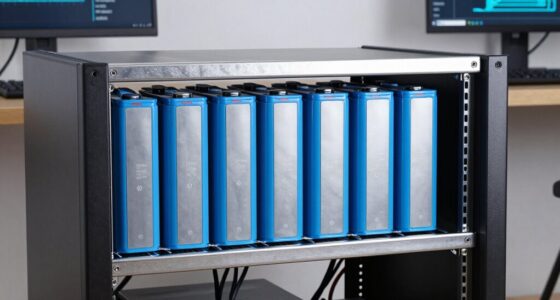

To maximize your battery’s lifespan, keep your depth of discharge (DoD) shallow, ideally around 20-30%, meaning you only use a small portion of its capacity before recharging. Avoid discharging below safe voltage levels, like 3.0V per cell, as deep discharges cause irreversible chemical damage that shortens battery life. Managing your discharge levels carefully helps maintain capacity and performance over time—you’ll find it beneficial to understand the best practices for longer-lasting batteries as you explore further.

Get backup power and energy gear delivered free — and shop member deals
- Fast, free delivery on millions of items
- Access to Prime Big Deal Days deals on October 6–7
- Prime Video, Amazon Music and more included
Key Takeaways
- Limiting depth of discharge to around 20-30% per cycle significantly extends battery lifespan.
- Discharging batteries below 80% capacity reduces internal stress and chemical degradation.
- Shallow discharges, such as 20-80%, maximize cycle count and prevent irreversible damage.
- Avoid deep discharges below 20% to prevent capacity loss and internal chemical damage.
- Maintaining discharge levels within safe voltage thresholds (e.g., above 3.0V per cell) promotes longevity.

Understanding how deep you discharge your battery is essential for maximizing its lifespan. When you use a battery, each time you drain it and recharge, it completes what’s called a battery cycle. These cycles are critical because they determine how quickly your battery wears out. The key to prolonging its life lies in managing how much of the battery’s capacity you use before recharging. This is where the concept of depth of discharge (DoD) comes into play. The deeper you discharge your battery, the fewer cycles it can handle over its lifetime. Conversely, shallow discharges extend the number of cycles, helping your battery last longer.
Voltage thresholds are important in this scenario. They refer to the voltage levels at which your battery is considered full or empty. Staying within ideal voltage thresholds helps prevent unnecessary strain on the battery. When you discharge your battery too deeply, you drop below a safe voltage level, which can cause internal damage over time. This damage reduces the number of effective cycles your battery can perform. To maximize longevity, you should aim to keep discharges within recommended voltage ranges, avoiding deep discharges that push the battery below its safe voltage threshold. For example, lithium-ion batteries are typically best kept above 3.0 volts per cell during discharge and not charged beyond 4.2 volts per cell. Going outside these limits increases stress and accelerates capacity loss.
You can manage your battery’s health by being mindful of how much you use it before recharging. For instance, if you routinely discharge your battery to 80% or less, you’ll greatly increase its total number of cycles compared to discharging to 100%. This approach reduces strain on the internal components and helps maintain capacity over time. It’s also important to recognize the impact of deep discharges on battery chemistry. Excessively low voltage levels can cause irreversible chemical changes, making the battery less effective and shortening its lifespan. Many modern devices and batteries have built-in safeguards, such as cutoff voltages, to prevent discharges that could cause harm, but you should still be conscious of your usage patterns. Additionally, understanding battery chemistry helps in selecting the right discharge practices for better longevity.
Ultimately, understanding how to balance your battery cycle with voltage thresholds is fundamental for longevity. Keeping discharges shallow and within safe voltage limits minimizes internal stress and preserves capacity. By doing so, you guarantee your battery performs reliably over a longer period, saving you money and reducing waste. Proper management of discharge levels isn’t just about avoiding failure; it’s about maximizing the value and lifespan of your investment in power storage.
lithium-ion battery cycle tester
As an affiliate, we earn on qualifying purchases.
As an affiliate, we earn on qualifying purchases.
Frequently Asked Questions
How Does Temperature Affect Depth of Discharge Limits?
Temperature substantially impacts your battery’s discharge thresholds due to thermal effects. When it’s too hot, high temperatures can accelerate chemical reactions, risking damage and reducing lifespan, so you should keep discharge levels within safe limits. Conversely, cold temperatures slow reactions, allowing deeper discharges without immediate harm. Always monitor thermal effects to maintain ideal discharge thresholds, ensuring your battery’s longevity and performance stay consistent across varying temperature conditions.
Are DOD Limits Different for Lithium-Ion vs. Lead-Acid Batteries?
You’ll find that DOD limits differ between lithium-ion and lead-acid batteries due to their chemistry. Lithium-ion batteries tolerate deeper discharges without significant damage, often around 80-90%, whereas lead-acid batteries usually require shallower discharges, around 50%. Proper maintenance practices, like avoiding deep discharges for lead-acid types, help extend lifespan. Always follow manufacturer guidelines to optimize performance and longevity based on your specific battery chemistry.
Can DOD Limits Be Adjusted for Specific Applications?
Think of your battery like a car’s fuel tank—sometimes you want to fill up less to extend engine life. Yes, you can adjust custom battery settings for application-specific limits, enhancing longevity. For example, in solar systems, limiting DOD prevents deep discharges that shorten battery life. By tailoring DOD limits to your needs, you guarantee your battery performs efficiently while lasting longer, just like fine-tuning an engine for ideal performance.
What Is the Impact of Frequent Shallow Discharges?
Frequent shallow discharges are beneficial for battery maintenance because they reduce stress and wear on the battery, extending its lifespan. By adopting discharge strategies that avoid deep cycles, you minimize capacity loss and improve longevity. Shallow discharges also help maintain a stable voltage, ensuring better performance over time. Overall, sticking to shallow discharge patterns is a smart approach to maximize your battery’s health and efficiency.
How Do Charging Cycles Influence DOD and Battery Life?
Charging cycles directly impact your battery’s depth of discharge (DoD) and overall life. Fast charging speeds can increase cycle stress, reducing capacity over time, while slower charging is gentler, prolonging battery health. Keeping your battery’s capacity well-maintained with moderate cycles helps prevent overuse. By managing charging speed and avoiding deep discharges, you preserve your battery’s longevity, ensuring it performs well over many cycles.
battery capacity monitor for rechargeable batteries
As an affiliate, we earn on qualifying purchases.
As an affiliate, we earn on qualifying purchases.
Conclusion
Think of your battery as a garden needing care; each deep discharge is like a storm that damages delicate blooms. By respecting the depth of discharge limits, you’re tending to this garden, ensuring its vibrant future. Handle your battery gently, avoid storms, and let it flourish over time. When you nurture it wisely, you’re planting seeds for long-lasting energy—turning fleeting sparks into a steady, enduring light that guides your journey ahead.
battery voltage checker for lithium batteries
As an affiliate, we earn on qualifying purchases.
As an affiliate, we earn on qualifying purchases.
As an affiliate, we earn on qualifying purchases.
Fall Picks
fall essentials
As an affiliate, we earn on qualifying purchases.