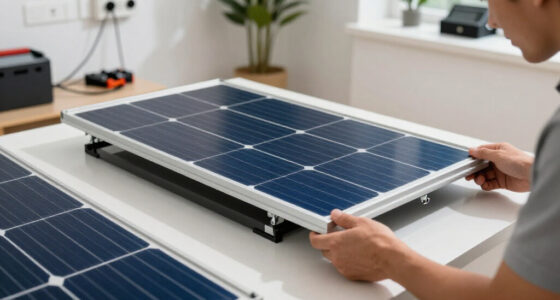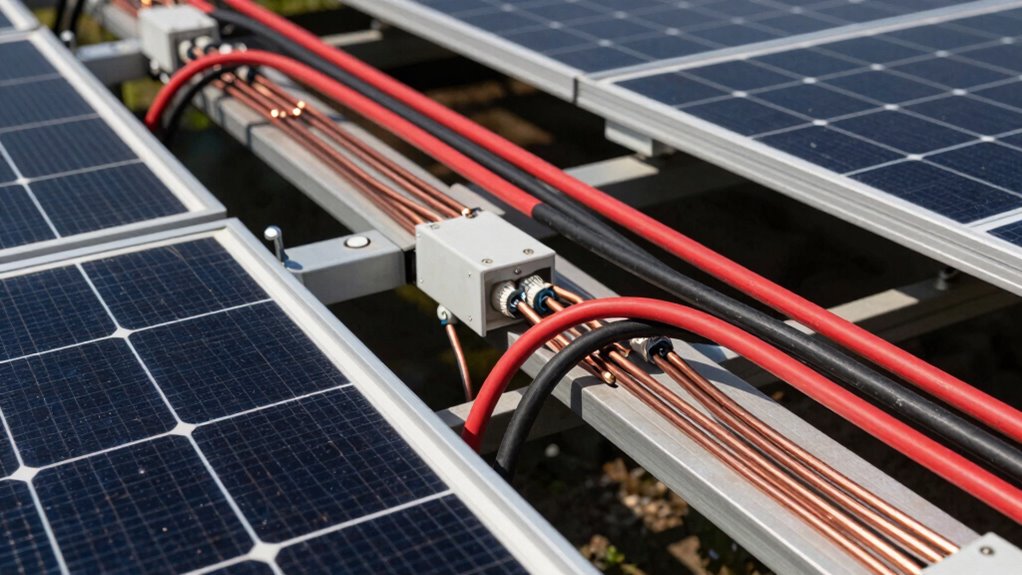

When you connect solar panels in series, your system’s voltage increases while current stays the same, making it suitable for long cable runs or matching battery voltages. In parallel, the voltage remains constant but the current adds up, providing higher power for charging batteries faster. These configurations also respond differently to shading or dirt—series wiring reduces output if one panel is shaded, but parallel limits the impact. Keep exploring to understand how to optimize your setup.

Get backup power and energy gear delivered free — and shop member deals
- Fast, free delivery on millions of items
- Access to Prime Big Deal Days deals on October 6–7
- Prime Video, Amazon Music and more included
Key Takeaways
- Series wiring increases total voltage but keeps current constant, affecting system compatibility and energy transmission.
- Parallel wiring maintains voltage but boosts current, influencing charging speed and component ratings.
- Shading impacts series-connected panels more severely, reducing overall output when one panel is shaded.
- Wiring configuration affects efficiency, cost, complexity, and ease of troubleshooting within the solar system.
- Proper wiring design optimizes performance, prevents overloads, and extends system lifespan under varying conditions.

Understanding how your solar panels are wired is essential for optimizing your system’s performance. The way you connect your panels—whether in series or parallel—directly influences the overall system behavior, especially regarding battery voltage and current flow. When panels are wired in series, the voltage of each panel adds up, resulting in a higher total voltage output. This setup is ideal if you need to match the voltage requirements of your battery bank or inverter. However, the current flow remains limited to the lowest current produced by any one panel, which means that if one panel is shaded or dirty, the entire string’s current drops. On the other hand, wiring panels in parallel keeps the voltage consistent across all panels, equal to the voltage of a single panel, but increases the total current flow. This configuration is useful when your system demands a higher current to charge batteries faster or to operate appliances that require lower voltage but higher current.
Additionally, understanding the impact of technology such as DLP vs. LCD in projectors can inform how you optimize your setup for different conditions. Your choice between series and parallel wiring impacts how your battery voltage and current flow behave under different conditions. For example, in a series connection, if each panel produces 20 volts and 5 amps, your system will produce 60 volts at 5 amps. This higher voltage can be beneficial for long cable runs, reducing energy loss, but it also demands that your batteries and inverter are rated for that voltage. Conversely, in a parallel setup, wiring three panels each producing 20 volts and 5 amps results in a system voltage of 20 volts but a total current of 15 amps. This increases the current that your wiring and components must handle but keeps the voltage at a manageable level for many standard batteries and inverters. Properly considering system design can help prevent overloads and maximize energy efficiency. Furthermore, the cost and complexity of installation can vary significantly between the two configurations, influencing your overall project planning.
It’s also crucial to consider system maintenance and how different wiring configurations can influence ease of troubleshooting and repairs. It’s important to understand that both wiring methods influence how your system responds to shading, dirt, or aging panels. In series, shading on one panel can markedly reduce the entire string’s output because the current flow is limited by the weakest link. In parallel, shading affects only the shaded panel, and the other panels continue to contribute to the total current. Knowing these behaviors helps you decide which wiring configuration best suits your needs and ensures your system operates efficiently. Ultimately, understanding how your panels are wired allows you to optimize battery voltage and current flow, preventing overloads, maximizing energy harvest, and prolonging your system’s lifespan.
As an affiliate, we earn on qualifying purchases.
Frequently Asked Questions
How Does Temperature Affect Series and Parallel Solar Wiring Performance?
Temperature effects markedly influence series and parallel solar wiring performance. As temperature rises, wiring resistance increases, reducing overall efficiency. In series wiring, higher resistance can cause voltage drops, lowering power output. Parallel wiring mitigates this by maintaining voltage levels, but increased resistance still affects current flow. Cooler temperatures decrease resistance, improving efficiency across both wiring types. Monitoring temperature helps optimize system performance and prevent issues caused by resistance changes.
Can Mixed Wiring Configurations Optimize Overall Solar System Efficiency?
Yes, mixed wiring configurations can optimize your overall solar system efficiency by offering hybrid configurations and wiring flexibility. By combining series and parallel setups, you can balance voltage and current, maximizing power output under varying conditions. This approach allows you to adapt to shading, temperature fluctuations, and panel differences, ultimately enhancing system reliability and performance. Tailoring wiring strategies guarantees your solar setup is more efficient and better suited to your specific energy needs.
What Are the Safety Concerns With Different Wiring Methods?
You need to prioritize grounding safety and wiring insulation to prevent electrical hazards. Improper wiring methods can lead to shock risks, short circuits, or fires. Make sure all connections are properly grounded, and use high-quality insulation to protect against moisture and physical damage. Regularly inspect wiring for wear or damage, and follow electrical codes. Staying vigilant about these safety concerns helps protect you and maximizes your solar system’s reliability.
How Does Shading Impact Series Versus Parallel Wiring Differently?
Shading affects series and parallel wiring differently because, in series, shading causes voltage drops and reduces overall system voltage, leading to decreased power output. In parallel, shading impacts current fluctuation, as shaded panels produce less current, but voltage remains consistent across all panels. You’ll find that shading can considerably reduce efficiency in series setups, while parallel wiring maintains voltage stability but still suffers from decreased current when shaded.
Are There Specific Inverter Requirements for Series or Parallel Systems?
Your inverter compatibility depends on whether you use series or parallel wiring, as each system has specific wiring standards. For series wiring, guarantee the inverter supports higher voltage levels since voltages add up. For parallel wiring, focus on current capacity, so the inverter must handle increased amperage. Always verify your inverter’s specifications match your wiring configuration to ensure safe, efficient system operation and compliance with manufacturer guidelines.
solar panel series parallel combiner box
As an affiliate, we earn on qualifying purchases.
As an affiliate, we earn on qualifying purchases.
Conclusion
Now, you see how wiring configurations can dramatically alter your solar system’s behavior. But what happens when you push these setups to their limits? Will you harness maximum power or face unexpected challenges? The answers lie in understanding the delicate balance of series and parallel wiring. Keep exploring, keep experimenting. Your next move could reveal hidden potential—or introduce unforeseen complications. Are you ready to discover what’s truly possible with your solar setup? The choice is yours.
solar charge controller for series and parallel wiring
As an affiliate, we earn on qualifying purchases.
As an affiliate, we earn on qualifying purchases.
solar system troubleshooting tools
As an affiliate, we earn on qualifying purchases.
As an affiliate, we earn on qualifying purchases.
Fall Picks
fall essentials
As an affiliate, we earn on qualifying purchases.