TL;DR

Get backup power and energy gear delivered free with Prime
- Fast, free delivery on millions of items
- Prime Video, Amazon Music and more included
- Member-only deals all year
Silicon Ranch has brought 15 cattle onto a 3.25-megawatt solar project in Christiana, Tennessee, using raised panels and a grazing mode designed to keep equipment clear of the herd. The company says the project is the first commercially viable utility-scale U.S. solar-and-cattle operation, but the approach’s cost, performance and potential to scale remain uncertain.
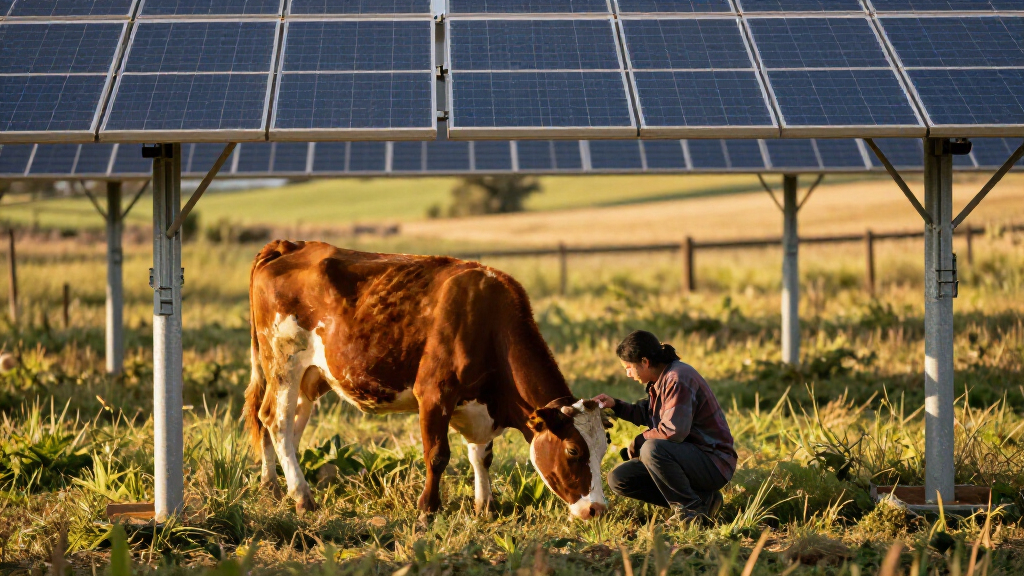
Silicon Ranch has put a 15-cow herd to graze beneath solar panels at a 3.25-megawatt project in Christiana, Tennessee, testing whether cattle ranching and utility-scale electricity generation can share land. The developer calls it the first commercially viable U.S. project of its kind; the approach could add agricultural use to solar sites, though its costs and potential to scale are still being assessed.
The herd was introduced about six months before the original report. The cattle rotate through 15 paddocks separated by electric wire, eating Bermuda grass growing under and around the panels. The arrays sit on higher steel supports than a standard installation, and their tracking equipment can shift into a setting that limits panel tilt while cattle are in a paddock.
Silicon Ranch developed a system it calls CattleTracker, with customized tracker controls supplied by NextPower. In “graze mode,” the panels’ rotation is limited to about 20 or 30 degrees, rather than reaching a maximum tilt of 60 degrees, to keep their lower edges above the animals. The company selected Murray Grey cattle, a breed the report describes as known for calm dispositions.
Silicon Ranch’s Loran Shallenberger said the project’s added cost for strengthening the solar arrays was 3% above a standard design. He also said the company sold the electricity to Middle Tennessee Electric for less than the wholesale rates the utility was paying the Tennessee Valley Authority. Those cost and pricing figures are the company’s account; the source report does not provide an independent project-cost assessment.
The project tests a way to use the same land for electricity and livestock, rather than choosing between solar development and agricultural production. That could matter in places where solar proposals face local resistance over land use, or where available sites are limited. It may also give farmers another source of revenue if the model proves workable and the terms benefit landowners.
The report places the cattle project within the wider growth of agrivoltaics, which combines solar generation with farming. Sheep already graze at solar sites as a way to manage vegetation, but cattle pose a different engineering challenge: their size and behavior can put panels and other equipment at risk. The Tennessee project offers a utility-scale test, not proof that the approach will be economical or suitable everywhere.
Sharing land does not address the greenhouse-gas emissions associated with cattle production. The report notes that methane from cattle remains a climate concern. The solar installation’s potential contribution is additional clean electricity alongside livestock production, not a reduction in livestock emissions.
Products Worth Considering

eufy Security SoloCam E42 4-Camera Kit, 4K Solar Security System

Philips Hue Festavia Outdoor Globe String Lights, 8 Bulbs, 22 ft

Google Nest Cam Indoor/Outdoor Battery Security Camera
As an affiliate, we earn on qualifying purchases.
Why Cattle Need a Different Array
Solar developers commonly prioritize generating as much electricity as possible per acre while keeping construction costs down. Cattle grazing can require taller supports and equipment adjustments, adding expense and creating new questions about animal and worker safety. The report says a previous 2-megawatt AES project explored solar and cattle in Massachusetts’ community-solar market, but Silicon Ranch describes its Tennessee site as the first commercially viable utility-scale example in the United States.
Silicon Ranch studied the design with support from a Department of Energy grant. Rather than building exceptionally tall structures, the company used moderately raised steel piles and adapted the trackers’ controls. The project’s “graze mode” is intended to maintain clearance over cattle while allowing the panels to track sunlight when grazing is not taking place in a paddock.
Terry Jennings, a principal team leader for renewable energy at the Electric Power Research Institute, said cattle-compatible projects generally need more specific designs, which can raise costs for developers and utilities. He also cautioned that research on how cattle interact with solar equipment remains relatively new.
“I thought it would work — I just didn’t think it would work this well.”
— Loran Shallenberger, who leads Silicon Ranch’s Regenerative Energy and Agrivoltaics division
Costs and Cattle Impacts Still Unclear
The project is a single 3.25-megawatt site, and the report does not establish whether its design can be repeated at larger projects or in different climates, grazing systems and cattle operations. Silicon Ranch’s reported 3% cost premium and electricity pricing have not been independently verified in the source material, and no full financial comparison with a conventional solar installation is provided.
It is also unclear how the system will perform over a longer period: the report describes roughly six months of grazing, not long-term equipment durability, maintenance costs, animal outcomes or power production across multiple seasons. Jennings said the evidence base on how cattle interact with panels is still developing. The report does not provide a measured comparison of grass growth or cattle weight gain against an otherwise similar pasture.
Longer-Term Results Will Matter
The next test is whether Silicon Ranch can operate the site over more seasons without equipment damage, costly maintenance or disruption to electricity generation. Longer-term reporting on operating costs, power output and livestock performance would help show whether the claimed cost premium and utility pricing hold up beyond the initial period.
Broader adoption would also depend on whether other developers can adapt the design to their sites and whether utilities and farmers see a financial case for doing so. The source report does not announce a schedule for expansion or identify additional cattle-and-solar projects. For now, the Christiana installation is an early operating example, while its commercial performance and wider applicability remain open questions.
Key Questions
Where is the cattle-and-solar project?
It is at a 3.25-megawatt solar project in Christiana, Tennessee, southeast of Silicon Ranch’s Nashville headquarters.
How many cattle are grazing at the site?
Silicon Ranch brought in a 15-member herd. The animals rotate among 15 paddocks separated by electric wire.
How are the solar panels kept clear of the cattle?
The panels sit on raised steel supports, and a setting called graze mode limits their tilt while cattle are in a paddock. Silicon Ranch developed the CattleTracker system for the project.
Is this the first U.S. project combining cattle and solar?
Silicon Ranch describes it as the first commercially viable utility-scale U.S. project combining the two. The report also mentions an earlier 2-megawatt AES project in Massachusetts that sought to test the concept in community solar.
Does the project reduce emissions from cattle?
The report does not say that it reduces cattle-related emissions. Its stated potential is to produce solar electricity on land also used for grazing; methane emissions from cattle remain a separate climate concern.
Source: canarymedia.com