The best home battery backup system overall in this lineup is the Jackery Explorer 5000 Plus, whose 5,040Wh capacity and 7,200W output give it more room to support demanding household loads than the smaller portable picks. For a lower-capacity setup, the EcoFlow DELTA Pro balances 3,600Wh with 3,600W output, while the Anker SOLIX E10 is the expandable choice for buyers planning a much larger system. The main tradeoffs are capacity versus portability, output versus the number of appliances you need to run, and a simple ready-to-use station versus a system that can grow. A portable power station can cover selected essentials, but it is not automatically a whole-home backup solution. Read on for the full comparison and guidance on matching capacity and output to your outage plan.

Get backup power and energy gear delivered free with Prime
- Fast, free delivery on millions of items
- Prime Video, Amazon Music and more included
- Member-only deals all year
Complete the kit


Key Takeaways
- The Jackery Explorer 5000 Plus leads on listed capacity and output: its 5,040Wh and 7,200W figures exceed those of the other fixed-capacity stations in this lineup, making it the strongest starting point for larger loads.
- The Anker SOLIX E10 serves a different purpose from the portable stations: its stated 12–90 kWh range makes expansion the main draw, but buyers should verify what is included and what installation their planned setup requires.
- Several mid-size options cluster around 3.6 kWh: the EcoFlow DELTA Pro, SolarPlay Q3600, and Jackery HomePower 3600 Plus have similar listed capacities, so output, solar bundle, and intended use matter more than capacity alone.
- The EcoFlow DELTA 3 and Anker SOLIX S2000 prioritize smaller-scale backup: their 1,024Wh and 2,010Wh capacities respectively suit a narrower essentials plan better than extended, high-load household backup.
- A solar panel bundle changes the setup, not the battery’s stored energy: the SolarPlay Q3600 includes a 400W panel, but real-world recharge time depends on sunlight, placement, and power use during charging.




| home battery backup system | Weight | Battery capacity |
|---|---|---|
| EcoFlow DELTA 3 Portable Power | 12.5kg | — |
| Jackery Explorer 5000 Plus Por | 134.5lb | — |
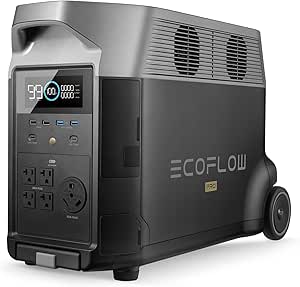
| EF EcoFlow DELTA Pro Portable | 99lb | 3,600Wh |
| SolarPlay Q3600 Portable Power | — | 3,840Wh |
| Jackery HomePower 3600 Plus Po | 77.2lb | 3,584Wh |
| Anker SOLIX S2000 Portable Pow | 35.7 lb | 2,010Wh |
| Anker SOLIX E10 Power Dock and | — | — |
More Details on Our Top Picks
EcoFlow DELTA 3 Portable Power Station, 1024Wh, 1800W
The EcoFlow DELTA 3 is the most manageable choice here for keeping essential appliances and electronics running without committing to a large, heavy system. Its 1,024Wh capacity and 1,800W output suit shorter outages and modest loads; compared with the 3,600Wh EcoFlow DELTA Pro, it offers much less stored energy but is far easier to move at 12.5kg. Fast AC charging can replenish it in as little as 56 minutes, while solar input provides another charging route. Expansion up to 5kWh gives owners a way to add capacity later, though that requires compatible batteries. I would pick it for portability and flexible everyday backup, not for powering a household through a prolonged outage: the base capacity is limited, and expansion adds equipment and expense.
Pros:- 12.5kg weight makes it substantially easier to move than the larger backup units in this lineup.
- LiFePO4 battery is rated for 4,000 cycles to 80% capacity.
- AC charging can reach a full charge in 56 minutes under stated conditions.
- Expandable to 5kWh with compatible EcoFlow batteries.
Cons:- The 1,024Wh base capacity limits runtime for refrigerators and other sustained loads.
- Reaching the stated 5kWh capacity requires purchasing compatible extra batteries.
- At 12.5kg, it is still heavier than a small device-focused power bank.
Best for: Apartment dwellers, campers, and households seeking portable backup for essential devices and smaller appliances during shorter outages.
Not ideal for: Buyers who need whole-home or multi-day backup from one unit; its 1,024Wh base capacity is far below the larger Jackery Explorer 5000 Plus.
- Capacity:1,024Wh
- AC output:1,800W
- Surge output:3,600W
- Battery chemistry:LiFePO4
- Battery cycle life:4,000 cycles to 80% capacity
- Maximum expansion capacity:5kWh with compatible batteries
- Maximum solar input:500W
- Weight:12.5kg
Our verdict“Choose the DELTA 3 for movable, short-duration backup and skip it if your priority is high-capacity household coverage.”
Jackery Explorer 5000 Plus Portable Power Station, 5040Wh, 7200W
For buyers who need more than a few hours of essential-device backup, the Jackery Explorer 5000 Plus leads this group on out-of-the-box capacity and household-scale output. Its 5,040Wh battery and 7,200W rated output, paired with 120V and 240V support, give it a broader role than the 120V EcoFlow DELTA Pro, whose output is 3,600W from a single unit. The Explorer can also accept up to 4,000W of solar input and expand to 60kWh, making it better suited to a larger backup plan than the compact DELTA 3. That scale comes with real setup costs: at 134.5lb it is not a grab-and-go station, solar panels are separate, and the smart transfer switch is also sold separately. I would shortlist it for serious home backup, not casual portable use.
Pros:- 5,040Wh capacity provides more stored energy than the other single-unit systems in this batch.
- 120V and 240V support suits a wider range of home appliances and backup needs.
- Accepts up to 4,000W of solar input.
- Expandable up to 60kWh for a larger backup setup.
Cons:- At 134.5lb, it is difficult to move without planning and assistance.
- The smart transfer switch is sold separately, adding a separate purchase and setup step.
- Solar panels are optional rather than included.
Best for: Homeowners planning extended backup for multiple appliances or 240V loads, especially those who can accommodate a heavy system and add a transfer switch.
Not ideal for: Renters and buyers who need a frequently moved power station; its 134.5lb weight and separately sold smart transfer switch make it less convenient as a simple portable option.
- Capacity:5,040Wh
- Surge output:14,400W
- Voltage:120V and 240V
- Battery type:LiFePO4
- Maximum solar input:4,000W
- Expansion capacity:Up to 60kWh
- Weight:134.5lb
Our verdict“Choose the Explorer 5000 Plus when household-scale capacity and 240V support matter more than portability or an all-in-one setup.”
EF EcoFlow DELTA Pro Portable Power Station, 3600Wh, 3600W AC Output
The EcoFlow DELTA Pro earns its place for buyers who want a substantial starting battery with several ways to build a larger system around it. Its 3,600Wh LFP battery and 3,600W running output make it a stronger starting point for sustained home backup than the 1,024Wh DELTA 3, while expansion to 25kWh is less extensive than the Jackery Explorer 5000 Plus’s stated 60kWh ceiling. The DELTA Pro’s flexibility is a genuine differentiator: it can charge from a wall outlet, solar, an EV station, a generator, or a car outlet, and app controls support remote monitoring. The tradeoff is physical and practical. At 99lb, it is not easy to carry, and its 120V output does not match the Explorer’s built-in 120V/240V support. I would choose it for modular backup and varied charging options, not light-duty portability.
Pros:- 3,600Wh LFP battery offers a substantial starting capacity for home backup.
- Expandable to 25kWh with compatible extra batteries or smart generators.
- Five charging methods include EV station and solar charging.
- App control and 15 output ports support remote monitoring and multiple devices.
Cons:- At 99lb, it is difficult to move around the home or transport regularly.
- The listed 120V output does not provide the Explorer 5000 Plus’s native 240V support.
- The maximum 4,500W output relies on X-Boost technology.
Best for: Homeowners who want a high-capacity starting unit, multiple charging routes, and the option to expand their backup setup over time.
Not ideal for: Buyers who need a lightweight station or native 240V output; it weighs 99lb and is listed as a 120V unit.
- Battery capacity:3,600Wh
- Battery type:LFP
- Running output:3,600W
- Maximum output:4,500W with X-Boost
- Expandable capacity:Up to 25kWh
- Voltage:120V
- Output ports:15
- Weight:99lb
Our verdict“Choose the DELTA Pro if you value several charging options and expandable capacity more than low weight or native 240V output.”
SolarPlay Q3600 Portable Power Station with 400W Solar Panel, 3840Wh LiFePO4 Battery
The SolarPlay Q3600 stands out as the only option in this group that includes a 400W solar panel, so buyers can start with solar charging without sourcing a panel separately. Its 3,840Wh battery and 3,600W continuous output put it in a similar power class to the EcoFlow DELTA Pro, while the included wheels and telescopic handle help with rolling its 93.7lb body between storage and use. A UPS mode with a stated transfer time of 20ms or less adds a specific use for equipment that needs backup power with minimal interruption. The bundle has limits: 400W is well below its 2,000W maximum solar input, and its 18-month warranty is shorter than the five-year coverage listed for both EcoFlow models here. I would favor it for a ready-to-start solar setup, but compare the warranty and expansion needs before choosing it for long-term home backup.
Pros:- Includes a 400W solar panel, unlike the Jackery Explorer 5000 Plus and HomePower 3600 Plus bundles described here.
- 3,840Wh capacity and 3,600W continuous output suit substantial backup loads.
- Wheels and telescopic handle make rolling easier than carrying the unit.
- UPS mode has a stated transfer time of 20ms or less.
Cons:- The 93.7lb body remains difficult to lift, even with wheels for rolling.
- The included 400W panel is well below the 2,000W maximum solar input.
- The stated 18-month warranty is shorter than the five-year terms listed for the EcoFlow DELTA 3 and DELTA Pro.
Best for: Households that want a large-capacity station with a solar panel included, plus wheels for moving it over short distances.
Not ideal for: Buyers who prioritize a longer stated warranty, easy lifting, or fast solar recharging without adding more panels; it weighs 93.7lb, includes a 400W panel, and lists 18 months of warranty coverage.
- Battery capacity:3,840Wh
- Battery chemistry:LiFePO4
- Continuous output:3,600W
- Surge output:5,500W
- Included solar panel:400W
- Maximum solar input:2,000W
- UPS transfer time:20ms or less
- Warranty coverage:18 months
Our verdict“Choose the SolarPlay Q3600 if an included solar panel is your priority, but look elsewhere if warranty length or lighter handling matters more.”
Jackery HomePower 3600 Plus Portable Power Station, 3584Wh, 3600W
Among the large-capacity choices, the Jackery HomePower 3600 Plus is the lighter one to reposition: its 77.2lb weight, wheels, and telescopic handle make it more manageable than the 93.7lb SolarPlay Q3600 or 99lb EcoFlow DELTA Pro. The 3,584Wh battery and 3,600W output still give it a serious home-backup role, and it can expand to 21kWh per unit. Charging flexibility is another plus, with AC, solar, gas-generator, and hybrid AC+DC options. The main limitation is its output arrangement: the supplied specs list just two outlets, while 240V operation requires units in parallel. It is also not a self-contained solar bundle, since panels are optional. I would favor it when a large battery needs to be moved around more easily, but not when outlet variety or built-in 240V support is the priority.
Pros:- 77.2lb weight is lower than the SolarPlay Q3600 and EcoFlow DELTA Pro in this batch.
- Wheels and a telescopic handle make repositioning easier than lifting a large station.
- Supports AC, solar, gas-generator, and hybrid AC+DC charging.
- Expandable up to 21kWh per unit, with 240V operation available in parallel.
Cons:- The listed two outlets offer less connection flexibility than the DELTA Pro’s 15 output ports.
- 240V output requires units to be used in parallel.
- Solar panels are optional, unlike the included panel with the SolarPlay Q3600.
Best for: Homeowners who need substantial battery capacity and expect to move the station between storage and backup use, with wheels and a handle to help.
Not ideal for: Buyers who need multiple outlets immediately or native 240V from one unit; the listed outlet count is two, and 240V requires parallel units.
- Battery capacity:3,584Wh
- AC output:3,600W
- Parallel output:7,200W
- Voltage:120V; 240V in parallel
- Expandable capacity:Up to 21kWh per unit or 43kWh with multiple units
- Battery cycles:6,000
- Charging options:Hybrid AC+DC, AC, solar, gas generator
- Weight:77.2lb
Our verdict“Choose the HomePower 3600 Plus for a large, expandable battery that is comparatively easier to roll, not for single-unit 240V or broad outlet access.”
Anker SOLIX S2000 Portable Power Station, 2,010Wh, 1,500W
The Anker SOLIX S2000 suits buyers who want a portable reserve for essential appliances rather than a whole-home system. Its 2,010Wh LiFePO4 battery and 1,500W continuous output can support a range of household devices, while the under-10ms UPS switchover helps protect connected equipment during brief outages. At 35.7 pounds, it is easier to move and store than the larger Jackery Explorer 5000 Plus, though its capacity and output are far more limited. Eight outlets and six charging methods add flexibility, but the 400W solar-input ceiling limits how quickly it can replenish from panels. It also lacks a 12V DC port, which narrows options for some vehicle-oriented gear. I’d choose it for portability and everyday backup, not extended outages or high-demand loads.
Pros:- 2,010Wh LiFePO4 battery is rated for 10,000 charge cycles
- Under-10ms UPS switchover supports sensitive connected equipment
- Eight outlets and six charging methods give users flexible setup options
- Compact size and 35.7-pound weight make it easier to move than higher-capacity stations
Cons:- 1,500W continuous output and 2,010Wh capacity limit support for demanding loads and long outages
- Solar input is capped at 400W, restricting panel-based recharge speed
- No 12V DC port for compatible equipment
Best for: Apartment residents and households seeking a movable backup for routers, lights, phones, and selected appliances.
Not ideal for: Homeowners aiming to power major appliances for long outages, or users who need a 12V DC port or faster solar replenishment.
- Battery capacity:2,010Wh
- Battery type:LiFePO4
- Continuous output:1,500W
- Peak output:3,000W
- Solar input:Up to 400W
- Total outlets:8
- UPS switchover:Less than 10ms
- Weight:35.7 lb
- Warranty:5 years
Our verdict“Choose the S2000 for portable backup of essential devices, but pick a larger system such as the Jackery Explorer 5000 Plus for higher loads and longer runtimes.”
Anker SOLIX E10 Power Dock and Extra Battery, 12–90 kWh
The Anker SOLIX E10 is the lineup’s choice for buyers planning around whole-home backup, not a portable station they can carry between rooms. Its included power module, two B6000 batteries, and power dock provide 12 kWh of storage, with expansion up to 90 kWh and coverage designed for a 200 A panel. That scale makes it a different proposition from the Jackery Explorer 5000 Plus, which is a portable power station with less storage and output. The E10 delivers 7.68 kW continuous output, up to 10 kW, and automatic switchover in 20ms or less; up to 9 kW of solar input per unit also supports a larger solar setup. The tradeoff is a more involved purchase and installation: the dock and extra battery ship separately, and professional installation may be needed. I’d favor it for a fixed home system, not renters or buyers seeking a simple plug-in backup.
Pros:- Storage starts at 12 kWh and can expand to 90 kWh
- Designed for backup coverage of a 200 A whole-home panel
- 7.68 kW continuous output and up to 10 kW turbo output support substantial household loads
- Outdoor operating range and switchover in 20ms or less suit fixed backup use
Cons:- Power Dock and extra battery ship separately
- Professional installation may be needed, adding setup complexity
- Its fixed, expandable design is less portable and simple than stations such as the Jackery Explorer 5000 Plus
Best for: Homeowners who want expandable storage and backup coverage designed for a 200 A whole-home panel, with room to build toward longer outage support.
Not ideal for: Renters, budget-conscious buyers seeking a portable plug-in station, or households unwilling to arrange separate components and possible professional installation.
- Included storage capacity:12 kWh
- Expandable storage capacity:Up to 90 kWh
- Continuous output:7.68 kW
- Turbo output:Up to 10 kW
- Solar input:Up to 9 kW per unit
- Whole-home coverage:200 A
- Switchover time:20ms or less
- Battery chemistry:LFP
- Operating temperature:-4°F to 131°F
Our verdict“Choose the E10 if you want an expandable, installed whole-home backup system; skip it if portability and straightforward setup matter more.”
How We Picked
I ranked these systems around the needs behind a home-backup purchase: usable capacity, output, and expansion potential. Capacity helps estimate how long stored energy may last, while output indicates whether a station can run a particular appliance or several loads together. I also weighed how each product fits a buyer’s plan, including portability, an included solar panel, and the difference between a standalone station and a system designed to expand.
The Jackery Explorer 5000 Plus ranks first because its listed capacity and output lead among the fixed-capacity options here. The Anker SOLIX E10 earns a distinct place for buyers who want a larger expandable system, but its scope makes it less straightforward than a portable station. Mid-size models follow according to their combination of capacity, output, and bundle; smaller models rank lower for whole-home ambitions, though they may suit essential devices better. I treat product specifications as a starting point, not a guarantee of runtime or home integration: actual performance depends on appliance loads, setup, and installation requirements.
Factors to Consider When Choosing Best Home Battery Backup Systems
Choosing a home battery is less about finding the largest number and more about planning what must stay on during an outage. I would start with the loads you cannot do without, then check the system’s output, usable energy, charging plan, and connection method. These choices can prevent two common mismatches: buying a compact station for loads it cannot support, or paying for capacity that your backup plan cannot use.
List essential loads before comparing capacity
Write down the appliances and devices you expect to run, then estimate their wattage and how many hours each needs power. Add up the loads that may run at the same time, because a battery’s capacity in watt-hours does not tell you whether its inverter can start or sustain those appliances. Refrigerators, pumps, and other motor-driven equipment may have startup demands above their regular draw. A smaller station can be a sensible choice for communications, lighting, and device charging, but it is a poor match for a backup plan built around several high-draw appliances. Avoid planning on every circuit running as usual; prioritizing a short list often makes a modest system more useful.
Separate power output from energy capacity
Output, measured in watts, is about how much power the system can supply at once; capacity, measured in watt-hours, is about how much energy it stores. Buyers often focus on the bigger capacity figure and miss that an appliance may exceed the station’s output limit. The reverse can happen too: a powerful unit may run a heavy load but drain sooner than expected if its stored energy is limited. Check continuous output and any stated surge capability against the appliance labels and startup needs. If you want to operate multiple items together, add their simultaneous draw rather than comparing each one with the station separately.
Choose between a portable station and a home-scale system
A portable power station is usually easier to relocate and may work well for selected essentials, but that does not mean it connects to a home’s circuits automatically. A larger expandable system can support a broader plan, though it may call for added batteries, compatible equipment, or professional installation. Before buying, find out whether your goal is to plug individual devices directly into the unit or power household circuits through a supported connection. Do not assume that a high output rating alone makes a station a whole-home backup system. The more closely a setup integrates with home wiring, the more attention you should give to compatibility, local electrical rules, and installation.
Plan for charging during a long outage
Stored energy is only one part of outage readiness; the ability to recharge determines how useful a battery remains after its first discharge. Compare charging options such as wall power, solar input, or other supported sources, and check the input limits and compatible accessories before relying on them. A bundled solar panel can simplify a starter setup, but a panel’s rated wattage does not promise a fixed recharge time. Sunlight, shading, panel orientation, weather, and loads running while charging all affect energy collected. If outages often last several days, plan for how you will recharge rather than buying capacity alone.
Treat runtime estimates as planning ranges
Runtime varies with the actual draw of connected devices, inverter losses, temperature, battery condition, and whether loads cycle on and off. A refrigerator, for example, may not consume its full rated wattage continuously, while a heater can draw heavily for as long as it runs. Use appliance energy labels or a plug-in power meter to build a more realistic estimate, then leave a reserve for changing conditions. Avoid dividing battery capacity by an appliance’s maximum wattage and treating the result as a guaranteed number of hours. A conservative plan helps prevent an outage from lasting longer than the energy you set aside.
Check expansion, installation, and long-term fit
Expandable systems can make sense when your backup needs may grow, but expansion is useful only if batteries and other components are compatible and available for the intended configuration. Confirm what the listed system includes, what must be bought separately, and whether installation work is required. For a portable unit, also think about where it will be stored, how much it weighs, and whether one person can move it to the needed location. Consider battery chemistry, operating limits, warranty terms, and service support as part of the ownership plan, not just the headline capacity. Paying more for expansion or home integration makes the most sense when you have a defined plan to use those capabilities.
Frequently Asked Questions
Can a portable power station run my whole house during an outage?
Usually, a portable station is better treated as backup for selected appliances and devices than as an automatic whole-house supply. Its output limits how many loads can operate at once, and its capacity limits how long those loads can run. Powering household circuits may also require compatible transfer equipment and qualified installation; plugging devices into the station is a different setup. Make a list of the circuits or appliances you want backed up and check both their combined draw and the connection method. A system designed for expansion or home integration may be a better fit if you want broader coverage.
How do I estimate how much battery capacity my household needs?
Start with the appliances you want to run, their wattage, and the hours of use you expect during an outage. For a rough estimate, multiply each device’s average power draw by its planned run time, then add the results and allow for conversion losses and uncertainty. Pay special attention to devices that cycle, such as refrigerators, and appliances with high startup loads. If you can, use appliance energy labels or measure actual consumption rather than relying only on maximum wattage. Compare that energy estimate with battery capacity, then check inverter output separately.
Is higher output or higher capacity more important for backup?
Neither specification wins on its own: output determines which loads can run together, while capacity influences how long they can run. A station with ample stored energy may still fail to power an appliance whose draw exceeds its output limit. A high-output station can handle heavier loads but may empty quickly if its battery is small. First check the largest appliance and the combined draw of simultaneous loads, then estimate the energy needed for the outage period. The right balance depends on whether your priority is supporting demanding equipment or extending backup time for lighter loads.
Does a solar panel included with a battery guarantee useful recharging during an outage?
No. A panel’s rated wattage describes its rating under specified conditions, not the energy it will deliver in every location or weather pattern. Cloud cover, shade, panel angle, season, and the battery’s charging limits all affect the result. The battery may also be supplying power while solar input is charging it, so net stored energy can rise slowly when loads are active. Check panel compatibility and charging input limits, then plan around conservative sunlight assumptions. For extended outages, keep an alternative charging plan if conditions are poor.
What should I verify before using a battery to power household circuits?
Confirm that the battery system supports the connection method you intend to use and that any transfer equipment is compatible with its output. Have a qualified electrician review the setup where connection to home wiring is involved, and follow local electrical requirements. Never connect a generator or battery to household wiring through an improvised cord or outlet, since that can create dangerous backfeed. Also check which circuits are backed up, whether loads need to be managed, and how the system will recharge. A portable station may be suitable for direct device connections without being approved for fixed household wiring.
Conclusion
For the broadest capability among the fixed-capacity stations here, I recommend the Jackery Explorer 5000 Plus as best overall, based on its 5,040Wh capacity and 7,200W output. For a best value-style fit focused on a ready-made solar bundle, the SolarPlay Q3600 pairs 3,840Wh with a 400W panel, though buyers should check solar compatibility and realistic recharge conditions. The Anker SOLIX E10 is my best premium pick for buyers who want an expandable system reaching a stated 12–90 kWh range and are prepared to check the required components and installation. Beginners with modest backup needs may find the EcoFlow DELTA 3 easier to size around a short list of essential devices than a large expandable system, while accepting its smaller 1,024Wh capacity. For specific needs, choose the Anker SOLIX S2000 for a mid-size portable option, the EcoFlow DELTA Pro for 3,600Wh and 3,600W in one station, or the Jackery HomePower 3600 Plus for a similar-capacity alternative. Match any choice to your actual loads and connection plan before treating it as household backup.