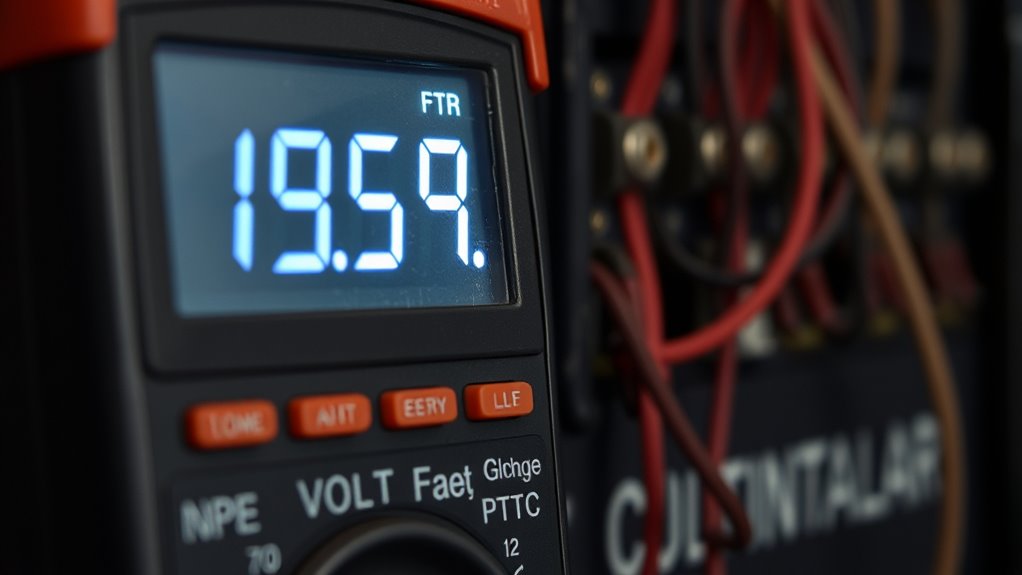

If your meter shows a small “ghost voltage” even when nothing is connected, it’s usually caused by electromagnetic induction or circuit interference rather than a live power source. Nearby energized wires or shared circuits can induce tiny voltages that digital meters pick up easily. These voltages are harmless and don’t indicate a true electrical fault. To understand why this happens and how to distinguish it from real power, keep reading for more details.

Get backup power and energy gear delivered free — and shop member deals
- Fast, free delivery on millions of items
- Access to Prime Big Deal Days deals on October 6–7
- Prime Video, Amazon Music and more included
Key Takeaways
- Ghost voltage occurs due to electromagnetic induction from nearby energized wires, not an active circuit.
- Small voltages detected are often caused by circuit interference or phantom power, not faults.
- Digital multimeters are sensitive and can detect these tiny, harmless voltages even when circuits are off.
- Using a low-impedance or high-current meter can help confirm if the voltage is real or just ghosting.
- Ghost voltages typically measure less than one volt and do not supply significant current or pose danger.

Have you ever noticed your multimeter showing a small voltage when nothing is connected? It’s a common experience, and it can be confusing. That tiny reading isn’t necessarily a malfunction; instead, it’s often caused by circuit interference or phantom power. Understanding these phenomena can help you determine whether your readings are meaningful or just noise.
Circuit interference is a major reason for ghost voltages. Electrical systems are complex, with many circuits running close to each other, sharing wiring and components. When you measure across a circuit that isn’t actively supplying power, the nearby energized wires can induce a small voltage through electromagnetic induction. This unwanted coupling creates a harmless but noticeable reading on your multimeter. It’s essentially a form of parasitic or induced voltage, not a sign of a live circuit or fault. This interference can be amplified if the wiring is long, poorly insulated, or runs parallel to high-current lines, increasing the chances of your meter picking up these stray signals.
Electrical interference from nearby energized wires can cause small, harmless voltage readings on your multimeter.
Phantom power is another culprit behind ghost voltages. It’s a term often associated with power supplied secretly over wiring, especially in telecom and audio systems. For example, some audio equipment and telephone lines send power down the same conductors that carry signals, even when the device is turned off. When you test these lines with your multimeter, you might detect a small voltage, even though no active power is being drawn. This is because the power is still present in the wiring, ready to activate the device when needed. Such phantom power is often present in circuits that are designed to provide continuous voltage, and it can appear as a harmless voltage reading to your meter.
It’s important to recognize that these ghost voltages are usually not dangerous or indicative of a fault. They are typically very small—often less than a volt—and cannot deliver any meaningful current. Many multimeters, especially digital ones, are sensitive enough to detect these minute voltages, but they don’t represent an active, dangerous current. To confirm whether a voltage is real or just phantom, you can try switching your multimeter to a higher current range or use a low-impedance meter. A low-impedance meter will help bleed off the induced voltage and give you a more accurate reading, confirming whether the voltage is truly present or just a ghost. Additionally, understanding the role of contrast ratio in projectors can help you better assess visual quality in home cinema setups.
digital multimeter for ghost voltage detection
As an affiliate, we earn on qualifying purchases.
As an affiliate, we earn on qualifying purchases.
Frequently Asked Questions
Can Ghost Voltage Damage My Electrical Devices?
Ghost voltage typically won’t damage your electrical devices since it’s usually a harmless, stray voltage caused by electrical fields. However, it’s important for electrical safety to accurately measure voltage and avoid unnecessary handling or assumptions about power. Always use proper tools for voltage measurement, and if you’re unsure, consult a professional. This guarantees your safety and helps prevent potential issues from incorrect readings or wiring problems.
Is Ghost Voltage Dangerous to Touch?
Ghost voltage isn’t dangerous to touch because it’s usually caused by electromagnetic interference and phantom power, which are low-voltage signals. These voltages don’t carry enough current to cause harm. When you handle electrical devices, avoid direct contact with actual energized parts, but ghost voltage itself poses no risk. Your body acts as a resistor, preventing any harm from these harmless, induced voltages.
How Can I Prevent Ghost Voltage in My Circuits?
To prevent ghost voltage, you need to address common issues like ground loops and wiring errors. Make sure your circuits are properly grounded and avoid creating multiple grounding points that can cause interference. Double-check your wiring connections, ensuring they’re correct and secure. Use a low-impedance tester to verify readings, and always turn off power before making adjustments. Taking these steps can keep ghost voltage at bay, protecting your circuits and your safety.
Does Ghost Voltage Affect Circuit Performance?
Ghost voltage doesn’t typically affect your circuit’s performance because it’s caused by phantom power and electrical noise rather than actual current flow. You might see it on your meter, but it’s usually harmless and won’t interfere with device operation. To minimize its impact, keep wiring tidy and use proper grounding. Remember, ghost voltage is more of a measurement artifact than a real electrical problem, so don’t worry too much about it.
What Tools Are Best for Detecting Ghost Voltage?
Did you know that over 80% of electricians rely on digital multimeters for detecting ghost voltage? To get accurate readings, you need the right tools. Voltage testers are ideal for quick checks, while a high-quality multimeter guarantees precise measurements. Focus on multimeter accuracy, selecting models with low internal resistance to prevent false readings. These tools help you confidently identify ghost voltage, avoiding misdiagnosis and ensuring safe, reliable electrical work.
As an affiliate, we earn on qualifying purchases.
Conclusion
So, now you know the truth behind ghost voltage readings—it’s often harmless, but always worth checking. Don’t dismiss subtle signals or shy surprises; stay savvy and stay safe. By understanding the subtle science behind these spooky-sounding voltages, you prevent problems before they start. Remember, a little knowledge and a cautious approach can clear the confusion and keep your electrical system secure. Stay sharp, stay safe, and let your meter master your electrical mysteries!
electromagnetic interference detector
As an affiliate, we earn on qualifying purchases.
As an affiliate, we earn on qualifying purchases.
As an affiliate, we earn on qualifying purchases.
Fall Picks
fall essentials
As an affiliate, we earn on qualifying purchases.