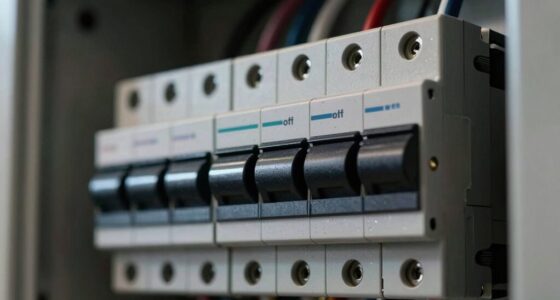
To trace a mystery circuit effectively, start by studying the schematic and confirming that your power supply is stable and correctly connected. Use a multimeter to check voltages, continuity, and component values, verifying each against datasheets or known good standards. Employ an oscilloscope to visualize signals and detect irregularities. Develop a step-by-step, logical testing process, documenting your findings carefully. Continuing with these techniques will help you pinpoint faults accurately without guessing.
Key Takeaways
- Start with schematic analysis to understand circuit design and expected signal paths.
- Use a multimeter to check voltages, continuity, and component values systematically.
- Isolate sections of the circuit and test step-by-step to identify deviations from normal operation.
- Employ oscilloscopes to visualize waveforms and detect irregularities or faulty switching.
- Document all findings to methodically narrow down the fault location without guessing.

Have you ever wondered how to track down a malfunctioning circuit? When a circuit stops working properly, it can feel like searching for a needle in a haystack. Instead of guessing which component is causing the problem, you need a systematic approach to fault diagnosis. This is where thorough circuit analysis becomes your best tool. By methodically checking each part and connection, you can pinpoint the issue with confidence rather than assumptions.
Start by examining the circuit’s schematic, if you have one. Knowing how the circuit is supposed to function gives you a clear reference point. Before diving into testing, verify the power supply is stable and correctly connected. A fluctuating or insufficient power source can mimic faults and lead you astray. Once power is confirmed, you can begin your fault diagnosis by measuring voltages at different nodes, comparing them to expected values. Any deviations indicate where the circuit is malfunctioning.
Begin with the schematic and ensure the power supply is stable before measuring voltages and identifying deviations.
Using a multimeter is essential for circuit analysis. You want to verify continuity on wires and traces, ensuring no breaks or shorts. When you encounter unexpected readings, you isolate the problematic area. Don’t jump to conclusions; instead, follow the signals step-by-step through the circuit. Check key components like resistors, capacitors, transistors, or integrated circuits, verifying their operation against datasheets or known good values. Additionally, understanding the role of contrast ratio in circuit performance can help in identifying issues related to signal clarity or noise. Recognizing how circuit parameters influence overall operation can also assist in diagnosing complex problems.
If your initial checks don’t reveal the fault, consider employing more advanced diagnostic tools like oscilloscopes or signal generators. These instruments allow you to visualize waveforms and identify irregularities that static measurements might miss. For example, a faulty transistor might still appear to have correct voltage at first glance, but an oscilloscope can show if it’s oscillating improperly or not switching as intended. Moreover, developing a systematic troubleshooting process ensures you don’t overlook subtle issues that could be causing intermittent faults.
Keep in mind that a logical, methodical approach saves you time and prevents unnecessary swapping of parts. Each test narrows down the source of the problem, and by documenting your findings, you build a clear map of the circuit’s current state. Remember, circuit analysis isn’t about guesswork; it’s about applying knowledge and precise measurements to uncover hidden faults. When you follow this disciplined method, you turn a confusing mystery into a solvable puzzle, making fault diagnosis both efficient and reliable. Understanding circuit analysis techniques is essential to effectively troubleshooting and maintaining complex electronic systems.
digital multimeter for circuit testing
As an affiliate, we earn on qualifying purchases.
As an affiliate, we earn on qualifying purchases.
Frequently Asked Questions
What Tools Are Essential for Tracing a Mystery Circuit?
You need a multimeter for testing procedures and component identification, which helps you measure voltage, current, and resistance accurately. A circuit diagram or schematic is also essential, guiding your troubleshooting process. A logic probe or oscilloscope can help analyze signals within the circuit. Additionally, a wire tester and continuity tester are useful for identifying broken connections. These tools streamline tracing a mystery circuit efficiently without guesswork.
How Can I Identify Faulty Components in a Circuit?
You can identify faulty components by performing component testing with a multimeter, checking for abnormalities like shorts or open circuits. Use signal analysis to trace signals through the circuit, noting where they drop or distort. This helps pinpoint problematic parts. Pay attention to inconsistent readings or unexpected signal behavior, as these clues often reveal the faulty component. Combining these techniques allows you to efficiently diagnose issues without guesswork.
What Safety Precautions Should I Take During Troubleshooting?
You should wear safety gear like gloves and goggles to protect yourself during troubleshooting. Before starting, perform voltage testing carefully to avoid electrical shocks. Always power off the circuit before inspecting or replacing components, and use insulated tools. Keep your work area dry and organized. These precautions help guarantee your safety while efficiently tracing the mystery circuit, preventing accidents and making the process smoother.
How Do I Interpret Circuit Diagrams Accurately?
To interpret circuit diagrams accurately, you need to understand circuit diagram symbols and how they represent components. Focus on reading schematic diagrams carefully, noting how symbols connect and relate to each other. Always cross-reference symbols with a legend if available. Pay attention to the flow of current, and verify connections. Practice reading diagrams regularly to improve your skills, ensuring you can troubleshoot circuits confidently without guessing.
When Should I Consult a Professional Electrician?
Think of your circuit as a delicate musical instrument. If you notice flickering lights, frequent breaker trips, or you’re unsure about electrical code compliance, it’s time to call a professional electrician. They guarantee safety, proper wiring, and energy efficiency tips are followed. Don’t risk damaging your home or risking injury—trust a pro when the task exceeds your skill, especially for complex or hidden issues.
oscilloscope for electronics troubleshooting
As an affiliate, we earn on qualifying purchases.
As an affiliate, we earn on qualifying purchases.
Conclusion
You’ve unraveled the tangled web of your mystery circuit, transforming confusion into clarity. Like a detective piecing together clues, you’ve brought order to chaos, illuminating the hidden pathways with patience and precision. Every connection uncovered is a step closer to mastery. Now, with your newfound skills, you hold the power to tame even the most elusive circuits. Think of this victory as a beacon, guiding you confidently through future electrical adventures, shining bright with knowledge and confidence.
As an affiliate, we earn on qualifying purchases.
component tester for resistors capacitors transistors
As an affiliate, we earn on qualifying purchases.
As an affiliate, we earn on qualifying purchases.