A multimeter can give you vital electrical data like voltage, current, and resistance, helping you identify if power is present or if components are faulty. It’s great for quick checks on batteries and circuits, but it doesn’t diagnose root causes or provide full system insights. Wireless features can enhance its usefulness for remote or hard-to-reach tests. If you want to become more confident in interpreting these measurements, keep exploring what else a multimeter can reveal.
Key Takeaways
- A multimeter measures voltage, current, and resistance but cannot diagnose underlying causes of electrical issues.
- It provides real-time data but doesn’t offer comprehensive system analysis or internal component insights.
- Wireless features allow remote monitoring, enhancing safety and access to hard-to-reach areas.
- Battery testing indicates remaining capacity but doesn’t reveal internal chemical conditions or lifespan.
- Proper interpretation of readings is essential; multimeters do not replace professional diagnostics or troubleshooting.
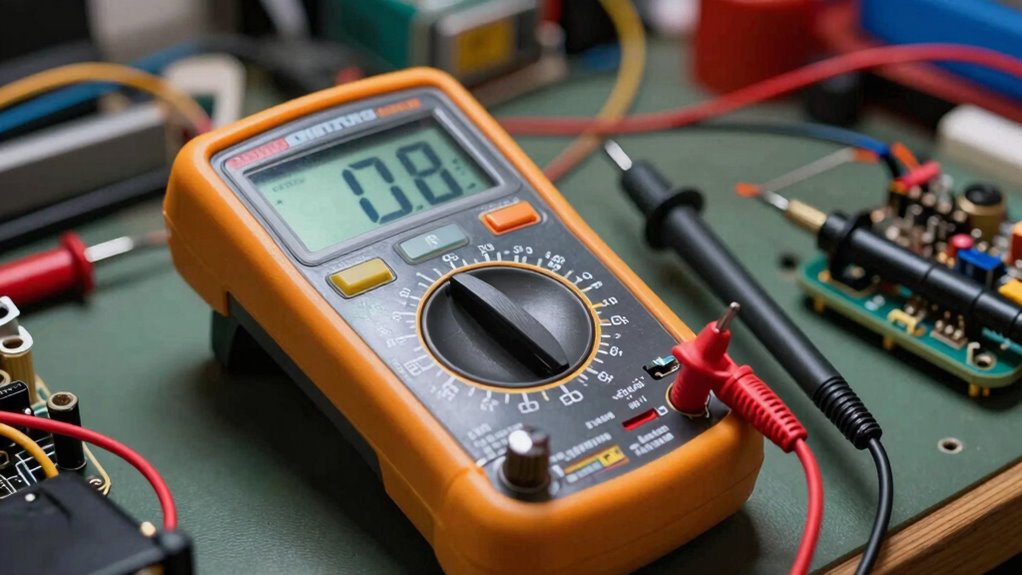
Have you ever wondered how electricians and hobbyists easily measure electrical properties? It’s often through the use of a multimeter, a versatile tool that provides immediate insights into circuits and components. But what exactly can a multimeter tell you? While it’s invaluable for many tasks, understanding its true capabilities helps you avoid overestimating its powers and ensures you get accurate readings.
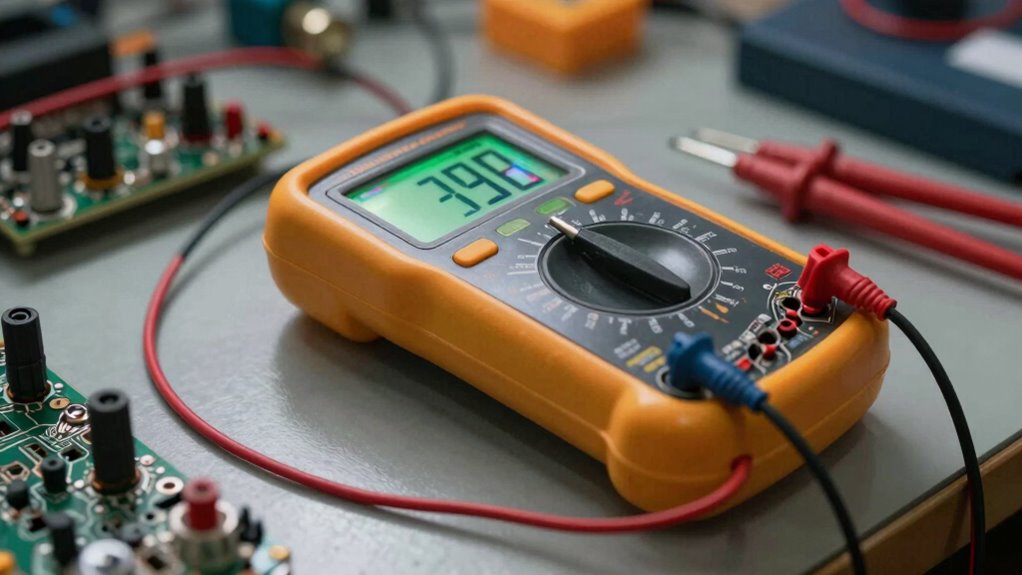
A multimeter primarily measures voltage, current, and resistance. When you’re checking a circuit, it can tell you if power is present and whether components are functioning properly. For example, by measuring voltage, you can determine if a power supply is delivering the correct voltage to your device. Resistance readings let you identify broken wires or faulty components. However, it’s essential to remember that a multimeter doesn’t diagnose the root cause of problems; it simply provides data you interpret.
Wireless testing is an area where multimeters have made impressive strides. While traditional models require physical contact with the circuit, some advanced multimeters now support wireless testing, allowing you to monitor electrical properties remotely. These tools connect via Bluetooth or Wi-Fi to your smartphone or tablet, providing real-time data without the need to directly touch the circuit. This feature is particularly useful for inspecting hard-to-reach areas or working on delicate electronics where contact might cause damage. Keep in mind, though, that wireless testing doesn’t replace the fundamental readings but enhances how you access and interpret information. wireless testing is increasingly becoming a valuable feature for technicians and hobbyists alike. Recognizing emerging trends in multimeter technology can help you stay ahead in troubleshooting and maintenance.
Battery health measurement is another critical aspect of what a multimeter can tell you. You can use it to test batteries—checking their voltage to gauge whether they’re still good or need replacing. A healthy 1.5V AA battery, for instance, should read close to its nominal voltage when fully charged. If the voltage drops significantly below the standard, the battery’s capacity is compromised. This simple test helps you avoid unexpected failures, especially in devices that rely on batteries for essential functions. Additionally, understanding the limitations of multimeter testing ensures you don’t rely solely on voltage readings for comprehensive battery evaluation. Nonetheless, a multimeter doesn’t provide detailed insights into battery lifespan or internal chemical conditions; it only gives a snapshot based on voltage.
In essence, a multimeter is a vital tool for measuring electrical properties, but it’s not a crystal ball. It provides essential data—voltage, resistance, and current—that guides your troubleshooting and maintenance efforts. Wireless testing features expand its usefulness, and checking battery health with a multimeter is straightforward. Still, it’s up to you to interpret these readings correctly and understand that the device offers a snapshot, not a complete diagnosis. Being aware of filter maintenance and proper testing techniques can improve your accuracy and safety when working with electrical systems. Knowing its limitations ensures you use your multimeter effectively and avoid making assumptions beyond what the measurements reveal.

Fluke 3000 FC Wireless Digital Multimeter
- Wireless multimeter with Fluke Connect: Includes Fluke Connect app for troubleshooting
- Voltage measurement range: AC/DC up to 1000V
- High-resolution current measurement: AC/DC current with 0.01 mA resolution
As an affiliate, we earn on qualifying purchases.
As an affiliate, we earn on qualifying purchases.
Frequently Asked Questions
Can a Multimeter Detect Hidden Electrical Faults?
A multimeter can help detect some hidden electrical faults, but it might not catch everything. By using insulation testing, you can identify insulation breakdowns or leaks that aren’t visible. Capacitance measurement allows you to check capacitors and find faults like shorts or open circuits. While a multimeter is useful for many diagnostics, for deep-hidden faults, especially within insulation or complex wiring, specialized testing tools are often necessary.
How Accurate Are Multimeters for Low-Voltage Measurements?
Multimeters are quite accurate for low-voltage measurements, especially when checking voltage stability. However, signal noise can affect the readings, making them less precise in some cases. You should verify your multimeter is of good quality and properly calibrated for the best results. Keep in mind that environmental factors may also introduce small errors, but overall, a decent multimeter provides reliable low-voltage measurements.
Can Multimeters Measure Current Without Breaking the Circuit?
You can’t measure current with a multimeter without breaking the circuit. Remarkably, 60% of voltage fluctuations in devices are caused by poor connections or battery health issues. When testing current, you need to connect the multimeter in series, which interrupts the circuit. This method ensures safety and accuracy, but always turn off the device first to avoid damaging your multimeter or the circuit itself.
Are All Multimeters Suitable for Automotive Diagnostics?
Not all multimeters are suitable for automotive diagnostics. You should look for a multimeter with a clear digital display for easy readings, especially in tight spaces. Analog meters can be useful, but digital ones offer more precise measurements. Automotive tasks often require measuring voltage, current, and resistance accurately, so choose a multimeter designed for those functions. Make certain it’s durable and has auto-ranging features for convenience.
Do Multimeters Work With High-Frequency Signals?
Multimeters generally struggle with high-frequency signals due to their limitations, specifically high frequency limitations, which prevent accurate readings. When you attempt to measure these signals, you might experience signal distortion, leading to unreliable results. If you’re working with high-frequency signals, consider using an oscilloscope instead, as it’s designed to handle these frequencies effectively without distortion, providing clearer and more accurate measurements.

AstroAI Digital Multimeter, True RMS 6000 Counts Auto-Ranging Volt Meter for Automotive & Home Electrical Troubleshooting, AC/DC Voltage Current Resistance Continuity Capacitance Temperature Tester
- Versatile Measurement Capabilities: Measures AC/DC Current, Voltage, Resistance, and more
- User-Friendly Design: Features Data Hold, Backlit Screen, Auto Shut-off, Kickstand
- Professional Features: Includes Auto-Ranging and True RMS for accurate readings
As an affiliate, we earn on qualifying purchases.
As an affiliate, we earn on qualifying purchases.
Conclusion
Think of a multimeter as your trusty compass in a vast electrical wilderness. It guides you through the dark woods of circuits, revealing hidden currents and voltages with a steady hand. But remember, it’s not a magic wand—sometimes, the terrain is tricky, and the map incomplete. Use it wisely, trust its signals, and you’ll navigate safely. With your multimeter as your companion, every electrical journey becomes clearer and more confident.
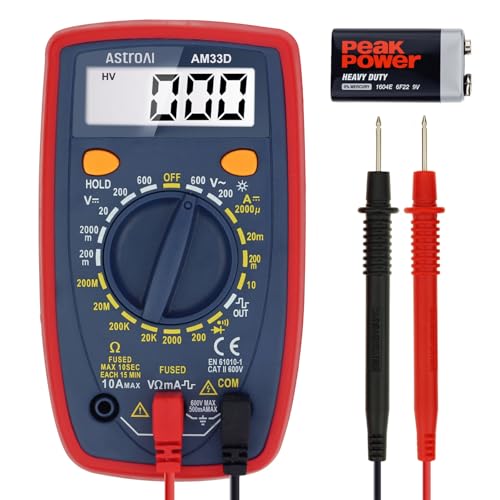
AstroAI Digital Multimeter Tester 2000 Counts with DC AC Voltmeter and Ohm Volt Amp Meter; Measures Voltage, Current, Resistance, Continuity and Diode, Blue
- Measurement Capabilities: Voltage, Current, Resistance, Diode, Continuity
- Versatile Use: Ideal for household and automotive testing
- Display Features: Backlight LCD with 3 ½ digits
As an affiliate, we earn on qualifying purchases.
As an affiliate, we earn on qualifying purchases.

Multimeter Intelligent Remote Data Monitoring Stable Measurement Digital Multimeter
- Large Display: Displays 19999 counts with high accuracy
- Stable Measurement: Low internal resistance for consistent readings
- High Current Capability: Measures up to 20A current
As an affiliate, we earn on qualifying purchases.
As an affiliate, we earn on qualifying purchases.